
Indonesian Teens Not That Fragile After All, Experiment Proves Empathy Can Be Increased in 10 Days
Indonesian youths are often portrayed as a generation fragile and prone to mental health issues. However, a school-based social experiment shows the opposite. It turns out Indonesian adolescents have strong prosocial resources and empathy, which can be shaped significantly through a simple intervention in the school environment.
The Cek Teman Sebelah 2.0 programme: ‘Report Your Friend’s Good Deeds’, initiated by the Health Collaborative Center (HCC), with the project lead and Chair of HCC Dr. dr Ray Wagiu Basrowi, MKK, FRSPH, together with HCC Executive Director Bunga Pelangi, MKM, MM, demonstrated that the structured reporting of a friend’s good deeds (tootling) over a 10-day period can significantly boost adolescents’ empathy and prosocial attitudes.
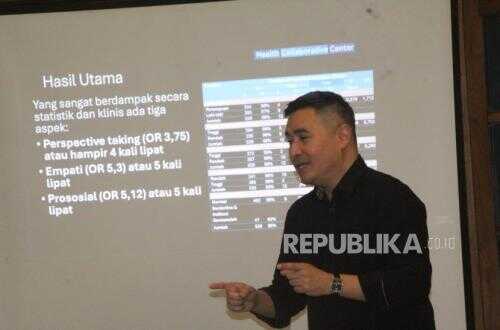
According to Ray, in an intervention involving 699 high school students in Jakarta, with 541 completing the full 10-day programme, it was demonstrated that high school students who actively engaged in reporting kindness showed five times greater empathy and five times greater prosocial behaviour. They also had nearly four times higher levels of perspective-taking, or the ability to understand others’ viewpoints.
Quoting the press release of Thursday, 5 March 2026, Dr. Ray explained that the social experiment intervention was inspired by the tootling method — reporting peers’ good deeds and positive actions while at school. In some advanced countries, this method has even become part of character education built into the basic curriculum.
At the end of the experiment, 4,710 instances of kindness were recorded in just 10 days, meaning a tenfold multiplier effect from a single simple intervention. Eight out of ten students reported experiencing positive changes after the programme. Those who actively reported kindness were 11 times more likely to perceive positive change, said Ray.
The findings show that the simple practice of ‘reporting a friend’s kindness’ can strengthen adolescents’ psychological foundations in a short time. Moreover, 77 percent of students reported kindness as a form of expressing thanks.
Then 71 percent reported it as a form of appreciation, 50 percent as a return of kindness, 41 percent to inspire other peers, and 34 percent so that kindness becomes known to the public. Interestingly, female students are 34 times more likely to report kindness to other girls than to boys, revealing social dynamics that could inform the development of future intervention strategies.
The programme measures six emotional aspects of adolescence (including emotional symptoms, behavioural problems, hyperactivity, peer relationships, distress scores, and prosocial behaviour), as well as the empathy component using the Interpersonal Reactivity Index. According to Clinical Psychologist Sulastry Pardede, PSI, at Puskesmas Ciracas, who is also the exclusive elaborator of this social experiment, the results show that the prosocial behaviours trained through the Cek Teman Sebelah tootling enhance empathy and solidarity. ‘They also reduce self-dislike or discomfort, foster positive social responses, and strengthen peer relationships,’ she said.