
Indonesian Student Association Hosts Job Fair in Beijing, Attracting 1,300 Applicants
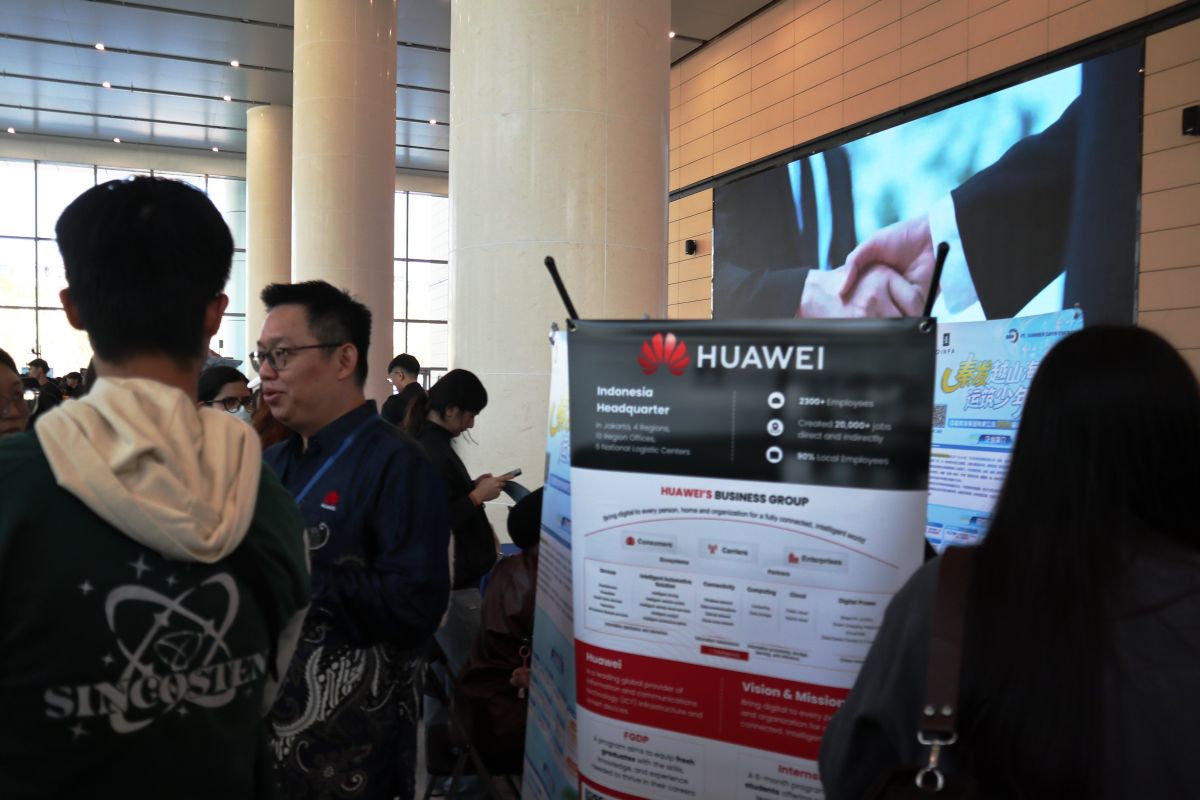
Beijing (ANTARA) - The Indonesian Students’ Association in China (PERMIT) Beijing held an offline and online job fair on 11-12 April 2026, successfully attracting 1,300 interested participants from various countries.
PERMIT Beijing Chairman Victor Hugo Yapadli stated that the job fair is the organisation’s annual event, which is increasingly popular among universities and industries.
“Because the PERMIT job fair focuses on career opportunities for international students, there are already 1,300 registrants to date, with 600 of them being Indonesian students,” Victor said when met by ANTARA at the event on Saturday local time.
The job fair featured 36 companies providing jobs present in person at the event held at Beijing University of Chemical Technology, Chaoyang campus, offering hundreds of job opportunities.
One postgraduate student in Journalism at Renmin University of China, Anna Pinkiewicz (25), said she preferred to attend the job exhibition in person.
“If applying online, I have to wait a long time without certainty and it gets frustrating; I need to be evaluated by the system first before by humans, but if attending the job fair, I can interact directly and make a good first impression with the recruitment team,” said Anna, who is from Poland, adding that she prefers interacting with the recruitment team over an automated system.
Anna also added that the atmosphere at this job fair felt more open to foreign job seekers compared to other job fairs.
“Here it feels more friendly to foreigners. The companies are also open and interested in employing foreigners. Usually, job fairs in China look for local and foreign candidates, but this one focuses more on foreign candidates,” she added, having attended several job fairs before.
Echoing Anna, an Indonesian student pursuing a Master’s in Mechanical Engineering at Beijing Institute of Technology, Marvell Millensza (23), said the job fair gave him the opportunity to discuss directly with company representatives to understand developments in the Chinese job market and obtain career development advice.
“I can meet recruitment teams from various Chinese and Indonesian companies, get a lot of information about the job market conditions. This way, I can assess my position and adjust to the job market needs,” Marvell said.
Moreover, according to Marvell, discussing with recruitment teams at the job fair can help in making decisions when faced with choices between continuing studies or working.
“I can get a lot of input from different perspectives and it has a positive impact when choosing between continuing studies or working. Some companies suggest looking for work after completing the Master’s because it’s more beneficial, like higher salary or faster promotion opportunities, so many consider continuing studies,” he said.
A representative from the Chinese construction software company Glodon, which also operates in Indonesia, said they are looking for candidates based on fit with criteria such as major, personality, language skills, and nationality for positions like marketing promotion specialist and software implementation engineer.
Indonesian applicants who have studied in China are seen as an added value because they have a deeper understanding of Indonesian culture for placements in Indonesia.
Meanwhile, the online retailer JD.com is seeking candidates who master the local language according to the placement location, such as in Indonesia, Japan, and Saudi Arabia, but for placements in China, Mandarin proficiency is still required.
Regarding language skills, a student from Semarang currently taking a language programme at Tianjin Foreign Studies University, Jeremy Nanda (23), considers Mandarin proficiency important for working in China or at Chinese companies.
“If the goal is to find jobs related to Mandarin, such as working in China or at Chinese companies, it’s certainly important. For me personally, learning Mandarin is not wrong because it adds skills, and if needed, at least I’m prepared,” he said.
Deputy Head of the Indonesian Embassy in Beijing Representation Parulian Silalahi, who attended the event opening, said the job fair strengthens collaboration between universities, industries, and young talent across countries.
“In recent years, we have witnessed growth in sectors such as green energy, manufacturing, and international trade, which also open up wide career opportunities in China. These sectors are also very aligned with the readiness of talent and developing technical expertise among students in China,” Parulian said.
According to Parulian, the Indonesian Embassy in Beijing will continue to facilitate closer relations between students, universities, and industry partners.
“I also hope for guidance and career cooperation between the government, universities, and companies to help create a more supportive ecosystem for foreign-language students in China,” Parulian added.
The job exhibition was held over two days, starting from 11 April offline and 12 April online.