
Indonesian Scientists Redefine Soil and Soil Science
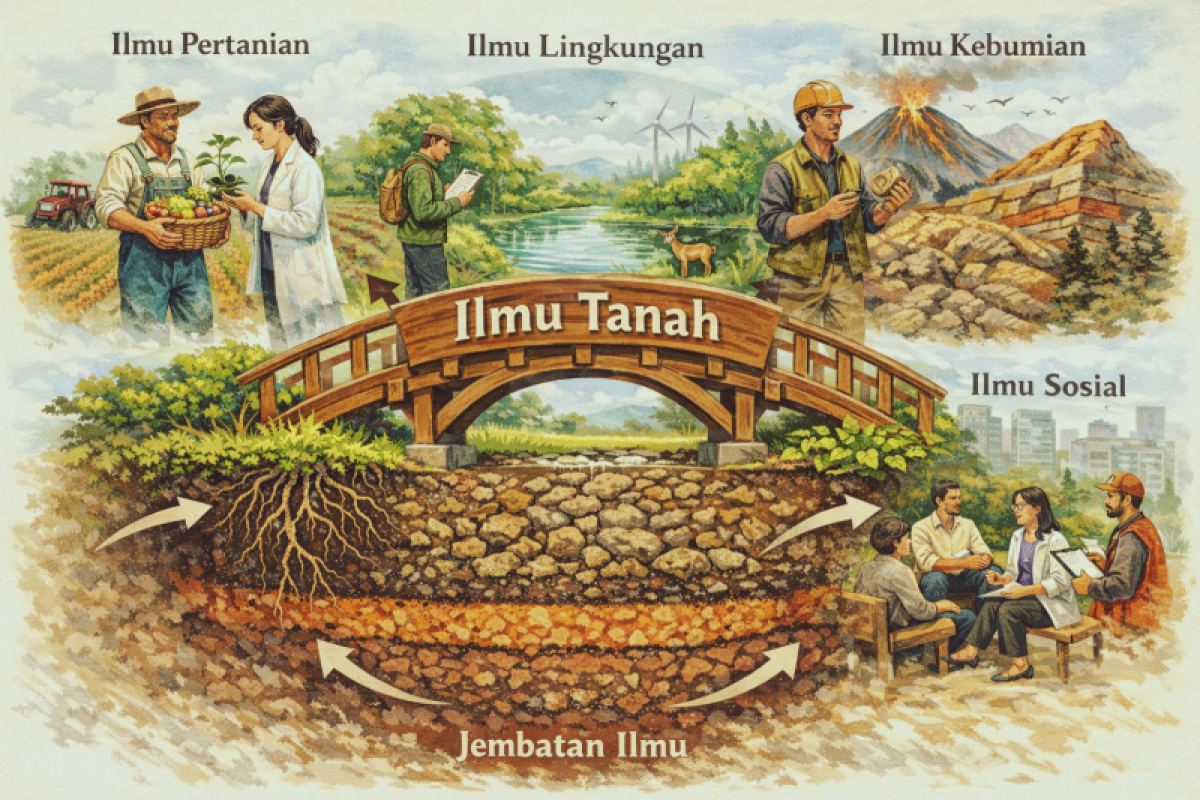
Redefining soil is not merely an academic debate. It is an initial step towards re-examining humanity’s relationship with the Earth that humans tread upon every day.
Jakarta (ANTARA) - Major changes often begin with something simple yet philosophical, such as a definition. The way humans define a concept determines how that science develops, how it is taught, and how it is applied to address societal needs and problems.
A definition is not merely a string of words, but the foundation of a scientific discipline’s way of thinking to address every era.
In this context, an important step has just been born from Indonesian soil scientists. The international journal Soil Security published a proposal for a new soil definition in May 2024 from Dr Destika Cahyana and Prof Budi Mulyanto.
The two define soil as “loose mineral or organic material consisting of three phases—solid, liquid, and gas—found on the Earth’s surface, which is the result of weathering processes from interactions among the lithosphere, atmosphere, hydrosphere, and biosphere, functioning as a habitat for microorganisms and macroorganisms, plants, and animals, and ultimately to support human life and civilisation.”
Subsequently, in March 2026, Husnain, PhD (Ministry of Agriculture), Dr Destika Cahyana (National Research and Innovation Agency), Wirastuti Widyatmanti, PhD (Gadjah Mada University), and Prof Momon Sodik Imanudin (Sriwijaya University) from the Indonesian Soil Science Society (HITI) published a soil science definition in the Canadian Journal of Soil Science, a reputable international journal, to complement the previously published soil definition.
In that journal, soil science is defined as “the study of soil as a dynamic ecosystem and life resource by examining its formation, properties, and functions within the Earth system to support human life and welfare.”
Through these two scientific publications, Indonesian researchers contribute to proposing a new understanding that soil is no longer viewed merely as a natural body supporting plant growth.
Soil plays a far broader role in supporting environmental systems, maintaining ecosystem balance, and sustaining human life and welfare.
For more than a century, the classical soil definition in soil science has generally been rooted in an agronomic perspective.
Soil is understood as a natural medium where plants grow, where roots develop, and as a source of nutrients for agricultural production.
This definition is very important and has shaped the development of modern soil science, particularly in supporting the agricultural revolution and global food security.