
Indonesian Police Arrest Five Suspects in Fake E-Ticketing Fraud Ring Controlled by Chinese National
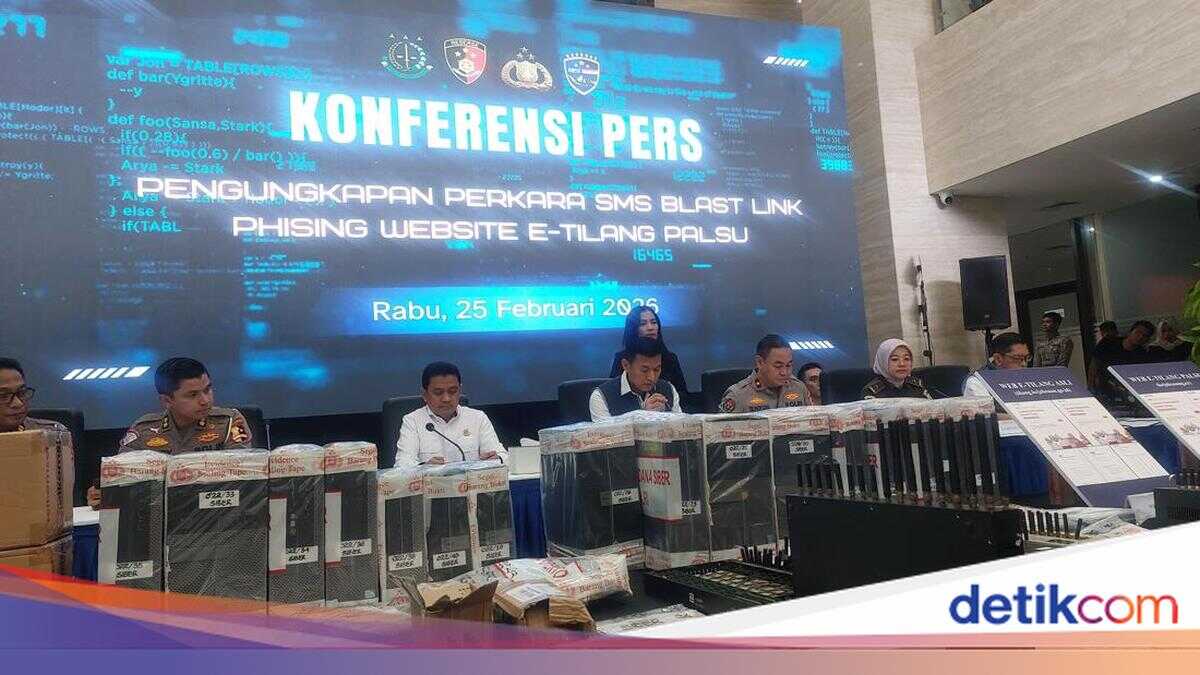
The Directorate of Cyber Crime (Dittipidsiber) of the Indonesian National Police Criminal Investigation Command (Bareskrim Polri) has arrested five suspects in an online fraud and phishing case using SMS blast distribution of fake electronic traffic ticket (e-tilang) payments. The suspects are believed to be controlled by a Chinese national.
The five suspects have been identified as WTP (29), FN (41), RW (40), BAP (38), and RJ (29), each with distinct roles in the criminal operation.
“Investigators conducted follow-up investigation and examination of the five suspects and discovered that this criminal enterprise is directly controlled by a foreign national from China,” stated Brigjen Himawan Bayu Aji, head of Dittipidsiber Bareskrim Polri, during a press conference at Bareskrim Polri headquarters in South Jakarta on Wednesday (25 February 2025).
Himawan explained that the suspects in Indonesia served as operatives receiving and executing orders from the Chinese national using Telegram accounts Lee SK and Daisy Qiu.
“To support their operations in Indonesia, the perpetrators from China directly sent SIM boxes (devices used for blasting) to the suspects in Indonesia,” Himawan clarified.
The roles of the five suspects in Indonesia are as follows:
WTP served as the primary operator managing the device and conducting SMS blasting since September 2025.
FN provided SMS blast services to foreign clients and managed SIM cards since July 2025.
RW assisted with SMS blasting operations alongside suspect FN since July 2025.
BAP served as the primary SMS blasting operator and device operator since February 2025.
RJ served as the provider and seller of registered SIM cards to other perpetrators.
Himawan stated that the Chinese national controlled the suspects in Indonesia to install SIM cards into SIM boxes or modem pools. The system was controlled remotely or via auto remote from China.
Suspects in Indonesia would merely open the Terminal Vendor System (TVS) application, through which they allegedly monitored the number of SMS phishing messages sent and failed deliveries.
“Within a single day, the SIM box device operated by the suspects was capable of sending phishing SMS messages to 3,000 mobile phone numbers. To operate the SIM box sent from China, the perpetrators required hundreds of SIM cards registered using Indonesian national identification numbers and citizen data,” he stated.
The suspects received monthly salaries in cryptocurrency or USDT as compensation, ranging from 1,500 USDT (approximately 25 million rupiah) to 4,000 USDT (approximately 67 million rupiah), depending on the number of SIM boxes operated.
“These commissions were regularly exchanged for Indonesian rupiah each month,” he said.
The five suspects face charges under Article 51 in conjunction with Article 35 of Law Number 1 of 2024 concerning the Second Amendment to Law Number 11 of 2008 on Information and Electronic Transactions, and/or Article 45A paragraph 1 in conjunction with Article 28 paragraph 1 of Law Number 1 of 2024 concerning the Second Amendment to Law Number 11 of 2008 on Information and Electronic Transactions, and/or Articles 3, 4, 5, and 10 of Law Number 8 of 2010 on Money Laundering Crimes, and/or Article 607 paragraph 1 letters a, b, and c of Law Number 1 of 2023 on the Criminal Code in conjunction with Article 20 letter c of Law Number 1 of 2023 on the Criminal Code.
“They face potential criminal prison sentences of up to 15 years and maximum fines of 12 billion rupiah,” he concluded.