
Indonesian Nickel Mining Association to Develop National ESG Standards at Upcoming Forum
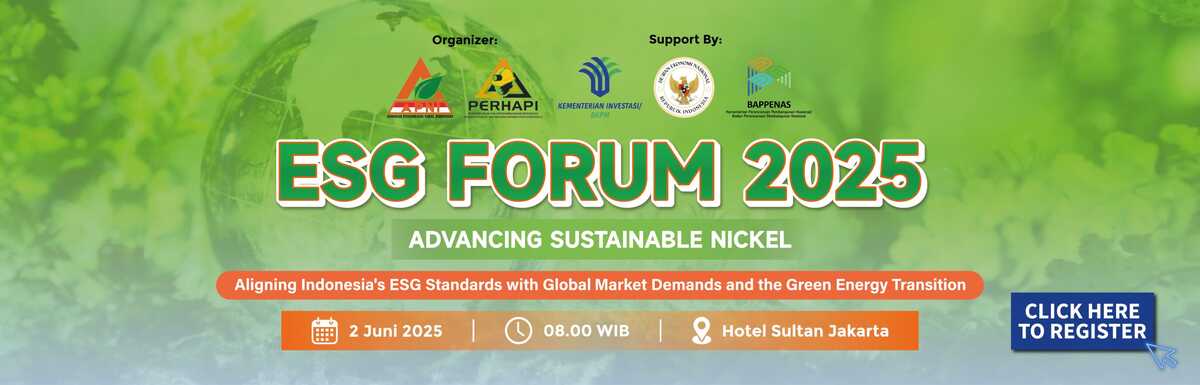
JAKARTA – The Indonesian Nickel Mining Association (APNI) will hold an Environment, Social, and Governance (ESG) Forum 2025. The event, themed ‘Advancing Sustainable Nickel’, will take place at Hotel Sultan Jakarta on 2 June 2025.
The forum plans to develop ESG standards tailored to Indonesia’s conditions and circumstances, with a focus on aligning Indonesian ESG standards with global market demands and the green energy transition. The forum is supported by the Ministry of Investment and Downstream Industries/BKPM, the National Economic Council (DEN), and Bappenas.
This represents an important milestone in investment governance and sustainable development through the design of national ESG standards. The strategic move aims to reduce dependence on international ESG standards that have served as the primary reference but are considered not to reflect Indonesia’s complexity and unique characteristics.
Why National ESG Standards Are Needed
International ESG standards such as GRI, SASB, TCFD, and IRMA have been used by companies in Indonesia to prepare sustainability reports and attract financing from global markets. However, many consider these standards not always relevant to domestic challenges.
In environmental terms, for instance, global pressure to reduce carbon emissions often overlooks Indonesia-specific issues such as deforestation, peatland degradation, and agrarian conflicts. On the social front, indigenous communities, extractive sector workers, and regional inequality require a more equitable and contextual ESG approach.
“Global ESG standards are drafted from the perspective of developed nations with established industrial structures. But we face different terrain here—geologically, socially, and politically,” said Meidy Katrin Lengkey, Secretary General of APNI, during the “Cakap-Cakap” programme broadcast on the Tempodotco YouTube channel on Monday (12 May 2025).
Plans for Developing ESG Standards
The formation of national ESG standards must involve various stakeholders, from government to mining entrepreneurs and associations or organisations. A committee for formulating Indonesian ESG standards is needed to develop an appropriate, effective, and equitable framework. This committee will then form a team to carry out the stages that produce ESG standards, including:
Benchmarking and Gap Analysis – The government will analyse global ESG standards and adapt them to domestic needs, ensuring no indicators contradict national realities.
Multi-stakeholder Consultation – The involvement of the business community, civil society organisations, academics, and indigenous communities is a key element in developing inclusive and broadly acceptable standards.
Regulatory Framework Development – National ESG standards will be integrated into the investment licensing framework, sustainability reporting, and environmental and natural resources sector regulations.
Public Testing and Pilot Projects – Before full implementation, the standards will be piloted at state-owned and private companies in strategic sectors such as mining, energy, and plantations.
Phased Implementation – Following trials, the standards will be applied gradually and made a mandatory component of corporate sustainability reports.
Implementation Challenges
One major challenge is resistance from industries already burdened with more than 200 cross-sectoral permits. “We are already struggling with unsynchronised licensing. Now we are asked to comply with foreign ESG standards that may not suit us,” said Meidy.
There is also the issue of harmonisation with global markets, particularly ahead of 2027, when the European Union market will require a Battery Passport—ESG certification for all nickel products entering the region.
“This means we must comply with their standards, but they do not comply with our realities. If you demand that I am clean, you must also be clean. Do not ask us to abandon coal while you are still using it,” Meidy remarked.
Opportunities and Indonesia’s Bargaining Position
Despite the challenges, developing national ESG standards opens strategic opportunities for Indonesia to assert its bargaining position in the global market, particularly as a major supplier of nickel, bauxite, and coal—commodities vital to the global energy transition.
Indonesia, together with 30 other mineral-producing nations, is also currently developing an alternative global ESG standards framework that is more inclusive and relevant to the realities of developing countries.
Tri Edi Budi Susilo, a lecturer at the School of Environmental Science at the University of Indonesia, emphasised the importance of a contextual approach in developing standards. “ESG is important, but it must be fair. Ecological justice is when standards are formed together, not unilaterally,” he said during the same programme.
Towards ESG Sovereignty
Indonesia’s move to develop national ESG standards is not a rejection of global sustainability principles, but rather an effort to bridge the gap between universal principles and local realities. These standards are expected to serve as a bridge between national development interests and global market demands.
With ESG standards designed on the basis of justice, local wisdom, and scientific sustainability, Indonesia not only strengthens the governance of extractive industries and investment, but also champions ecological and economic sovereignty amidst the often unequal currents of globalisation.