
Indonesian National Police Now Growing Maize, Here Is the Purpose
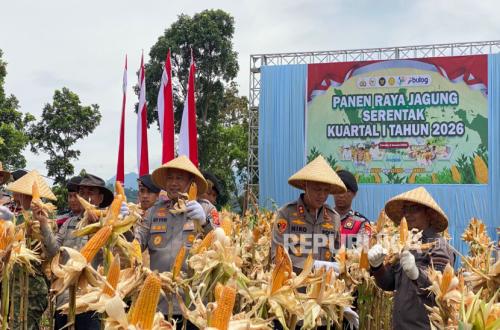
Jakarta — The development of national maize cultivation by the Indonesian National Police (Polri) is aimed not only at meeting feed requirements, but also has the potential to be utilised as an energy source. This was conveyed by the Assistant to the National Police Chief for Human Resources (HR Assistant) Inspector General Anwar during a meeting at the Office of the Ministry of Agriculture (Kementan) in Jakarta on Wednesday, 11 March 2026.
The programme is part of optimising Polri’s maize planting, which is targeted to reach one million hectares. To date, maize planting realisation has only reached approximately 650,000 hectares. The expansion of cultivation is carried out through strengthening upstream to downstream sectors, ranging from seed supply, fertiliser, modernisation of agricultural equipment, to the management of storage and sales of harvested crops.
“Today’s agenda related to Polri is how we can optimise the increase in maize self-sufficiency from 2025 to 2026. Previously we targeted one million hectares of maize, with only 650,000 hectares planted. Now we are maximising it, even exceeding one million, with various strengthening from upstream to downstream,” said Anwar.
He stated that discussions on maize development were also carried out with the Minister of Agriculture, Andi Amran Sulaiman. The programme is hoped to not only strengthen national feed independence, but also open up opportunities for utilising maize as a raw material for energy. According to Anwar, the use of maize for energy is still in the stage of further discussion at the government level.
“We have already discussed it with the Minister. In the future, we will carry out this optimisation. Hopefully the target of one million hectares will be achieved and later, in addition to feed, it can also be used for energy,” he said.
He explained that achieving the maize planting target still faces various obstacles in the field. Weather factors, natural disasters and varied land conditions affect the planting process in several regions.
“Of course, there are many obstacles. Mainly disasters, weather anomalies, and then different land conditions. There are mountainous lands, rice fields, and so on,” said Anwar.
Minister of Agriculture Andi Amran Sulaiman appreciated Polri’s support in increasing national maize production. He assessed that cross-institutional collaboration provides a genuine contribution to increased production whilst reducing imports.
“Do you know the increase? Our production increased by one million tons. That is not easy. Then we achieved feed self-sufficiency, zero percent import. This is the good news, zero percent import,” said Amran.
The maize planting programme is carried out through collaboration with various parties. Polri has partnered with farmer groups, social forestry programmes, non-governmental organisations (NGOs), and individual landowners.
“It varies. Some are planted in Polri’s facilitated areas together with farmer groups, collaboration with social forestry, NGOs, and even privately owned land. We are collaborating with all of them,” said Anwar.
Maize yields from the programme are distributed through a procurement mechanism by Perum Bulog. This scheme is hoped to maintain market stability whilst providing marketing certainty for farmers.