
Indonesian Motorcycle Mechanics Hit Hard as Public Tightens Belts on Vehicle Servicing
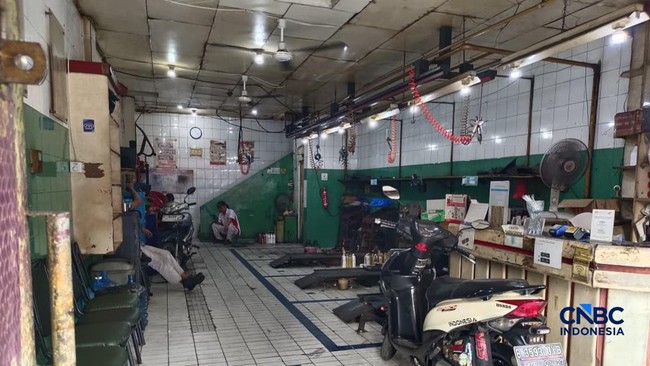
The pressure on public purchasing power is not only being felt by consumers and business owners. Motorcycle workshop mechanics are now also experiencing the impact, from a decline in customers to the loss of tips that had previously served as a daily income supplement.
This scene was observed at a motorcycle workshop in the Mampang area of South Jakarta. When met by CNBC Indonesia, Roni, a workshop mechanic, appeared to be sitting pensively in front of his workplace smoking a cigarette. Around him, there was no visible queue of motorcycles usually waiting for servicing or oil changes.
Roni acknowledged that the number of customers coming to the workshop has indeed decreased recently.
“Yes, there has been a decline in visitors. There are days when customers come in, but lately, because the economy is like this, purchasing power has decreased,” Roni told CNBC Indonesia at the location on Friday (5/6/2026).
According to him, this situation has become noticeable over the last month, coinciding with the rising price of oil and vehicle spare parts.
“Over this last month. Because the prices of goods have all gone up. And what we used to sell, oil with the installation service for Rp65,000, now it has become Rp75,000, so to speak,” he said.
Roni said that this price increase has caused some customers to start reducing spending on vehicle maintenance. The impact is not only felt in the number of visiting customers but also in the habit of customers giving tips to mechanics.
“Yes, now it’s rare to get a tip. Before, I could still get Rp10,000 as a tip, now that Rp10,000 is used by them [customers] to pay for the earlier price increase,” he explained.
According to him, the money previously given to mechanics now goes towards covering the rising service costs.
“So, in the end, the mechanic doesn’t get given anything anymore. At most, they buy us a coffee if the process takes a bit longer,” he said.
Roni also noted that many customers are now starting to postpone oil changes to save money.
“Maybe they are economising, so their motorcycles are used less frequently. They might take the busway [Trans Jakarta] or something, so the motorcycles are rarely used. So they change the oil once every two months, and even that is not certain,” said Roni.
“If it’s not when they get paid, they might change it later, or in another two months they’ll change it. It goes on like that,” he continued.
A similar phenomenon was also observed at another workshop still located in the Mampang area. When CNBC Indonesia visited the workshop where Ilyas works, the mechanic appeared to be asleep behind a cabinet. He woke up shortly after hearing a customer call out to inflate a motorcycle tyre.
According to Ilyas, the workshop atmosphere is indeed much quieter compared to several months ago.
“Yes, it’s been quite quiet lately. It seems like for the past two months the workshop has been getting quieter,” said Ilyas, met separately.
He suspects that the public is starting to hold back on spending amidst the rise in various prices of necessities.
“Maybe people are starting to hit the brakes on spending, because we know the economy is chaotic right now, plus the prices of goods have gone up. This is most noticeable in oil, the increase is quite significant,” he said.
Ilyas explained that the increase in oil prices has caused service costs to rise correspondingly. Whereas a few months ago a customer could still change the oil along with the fitting service for around Rp60,000, now that rate has increased to Rp75,000.
“Usually, three to four months ago, including the service, it was only Rp60,000. Now Rp60,000 is just the purchase price of the oil from the store. If I buy it for Rp60,000, I can’t sell it for the same, there is a service fee. So now I have set it at Rp75,000,” he stated.
He recounted that many customers have questioned this price increase.
“Oh, a lot of them protest. They ask, ‘Why has it gone up?’, ‘Why has it become expensive?’, things like that. I just tell them it went up at the supplier end. Whether they want to change the oil or not, they can check at another workshop—the price will be the same anyway,” he said.
However, Ilyas admitted he cannot do much because the price increase originates from the suppliers.
“Yes, some accept it, some don’t go through with it. But I can’t force them. Maybe they simply don’t have enough money. They are welcome to check with another workshop; I am sure the price averages around that,” said Ilyas.