
Indonesian Embassy in Beijing invites Hunan private sector companies to do business in Indonesia
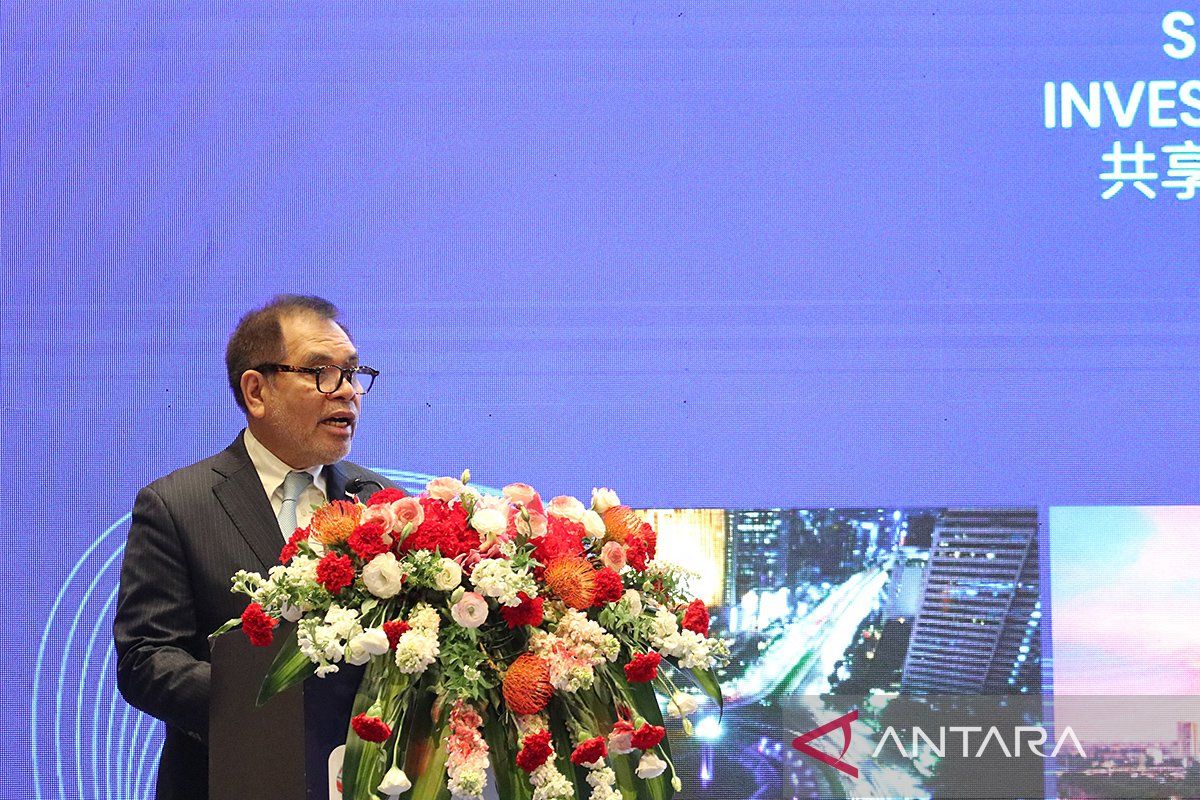
CHANGSHA, Hunan — The Indonesian Embassy in Beijing has invited various private companies from Hunan Province to conduct business in Indonesia.
“As one of China’s major construction hubs, Hunan’s technology and expertise across its various industries have spread to numerous regions in Indonesia. Today’s event aims to help our partners identify new opportunities in Indonesia whilst gaining insights from key actors in Indonesia–China economic cooperation,” said Indonesia’s Ambassador to China and Mongolia Djauhari Oratmangun in Changsha, Hunan on Tuesday.
Ambassador Djauhari made these remarks at the “Indonesia–China Business Dialogue” event, organised by the Indonesian Embassy in Beijing in collaboration with the Indonesia Investment Promotion Center (IIPC) Beijing, and attended by approximately 200 business people from both China and Indonesia.
“Growth in investment from China reflects strong confidence from China’s business community towards Indonesia. Investment from Hunan to Indonesia approached USD 2.5 billion in 2025. Meanwhile, the volume of trade between Hunan Province and Indonesia reached USD 3.4 billion, an amount even larger than trade with several Western European countries,” Ambassador Djauhari stated.
In total, Indonesia–China trade value in 2025 reached USD 167.48 billion, with exports from Indonesia increasing by 16.7 per cent, whilst investment from mainland China and Hong Kong to Indonesia reached USD 18.1 billion.
“In recent years, Chinese investment has made a significant contribution to Indonesia’s development, such as the Jakarta–Bandung high-speed rail project, the development of electric vehicle ecosystems from mineral downstream processing to battery production, as well as cooperation in energy transition,” Ambassador Djauhari stated.
Although implementation of these projects has not been without various challenges, Ambassador Djauhari noted that the Indonesian government remains firmly committed to moving forward.
“Through each stage of cooperation, our partnership continues to develop into something increasingly strong and resilient. This resilience is particularly important as we face an increasingly uncertain global environment,” Ambassador Djauhari added.
Meanwhile, Guo Ning, Director-General of the Hunan Province Foreign Cooperation Office, said that in recent years, official visits between Hunan Province and Indonesia have increased significantly, whilst economic and trade cooperation has intensified.
Guo Ning cited the example that in 2023, Hunan Governor Mao Weiming led a delegation visiting Indonesia, and in return, Indonesia’s Ministry of Health, Ministry of Energy and Mineral Resources, as well as ministries overseeing food matters and other institutions sent delegations to Hunan.
According to Hunan Province customs data, in 2025, the total value of Hunan’s imports and exports with Indonesia reached 23.17 billion RMB (approximately USD 3.36 billion), an increase of 30.5 per cent compared to the previous year.
“Indonesia has firmly become one of Hunan’s most important trading partners in the ASEAN region. This fully demonstrates the resilience of both nations’ markets and the significant potential they possess, and this is also reflected in more than 130 Hunan companies present at today’s forum,” Guo Ning stated.
He proposed four measures to strengthen economic relations between Hunan and Indonesia: firstly, deepening industrial synergy between Hunan and Indonesia.
“We also invite Indonesian companies to strengthen industrial linkages with Hunan companies, jointly develop markets, and establish mutually beneficial cross-border industrial cooperation patterns by combining Indonesia’s resources with Hunan’s technology,” Guo Ning added.
Secondly, modern agriculture integration, given Hunan’s advantages in hybrid rice and modern agricultural machinery that can help Indonesia increase food production capacity, whilst also promoting more of Indonesia’s premium agricultural products to enter the Hunan market.
Thirdly, strengthening skilled workforce development.
“As the number of Hunan company projects in Indonesia increases, the demand for local technical personnel grows. Hunan is willing to leverage our advantages in vocational education to help Indonesia develop highly qualified skilled workers specifically matched to requirements in new energy and automation sectors,” Guo added.
Fourthly, expanding people-to-people exchanges and strengthening relations between peoples, particularly as Changsha opened a direct flight route to Jakarta in December 2025.
“The opening of this route was also driven by strong demand from Hunan companies investing in Indonesia, so our provincial government facilitated the opening of this flight. The presence of this route greatly facilitates the mobility of people,” Guo stated.
The dialogue forum also featured a seminar with panellists directly involved in conducting business in Indonesia, as well as the signing of a cooperation agreement between Hunan-based lithium battery company CNGR and Gadjah Mada University (UGM), and “one-on-one sessions” bringing together stakeholders from Indonesia and Hunan Province.