
Indonesian Embassy Beijing Explores Agricultural Cooperation with Hunan Province
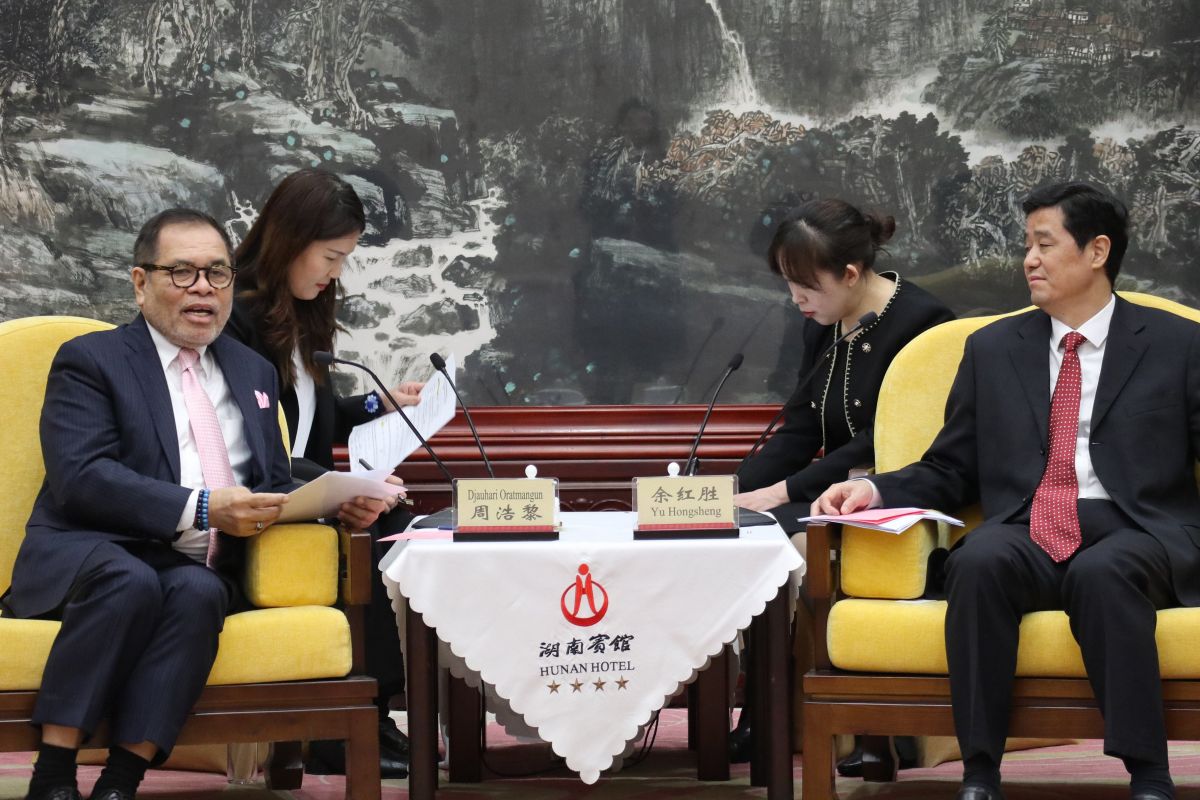
Changsha — Indonesia’s Ambassador to China and Mongolia, Djauhari Oratmangun, visited Hunan province to explore agricultural cooperation.
“I wish to explore cooperation in agriculture, particularly the development of paddy and rice production. Perhaps this month I will dispatch a specialist team, including representatives from the Indonesian Embassy along with professional representatives from Indonesia to study agricultural product development in Hunan,” Ambassador Djauhari stated in Changsha on Monday, 9 March.
Djauhari made this statement whilst meeting with Hunan Vice Governor Yu Hongsheng during a working visit that includes plans to organise Indonesia’s first business forum in China in 2026.
“Last year, Indonesia-China trade totalled USD 168 billion, making China Indonesia’s largest trading partner. This year, we also plan to begin exporting tropical fruits from Indonesia, such as fresh coconut and durian, to the Chinese market,” Ambassador Djauhari added.
Several universities in Hunan are renowned for excellence in metallurgy, agriculture and medicine, and the Ambassador wishes to create more opportunities for Indonesian students to study at Hunan campuses.
“Last night I met more than 200 Indonesian students studying in Changsha and its surroundings. Many of them are studying metallurgy because the province is renowned for this field, so I also wish to strengthen people-to-people relations in the education sector,” he said.
The visit also includes exploration of tourism cooperation, given that direct flights between Jakarta and Changsha have been operating since December 2025.
“I have always supported cooperation in people-to-people engagement, because when cooperation in this area is strong, it will yield economic benefits and other advantages,” added the Ambassador.
Hunan Vice Governor Yu Hongsheng stated that as of January 2026, there are 100 companies from Hunan operating in Indonesia, with total investment value of approximately USD 224 million (around IDR 3.78 trillion).
“Currently, several leading companies from Hunan such as Sany Heavy Industry and Zoomlion have established joint ventures in Indonesia. Beyond these investments, various other companies from Hunan have also established business partnerships in Indonesia. We also hope that Indonesia can provide support in various service aspects for these companies,” Yu said.
He also expressed hope that the Indonesian Embassy Beijing could help introduce Hunan’s situation to more Indonesian entrepreneurs, thereby encouraging more Indonesian companies to invest in various projects.
“We propose to further strengthen agricultural cooperation, as Hunan is the birthplace of the ‘father of hybrid rice’, with strong technological capabilities and an advanced agricultural ecological system. We hope to strengthen communication and technology cooperation with Indonesia,” Yu added.
Yu also proposed strengthening cooperation in tourism and culture, given that Hunan possesses natural beauty and cultural heritage with a long history, including the Yuelu Academy in Changsha, the ancient town of Fenghuang in Xiangxi and the natural scenery of Zhangjiajie.
“Indonesia itself is a very beautiful and attractive country to visit. Hunan residents are also very interested in visiting Indonesia, and with the direct flights between Changsha and Jakarta, we hope that more tourists from Hunan will visit Indonesia,” Yu stated.
Indonesia is Hunan’s second largest trading partner in Southeast Asia. Indonesia-Hunan trade value in 2025 reached USD 3.23 billion (approximately IDR 54.56 trillion).
Hunan province is known for agricultural advantages as one of China’s primary grain reserves. The province produced 7.46 tonnes of rice in the early 2025 season, supported by agricultural technology innovation, including hybrid rice varieties such as Liangyou 8022, which recorded a yield of 18.8 tonnes per hectare, while the Qingliangyou 3261 rice variety can yield six tonnes per hectare.
Hunan also applies a systematic approach called the “Four Laws” for agricultural transformation: the “addition” law using drones, sensors and artificial intelligence; the “reduction” law through water-saving fertilisation technology that conserves up to 90 per cent of water; the “multiplication” law developing agricultural product processing industries; and the “division” law utilising rice plant residues.
Hunan also leads in agricultural product exports, reaching 17.385 billion RMB in 2025, with vegetable exports reaching 771,000 tonnes valued at 12.96 billion RMB.
Hunan Provincial Governor Mao Weiming visited Indonesia on 10-13 September 2023 to meet the Minister of Industry Agus Gumiwang and various other economic officials to develop cooperation under the “Belt and Road Initiative” framework.
During the visit, cooperation agreements were signed between Hunan-based construction, mining and agricultural companies, Zoomlion, and Indonesian company Java Seed Indonesia, as well as Chinese battery company CNGR, which has established battery processing facilities in Morowali with Indonesian private company BUMANIK, which operates in nickel ore production and export.
Additionally, from December 2025, direct flights between Changsha and Jakarta commenced operations once weekly.
In China, Hunan ranked 10th among provinces by Gross Domestic Product (GDP) in 2025, with 5.53 trillion RMB (approximately IDR 13.54 trillion), with leading products being electric vehicles, lithium batteries and photovoltaic products as well as construction machinery and steel, with primary trading partners being ASEAN countries and Africa.