
Indonesian Citizens Changing, BPS Reveals the Data Evidence
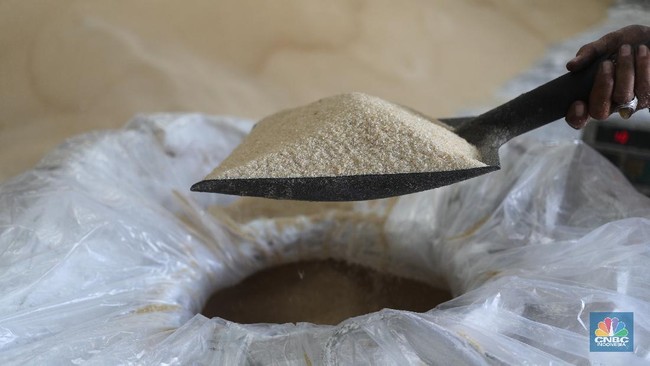
Jakarta, CNBC Indonesia - Changes in the behaviour of Indonesian society are starting to become evident from sugar consumption data. The Central Bureau of Statistics (BPS) has recorded a decline in household and per capita sugar consumption, indicating a shift in societal consumption patterns.
Deputy Head of BPS Sonny Harry Budiutomo Harmadi revealed that this trend is evident from the latest 2025 data. He stated that national household sugar consumption reached around 1.4 million tonnes.
“The 2025 data shows that total household consumption for sugar reached 1.4 million tonnes, nearly 1.5 million tonnes,” Sonny disclosed during a Working Meeting with Commission VI of the House of Representatives (DPR RI) at the Parliamentary Complex, Jakarta, on Wednesday (8/4/2026).
However, the household consumption portion is relatively small compared to the total national sugar usage. He explained that household consumption only accounts for about 23.13% of total sugar consumption in Indonesia.
“We can also see that sugar usage for the processing industry reaches nearly 3.9 million tonnes. Then, for horeca, consisting of hotels, restaurants, and catering, it reaches over 970,000 tonnes. Then, for SPPG services and so on,” he clarified.
Overall, the total national sugar usage in 2025 reached more than 6.3 million tonnes.
“So, the total volume of sugar usage in 2025 nationally reaches 6,330,690 tonnes. Interestingly, our sugar consumption tends to decline over time, including per capita consumption,” he explained.
This decline is even more evident from the household consumption side as well as per capita societal consumption.
“So currently, household sugar consumption is only 1.46 million tonnes, down from previous years. Then, what about the per capita consumption trend? Our per capita consumption has also dropped to 5.15 kilograms per capita per year, this is for sugar,” he said.
According to Sonny, this declining trend also occurs in other commodities like salt, which strengthens the indication of changes in societal lifestyles.
“Is this consistent with other consumptions? Yes, including with salt. Because per capita salt consumption has also decreased compared to before. So, ladies and gentlemen, we can see there are two possibilities,” he stated.
He mentioned two main factors driving this change. First, increasing public awareness for a healthier lifestyle. Second, a shift in consumption patterns to ready-made foods.
“So they do not buy sugar and salt directly, but use ready-made foods produced either by industry or by restaurants,” he explained.
Meanwhile, on the supply side, national sugar production actually showed an increase in 2025. This was supported by an increase in the harvested area of sugarcane in several regions.
“Sugar production in 2025 reached 2.67 million tonnes. This production is up from the previous year, 2024, which was only around 2.47 million tonnes. One of the supports for the increase in sugar production in 2025 is the increase in the harvested area of our sugarcane,” Sonny said.
The sugarcane production centres, according to Sonny, are still concentrated in several provinces such as East Java, Lampung, Central Java, South Sumatra, West Java, and several other sugarcane production centres.
“So, in total in 2025, our sugarcane harvested area reached 563,000 hectares, up from 2024 which only reached 521,000 hectares. Of course, this is due to the hard work directed by the President (Prabowo Subianto), the ministry team working collaboratively,” he concluded.