
Indonesia-US Trade Agreement Challenged, Trade Minister Responds and Clarifies Facts
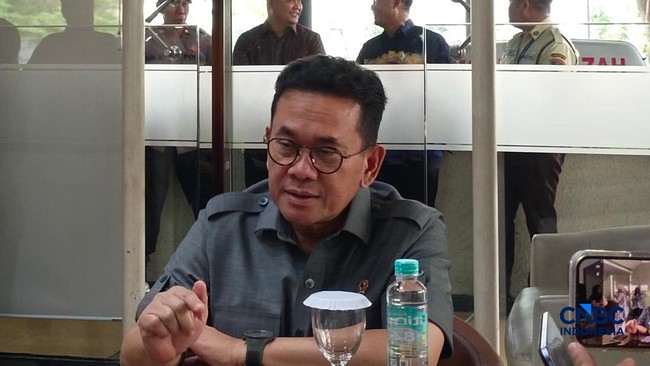
The government has affirmed that the ratification process for the Indonesia-United States trade agreement, known as the Agreement on Reciprocal Trade (ART), will not deviate from regulations, despite being challenged by several civil society organisations.
Trade Minister Budi Santoso assured that the involvement of the Indonesian House of Representatives (DPR RI) remains a crucial part of the ratification stages, as stipulated in Law No. 7 of 2014 on Trade.
“If according to the rules, in the Trade Law, Law No. 7 of 2014, consultation or ratification is carried out with the DPR. That is after the trade agreement is signed and at the latest within 90 days, consultation must be conducted,” Budi told reporters at his office in Jakarta on Friday (27/3/2026).
He emphasised that the signing of the ART does not mean the ratification process is complete. Instead, that stage marks the beginning of determining the form of approval that will be decided jointly with the DPR.
“Then it appears as if, ‘why is the form of ratification a presidential regulation (perpres), it should be a law’. Well, not yet. The ratification process is about to happen. The ratification itself will then produce the legal product, whether perpres or law, according to the results of our consultation with the DPR,” he said.
Budi also refuted allegations that the DPR was not involved in the agreement process. He stressed that the mechanism followed is the same as trade negotiations with other countries and has adhered to the applicable legal corridors.
“So we signed the ART in accordance with the provisions. And the mechanism is the same as when we conduct trade negotiations with other countries,” he explained.
Amid this process, the government must also anticipate trade policy dynamics from the US. This follows the US Supreme Court’s decision to cancel the previous reciprocal tariff scheme.
According to Budi, within a certain period, the US government could issue new tariff policies, including against Indonesia, which is currently under a trade investigation.
“Well, after 150 days, the US government could make new tariff policies. We don’t know yet, but clearly they are conducting Section 301 investigations on several countries, one of which is Indonesia,” he said.
This Section 301 investigation could potentially serve as the basis for the US to impose new tariffs on Indonesian products. Therefore, the government is beginning to prepare anticipatory steps, including strengthening inter-ministerial coordination and business actors to respond to potential trade pressures.
Previously, four civil society organisations sued the reciprocal trade agreement between Indonesia and the United States, the Agreement on Reciprocal Trade (ART), at the Jakarta State Administrative Court (PTUN).
According to CNN Indonesia, the four organisations consist of the Center of Economic and Law Studies (CELIOS), Aliansi Jurnalis Independen (AJI), Indonesia for Global Justice (IGJ), and Perserikatan Solidaritas Perempuan. The National WALHI and Trend Asia also support this lawsuit.
The lawsuit was filed against the actions of the President of the Republic of Indonesia, Prabowo, who signed the agreement on 19 February 2026, which the plaintiffs deemed an unlawful act by the government (onrechtmatige overheidsdaad).
CELIOS Executive Director Bhima Yudhistira said the purpose of the lawsuit is to nullify the agreement in question.
“Yes, the message is clear that we as plaintiffs are requesting that the reciprocal trade agreement, the Agreement on Reciprocal Trade between Indonesia and the United States, be declared null and void by law, invalid,” Bhima told reporters at the PTUN Jakarta on Wednesday (11/3/2026), quoted from CNN Indonesia.
Bhima considers the agreement to be unilateral and predominantly demands that Indonesia change its domestic policies, while similar obligations from the US side are deemed very minimal.
“This was done unilaterally, one-sided, where the demands for Indonesia to make policy changes are very dominant, while the obligations for the United States to make policy changes are very minimal,” he said.
In addition, Bhima highlighted procedural violations in the signing of this agreement because the government made commitments without consulting the DPR and the public.
“They were just spectators, never given consent, never informed, the DPR was also not made a partner for consultation in this trade agreement,” he said.