
Indonesia Strengthens Climate Collaboration and Carbon Market at Ecosperity Week 2026 and GenZero Climate Summit 2026
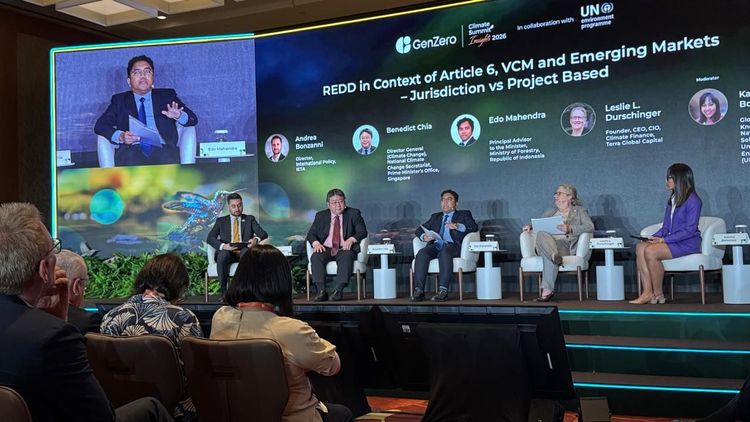
Singapore, 22 May 2026 – The Ministry of Environment and Forestry of the Republic of Indonesia reaffirmed Indonesia’s commitment to strengthen climate mitigation actions and develop a high-integrity carbon market through active participation in Ecosperity Week 2026 and GenZero Climate Summit 2026 in Singapore. The events bring together government, business, financial institutions, academia, and development partners to strengthen collaboration in accelerating the transition to a green economy and sustainable development through carbon investments.
In various sessions, the Ministry highlighted strategic steps being taken to strengthen the operation of international carbon markets in the forestry sector. These include development of a credible carbon accounting framework, streamlining the process for issuing carbon units, and strengthening engagement of communities, biodiversity, and carbon safeguards against leakage (safeguard for reversal risk).
At the forum Nature, Markets, Scale organised by the United Nations Environment Programme (UNEP) and GenZero on 18 May 2026, the panel discussed developments in REDD+ under various carbon market schemes, including compliance markets, voluntary carbon markets (VCMs), and sovereign mechanisms under development. The discussion also highlighted jurisdictional- and project-based approaches, and how Article 6 of the Paris Agreement, CORSIA, and national carbon trading systems are shaping demand, participation and credibility of carbon markets in the future. It also reviewed potential new supply and demand sources, including developments in Japan, South Korea, and China.
During the occasion, Edo Mahendra, Senior Advisor to the Minister of Environment and Forestry of the Republic of Indonesia, explained that the latest regulatory changes have reopened investment opportunities in the forestry sector for international carbon trade in Indonesia.
“Indonesia has entered a new phase in the era of carbon markets; this time, our political will is clearly translated into regulatory products,” said Edo.
He added that Minister of Environment and Forestry Regulation No. 6 of 2026 forms the foundation for accelerating carbon trading in the forestry sector through clearer and simpler business processes. He noted that the regulation is a response to the growing market demand for high-quality, high-integrity carbon credits. In this regard, the government opens all mechanisms of carbon value instruments, including through the Nesting scheme. The nesting approach is regarded as essential to ensure environmental integrity, prevent double counting, and strengthen market and investor confidence.
Separately, Laksmi Wijayanti, Director General of Sustainable Forest Management, in her closing remarks stated that the Ministry is open to carbon investment in the forestry sector by opening all mechanisms of carbon value instruments.
In meetings with representatives of Securing Energy for Europe (SEFE), Ilham, Director of the Agency for the Utilisation of Forest Resources, emphasised that there is now a presidential commitment via a Special Presidential Envoy for Climate and Energy to publish a restoration/rehabilitation programme for 12 million hectares of critical land, an avoidance emissions reduction project in the forestry sector covering 50 million hectares, social forestry of 8.3 million hectares, and indigenous forests of 1.4 million hectares, presented at COP 30 of the UNFCCC in Belem, Brazil, 2025. Consequently, the Indonesian government is opening all mechanisms to invest in forest carbon to meet these commitments. Additionally, the government has issued regulations to simplify/breeze the process for forestry carbon credit investment via Minister of Environment and Forestry Regulation No. 6 of 2026, without reducing outputs that yield high-integrity, high-quality carbon credits.
The President’s commitment to restoration/rehabilitation of 12 million hectares is a major challenge for the forestry sector, but aligns with the international carbon market demand for high-integrity, high-quality carbon credits. The government is obliged to meet the President’s commitments, with one of the measures being simplification of business processes, while requiring project developers to produce high-integrity and high-quality credits meeting international standards and the Core Carbon Principles (CCP) of ICVCM, including additionality, community engagement, biodiversity protection, and safeguards.
Beyond the main forum, the Ministry’s delegation also attended strategic meetings including the ICGD Roundtable on Building High-Integrity Carbon Markets Across ASEAN, chaired by Mari Elka Pangestu, focusing on sharing the latest developments in carbon markets among ASEAN member countries, identifying common challenges and key enabling factors, and exploring opportunities for regional cooperation to accelerate credible and high-integrity national carbon markets.
The Ministry’s delegation also attended the Roundtable on “Shaping the Future of High-Integrity Carbon Credit Markets” organised by the World Business Council for Sustainable Development (WBCSD), the Coalition to Grow Carbon Markets (CGCM), and the Glasgow Financial Alliance for Net Zero (GFANZ). In that forum, Edo Mahendra said Indonesia hopes CGCM would deliver concrete outcomes through greater capital flows.