
Indonesia Requires Water Storage Capacity of 150 Cubic Metres Per Capita, Says AHY
If the current capacity is 70 cubic metres per capita, it needs to be one and a half to two times that amount.
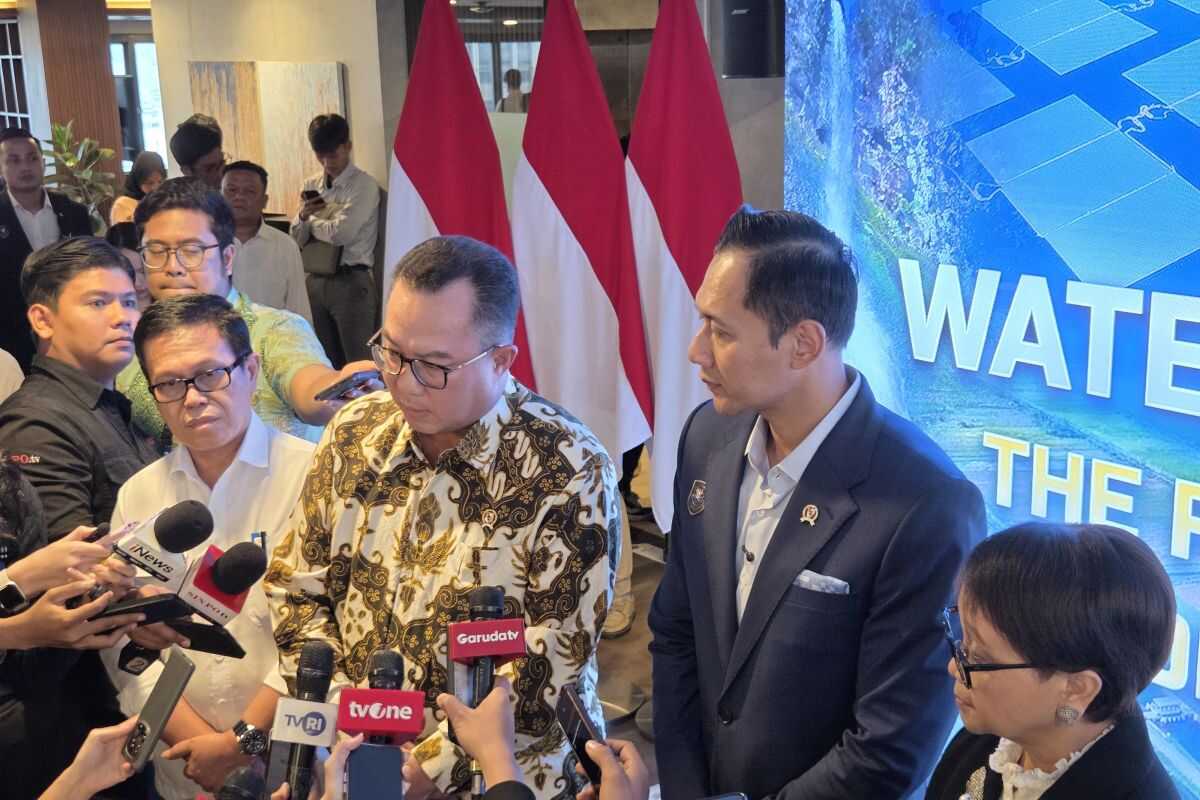
Jakarta (ANTARA) – Coordinating Minister for Infrastructure and Regional Development, Agus Harimurti Yudhoyono (AHY), stated that Indonesia requires an ideal water storage capacity of 100-150 cubic metres per capita to ensure national water security.
According to him, Indonesia’s current per capita water storage capacity is still far from the ideal figure. Based on a 2021 World Bank report, Indonesia’s water storage capacity is currently recorded at around 71 cubic metres per capita.
“Ideally, our required storage capacity is approximately 100 to 150 cubic metres per capita. So, if it’s currently 70 cubic metres per capita, it needs to be one and a half to two times that amount,” said AHY at a Water Townhall Meeting in Jakarta on Tuesday.
Minister AHY believes that this capacity is still lagging behind several countries in the Southeast Asian region.
Vietnam has a water storage capacity of around 310 cubic metres per capita, Malaysia 710 cubic metres per capita, and Thailand reaches 1,006 cubic metres per capita.
In total, Indonesia’s current water storage capacity is estimated to be in the range of 10-20 billion cubic metres. However, to optimally meet national needs, AHY explained that Indonesia requires an ideal capacity of 30-40 billion cubic metres.
Increasing water storage capacity is crucial to anticipate the disparity between water availability and demand, as well as to strengthen resilience against the risks of drought and floods in various regions.
On the same occasion, the UN Secretary-General’s Special Envoy for Water Issues, Retno Marsudi, stated that to address this challenge, water management must move away from a narrow sectoral approach because water is a connector and a support for various sectors of life and development.
“Think and act outside the water box. Water never stands alone; it is a connector and enabler for many sectors,” said Retno.
Retno explained that water is directly related to the agricultural, health, energy, and industrial sectors.
She mentioned that the agricultural sector consumes about 72 per cent of the world’s freshwater, while in terms of health, around 1,000 children under the age of five die every day due to contaminated water and inadequate sanitation.