
Indonesia Promises Faster Permits and Simplified Bureaucracy to Attract Investors at ASEAN Conference
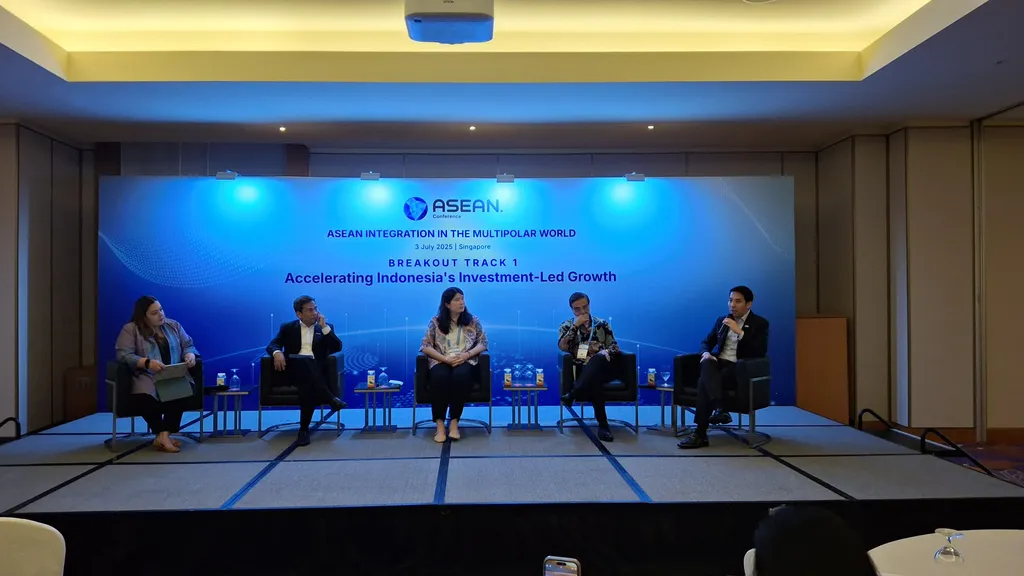
SINGAPORE, KOMPAS — At the 9th ASEAN Conference entitled “ASEAN Integration in the Multipolar World” held in Singapore, the Indonesian Government promised investment opportunities with various facilitations, including accelerated licensing and simplified bureaucracy. Such measures are deemed essential to maintain Indonesia’s competitiveness in the region and ensure it remains the primary choice for investors.
At the event on Thursday (3/7/2025), Deputy for Investment Cooperation at the Ministry of Investment and Downstreaming/Investment Coordinating Board (BKPM) Tirta Nugraha Mursitama stated that the Indonesian Government is serious about improving the domestic investment climate. Complaints from investors regarding convoluted licensing processes are being addressed earnestly. BKPM will respond swiftly to investor complaints about bureaucratic licensing procedures.
“Licensing is always the priority. We will endeavour to accelerate the completion of permits. If there is feedback or reports from investors regarding lengthy and slow licensing processes, we will follow up so they can be processed more quickly — but still in accordance with prevailing regulations,” said Tirta.
One measure the government is taking to accelerate and facilitate the flow of investment into Indonesia, Tirta continued, is optimising existing industrial estates. The government will identify the industrial sectors seeking entry and match them with the locations of industrial estates already developed.
“Then, what does the investor want? If they want a data centre, Batam is available; if it’s tourism and health, Sanur is an option. This thematic approach is what we will promote,” said Tirta.
President Director of UOB Indonesia Hendra Gunawan, speaking during the “Indonesia Break Out Track” session as part of the ASEAN Conference, stated that to maintain Indonesia’s investment competitiveness in the region, attention must be paid to law enforcement and regulatory certainty. These two factors, he said, are urgently needed by investors. Without strong law enforcement and regulatory stability, business cannot function properly.
“Even the government’s own strategic projects, which are priorities, can be disrupted. What about projects beyond those? Therefore, firm law enforcement is very much needed,” said Hendra.
According to Hendra, regulatory certainty is also necessary for investment to proceed smoothly. Good policies should not be changed simply because there is a change in decision-makers or a rotation of officials. Regulations that change easily create uncertainty.
“Ideally, a change of officials should not always mean a change of policy. Nor should good policies be replaced simply because a new official has taken office,” he said.
Managing Director of Group FDI at UOB Jimmy Koh added that Indonesia remains attractive to investors owing to its dual role as both a holder of natural resource wealth and a potential market. Indonesia therefore remains highly worthy as a primary investment destination. However, the Indonesian Government must make a number of improvements, particularly regarding regulatory stability.
“Indonesia is the largest economy in ASEAN. Its population is large and its middle class continues to grow. Moreover, Indonesia possesses natural resource wealth that other ASEAN nations do not have. That is why Indonesia remains a worthy investment destination,” said Jimmy.
Downstreaming and Renewable Energy
At the conference, Indonesian representatives offered downstreaming projects, such as processing nickel into electric vehicle batteries. Projects related to the energy transition, such as the construction of renewable energy power plants, were also considered to hold significant potential — particularly as Indonesia possesses diverse renewable energy resources including geothermal, wind, hydro, and solar power.
Deputy for Investment Promotion at the Ministry of Investment and Downstreaming/BKPM Nurul Ichwan identified nine priority sectors expected to attract foreign investment to Indonesia. The nine sectors are renewable energy, downstreaming industries, food security, semiconductors, the digital economy and data centres, export-oriented manufacturing, healthcare, Nusantara Capital City (IKN), and vocational education.
“Downstreaming is the flagship. To become a developed nation, industrialisation must be strengthened, beginning with downstreaming projects. The Prabowo administration is deeply committed to downstreaming,” he said.
One Singaporean company investing in Indonesia, Sembcorp, stated it continues to explore various business opportunities in Indonesia, particularly those related to energy transition projects. Sembcorp has partnered with PT Perusahaan Listrik Negara (Persero) to provide solar power at Nusantara Capital City (IKN) in East Kalimantan.
“Developing renewable energy requires close partnership between the private sector and the government. This can be achieved through a public-private partnership scheme,” said COO of Integrated Urban Solution at Sembcorp, Gareth Wong, who was one of the speakers at the “Indonesia Break Out Track”.
According to BKPM data, investment realisation in Indonesia during the first quarter of 2025 reached Rp 465.2 trillion. Of this amount, foreign direct investment (FDI) accounted for Rp 230.4 trillion and domestic investment Rp 234.8 trillion. The base metals, metal goods (excluding machinery and equipment) sector recorded the highest investment realisation for both foreign and domestic investment, at 14.5 per cent or equivalent to Rp 67.3 trillion.