
Indonesia prepares "element paper" to improve global digital royalty governance
Jakarta (ANTARA) - The Indonesian government is preparing a draft element paper on the Indonesian Proposal for an internationally binding instrument on copyright royalty governance in the digital environment to improve global digital royalty governance.
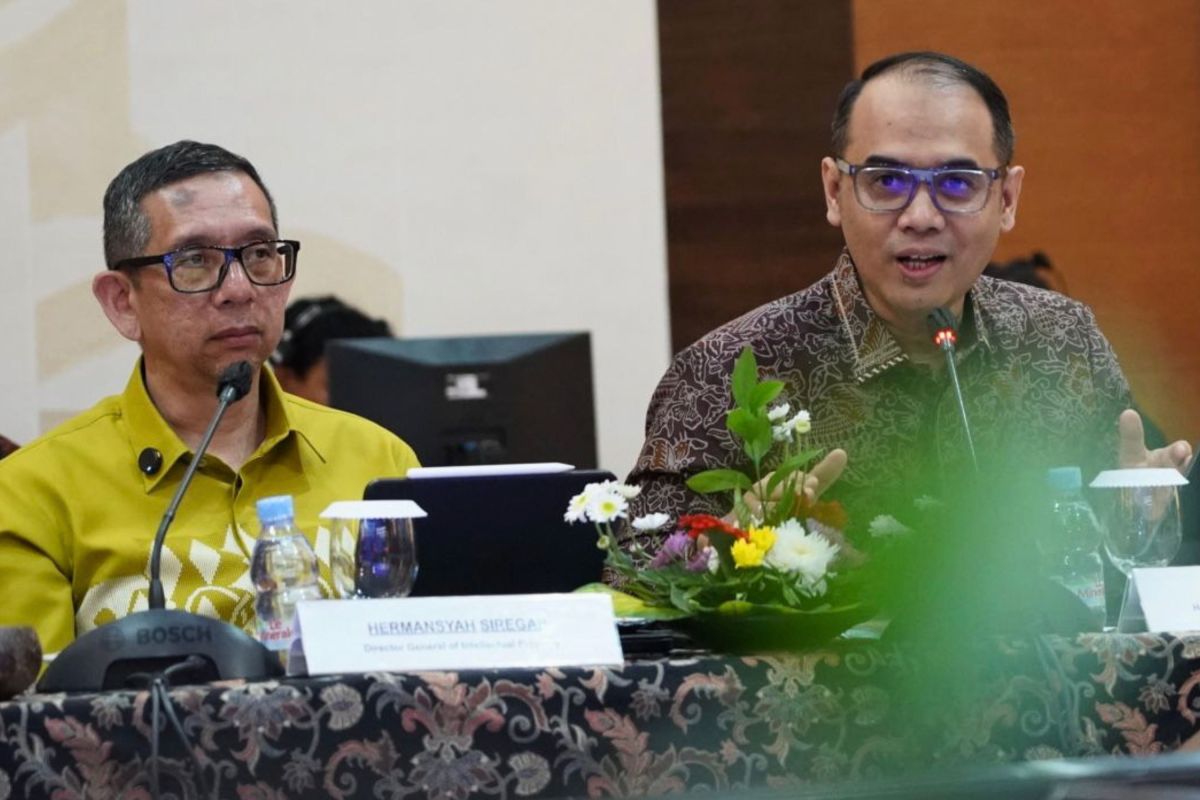
In a discussion on drafting in Denpasar, Bali, on Thursday (26/3), the Director General of Intellectual Property at the Ministry of Law, Hermansyah Siregar, highlighted the urgency of updating copyright governance in the digital era.
“The development of digital technology, particularly algorithm-based platforms and systems, has fundamentally changed the way works are accessed, distributed, and monetised,” said Hermansyah, as quoted from a statement confirmed in Jakarta on Friday.
Therefore, according to him, an international instrument is needed to bridge the gap between existing legal norms and field practices.
Hermansyah also emphasised that intellectual property protection must provide real benefits to creators.
In that way, he continued, intellectual property protection should not only stop at recognising rights but must ensure that creators receive fair and transparent remuneration.
For that reason, he considered it important for creators to register their works, ensure complete metadata, and utilise available royalty management mechanisms.
Meanwhile, the Head of the Policy Strategy Agency (BSK) of the Ministry of Law, Andry Indrady, explained that the Indonesian Proposal focuses on strengthening global governance, not creating new rights.
“We want to ensure transparency, data interoperability, and more accountable cross-border royalty distribution mechanisms,” said Andry.
He mentioned that the main issue raised is the governance gap in the international royalty system.
It was stated that the main problem in that issue is not the lack of legal norms, but how cross-border royalty management systems can operate effectively.
Therefore, he encouraged global standards that guarantee consistent data flows, metadata accuracy, and inter-agency coordination.
The discussion involved the Indonesian Ministry of Foreign Affairs (Kemenlu) and experts from the South Center, an organisation that conducts research on various international government policies.
Deputy Minister of Foreign Affairs Arif Havas Oegroseno emphasised the importance of global collaboration in the process.
“I am confident this discussion will be very beneficial for the results and challenges we face. We know there are many unfavourable geopolitical conditions, but there are still the same problems from developing and advanced countries,” said Arif on the same occasion.
He explained that the preparation of the document does not only focus on legal aspects but also on efforts to build international understanding.
He also stated that the proposal is substantively not entirely new, but no one has truly made it into an international agreement.
Arif also emphasised the importance of building alliances with global creators, especially from non-English speaking countries, who face similar challenges.
According to him, Indonesia is not only looking at a draft document that is legally binding but also how most countries will agree with this draft.
“I want us to see this as a continuation of GRULAC, not just our initiative. I am 100 percent sure that not all countries will agree, but that is normal,” he said.
The discussion aims to formulate substantive elements that will form the basis of the Indonesian Proposal in international forums while addressing global challenges such as transparency, accountability, and cross-border royalty distribution.
The activity affirms that digital technological developments have created a new complex ecosystem, so intellectual property protection needs to be strengthened through a system capable of ensuring creators’ economic rights in a fair and sustainable manner.
Through this activity, Indonesia reaffirms its commitment to continue advocating for intellectual property protection as the foundation of the national and global creative economy.
The public, especially creators, are urged to actively protect their works through intellectual property registration, understand rights and obligations in work utilisation, and utilise available systems so that their economic rights are optimally protected.
The discussion in Bali is expected to produce a solid element paper document as the basis for submitting the Indonesian Proposal at upcoming international forums.
With strong collaboration between countries and stakeholders, the Indonesian government is optimistic about driving the creation of a more just, transparent global system that favours copyright holders in the digital era.