
Indonesia Plans to Build 34 Waste-to-Energy Power Projects, This Landfill Serves as an Example
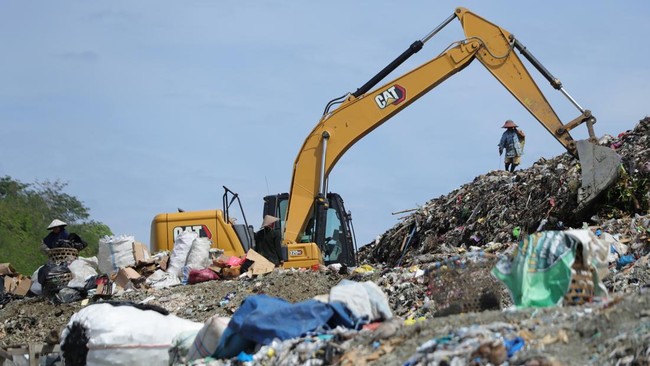
The government is continuously striving to boost the development of waste-to-energy power plants (PLTSa) as a solution to the increasingly urgent waste management crisis in various regions. At least, the construction of 34 waste-to-energy (WtE) projects in 34 cities during the 2026-2027 period is being accelerated.
This is being done following the increase in national waste volume, while the capacity of final disposal sites (TPA) is becoming increasingly limited. In fact, almost all TPAs in Indonesia are projected to experience excess capacity at the latest by 2028 if there is no significant breakthrough.
Vice Minister of Energy and Mineral Resources Yuliot Tanjung stated that urban waste management is a priority activity that is directly monitored by President Prabowo Subianto.
“Therefore, serious and systematic efforts are needed so that urban waste no longer becomes a source of problems, but instead provides benefits,” he said after inspecting PT Sumber Organik, which is building and operating the Waste-to-Electricity Power Plant (PSEL) at the Benowo TPA in Surabaya, quoted on Thursday (16/4/2026).
Yuliot added that the government has issued Presidential Regulation No. 109 of 2025 as the legal umbrella to accelerate urban waste handling through processing waste into renewable energy based on environmentally friendly technology.
In his direction at the 2026 National Coordination Meeting of Central and Regional Governments, President Prabowo also emphasised the plan to launch the Gerakan Indonesia ASRI, which stands for safe, healthy, clean, and beautiful. This movement will be a national step to create a clean and orderly environment.
The President assessed that the waste issue has become a crucial problem in many regions. He mentioned that almost all TPAs in Indonesia are projected to experience overcapacity in 2028, even possibly sooner.
“The waste issue has become a problem. It is projected that almost all waste TPAs will experience overcapacity in 2028, even sooner,” said Prabowo.
At the same location, President Director of PT Sumber Organik Agus Nugroho Santoso explained that his company manages waste from the Surabaya community and surrounding areas with a volume of 1,600 tonnes per day. Unlike management in many other places that only handles new waste, PT Sumber Organik also processes old waste piles so that they can be reused.
“We process waste piles, both old and new waste, into useful materials,” said Agus.
PT Sumber Organik is known to have built and operated the Waste-to-Electricity Power Plant (PSEL) at the Benowo TPA in Surabaya, which was inaugurated by the President of the Republic of Indonesia on 6 May 2021.
In addition to processing waste into electricity, a waste-to-fuel facility is currently being built at the Benowo TPA by PT Prakarsa Energi Sejahtera (SEP). This facility is intended to reduce waste piles and is planned to operate soon.
The process of converting plastic waste into fuel is carried out through sorting or handpicking stages to ensure the pyrolysis raw material in the form of plastic. After that, the plastic is processed using a pyrolysis machine (heating technology) using a flue gas treatment system method to meet the emission quality standards set by the Ministry of Environment to produce Renewable Fuel Oil (BBMT) equivalent to diesel oil.
Currently, the waste-to-fuel processing plant is still under construction; once completed and operational, the plant can process waste into BBMT with a capacity that can be adjusted to the volume of urban waste that urgently needs processing. Based on the pilot project that has been carried out from the existing process, BBMT production of 60-70 kilolitres per day will be obtained.