
Indonesia Now Controls Over 60 Per Cent of Global Mineral Sales Market, Says APNI
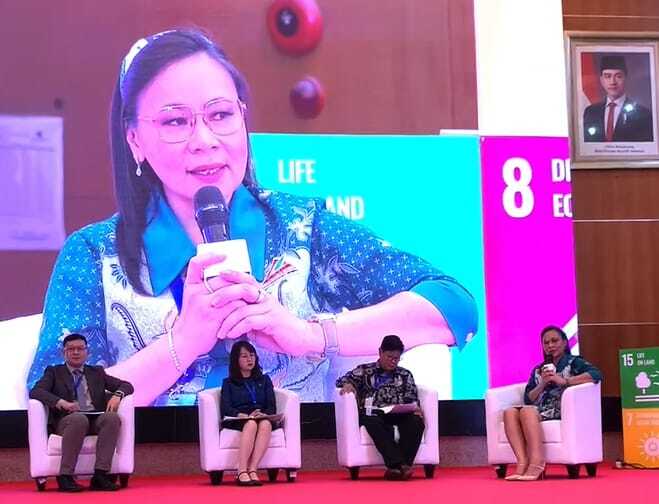
NIKEL.CO.ID, JAKARTA – The Secretary General of the Indonesian Nickel Miners Association (APNI), Meidy Katrin Lengkey, stated that Indonesia has now captured more than 60 per cent of the global mineral sales market, thanks to the accelerated construction of processing plants and consistent downstream industrialisation policies.
Speaking at Roundtable Three: “Green Industrial Zone Development” under the main theme of the inaugural Global Business Summit on Belt and Road Investment Infrastructure at the Ministry of Investment and Downstream Industry (BKPM) in Jakarta on Sunday (25/5/2025), Lengkey noted that since 2022, Indonesia’s mineral processing industry has experienced significant growth.
“We have approximately 49 mineral technology companies, including five biotechnology firms, and we manage 398 mineral technologies across the Southeast Asian region,” she explained.
According to Lengkey, this success is inseparable from the government’s downstream industrialisation policy, which encourages domestic processing. “Since 2020, we began organising mineral sales and processing systems more comprehensively. Now, we are no longer just talking about exporting raw materials, but about how to generate added value for the nation,” she asserted.
Lengkey also highlighted the development of industrial zones supporting mineral processing. “We have large industrial zones in Sulawesi and Papua, including a new project in Pomala covering an area of up to 11,800 hectares. This demonstrates that the scale of our development is no trifling matter,” she said.
Regarding sustainability, Lengkey emphasised that the development of processing industries must align with social and environmental considerations. “We do not want to merely build factories, but also build a future for communities and protect the environment. NGOs and civil society must view this holistically, not just from a technical perspective,” she added.
Although the majority of downstream products currently still go towards stainless steel production (approximately 70 per cent), Lengkey noted that Indonesia is strengthening its electric vehicle battery ecosystem. “We understand that entering the battery market requires advanced technology and environmental caution. But those steps have already begun,” she said.
In closing, Lengkey called on all stakeholders to support the transition of Indonesia’s mineral industry towards sustainability. “We are building a national industrial legacy. This is not a one or two-year project, but a long-term transformation,” she concluded.