
Indonesia Hopes to Conclude CEPA with United Kingdom
Indonesia is seeking to conclude a Comprehensive Economic Partnership Agreement (CEPA) with the United Kingdom, as this is crucial for maintaining and enhancing bilateral trade value sustainably, whilst the current Developing Countries Trading Scheme (DCTS) remains in effect and can be leveraged by Indonesian businesses.
Deputy Minister of Trade Dyah Roro Esti Widya Putri stated this whilst delivering remarks at the Launch of the UK-Indonesia EGP in Jakarta on Wednesday, 25 February.
Accordingly, Deputy Minister Roro also encouraged Indonesian businesses to maximise tariff preference facilities through the DCTS to enhance export competitiveness in the British market.
On the other hand, through future CEPA negotiations, it is hoped that broader market access can be opened, trade performance improvements can be driven, regulatory certainty can be strengthened, and a more comprehensive and long-term cooperation framework can be created.
Furthermore, Deputy Minister Roro also emphasised the importance of utilising various trade promotion platforms, including Trade Expo Indonesia (TEI) as a mechanism that brings together Indonesian business actors with business actors from various countries, including Britain.
According to her, TEI is capable of boosting realisation of sustainable trade contracts, so strengthening promotion through this platform becomes an important part of EGP implementation so that the cooperation built is not merely at the policy level, but also continues in concrete business transactions.
With synergies between cross-sectoral policies, trade facilitation, infrastructure development and digitalisation, and integrated trade promotion, the EGP is expected to significantly increase the value of bilateral trade and investment. This more structured collaboration is also expected to strengthen the competitiveness of business actors from both countries.
Indonesia-UK Bilateral Meeting
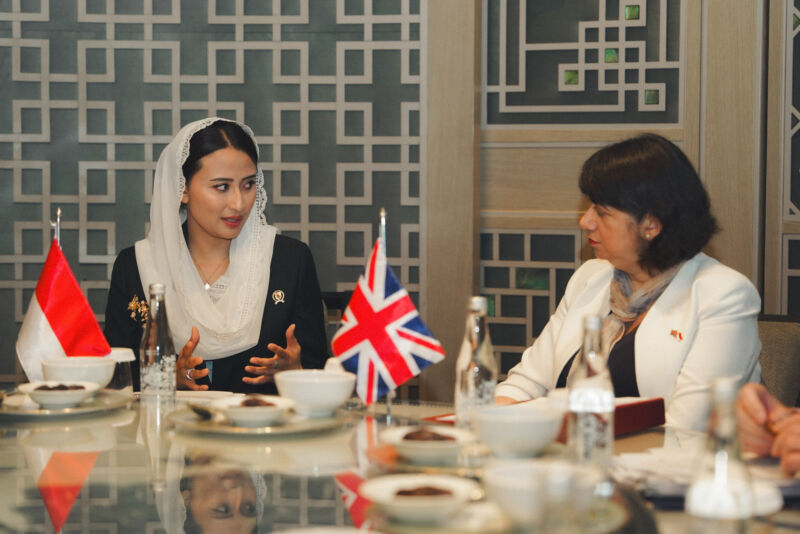
After delivering remarks at the Launch of the UK-Indonesia EGP, Deputy Minister Roro proceeded with her agenda by meeting the British Minister for the Indo-Pacific, Seema Malhotra, in Jakarta on the same day, Wednesday, 25 February.
The bilateral meeting discussed developments in trade cooperation between the two countries, including global trade dynamics and opportunities for strengthening partnerships in the Indo-Pacific region.
In the meeting, both parties also exchanged views regarding Indonesia’s accession process to the Comprehensive and Progressive Agreement for Trans-Pacific Partnership (CPTPP). British support for the smooth progress of Indonesia’s accession process discussions becomes an important part of strengthening coordination and communication with all CPTPP members.
Additionally, the dynamics of trade negotiations currently underway in various forums and prospects for broader Indonesia-UK trade cooperation in the future were discussed, in line with both countries’ commitment to continue exploring mutually beneficial collaboration opportunities.
On this occasion, Deputy Minister Roro was accompanied by Mochamad Rizalu Akbar, Director of Trade Negotiations for Services and Electronic Trade Systems at the Trade Ministry, and Bayu Wicaksono Putro, Director of Market Development and Export Information at the Trade Ministry. Also present were UK Minister for the Indo-Pacific Seema Malhotra, UK Ambassador to Indonesia and East Timor Dominic Jeremy, and Edi Prio Pambudi, Deputy for Coordination of Economic and Investment Cooperation at Indonesia’s Coordinating Ministry for Economic Affairs.
Meanwhile, UK Minister for the Indo-Pacific Seema Malhotra stated that Britain and Indonesia share the conviction that growth should be sustainable and inclusive. She emphasised that the trade and investment partnership between the two countries, which is now valued at nearly GBP 4 billion, serves as a foundation for strengthening UK-Indonesia cooperation through the EGP. According to her, the success of this partnership will be measured by the tangible, measurable, and concrete benefits for the business sector and people in both countries.