
Indonesia Golden 2045 Requires Modern Cooperatives and Productive Generations
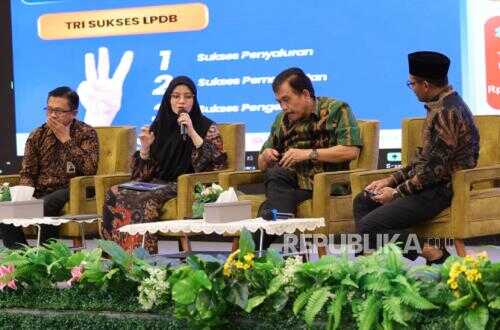
JAKARTA – The Director General and Legal Officer of LPDB Koperasi, Deva Rachman, has emphasised the importance of cooperative transformation as a strategic instrument in strengthening Islamic economy and expanding Indonesia’s halal market share, which is considered insignificant at the global level. He made these remarks at the Ramadan Leadership ICMI 2026 gathering of Muslim intellectuals.
Addressing participants comprising largely intellectual and professional Muslim circles, Deva stated that Indonesia currently has more than 140 million young people from millennial, Gen Z, and Alpha generations who will determine the direction of the national economy towards Indonesia Emas 2045 (Golden Indonesia 2045).
“The Red and White Village Cooperative Programme initiated by President Prabowo Subianto represents a form of social engineering to change social stratification and redirect economic flow from being concentrated in cities to village-based systems. This is a moment of modern cooperative revival,” said Deva.
According to him, the greatest challenge for cooperatives today is generational renewal and modernisation. Data shows that the average age of cooperative members in Indonesia reaches 55 years, with a dominance of savings-and-loan cooperatives. This condition indicates the need for cooperative repositioning to be more relevant to productive generations and the real economy sector.
As a Public Service Agency (BLU) under the Ministry of Cooperatives, LPDB Koperasi manages revolving funds of Rp 2.1 trillion in 2026. Strategic policy is directed towards changing the financing composition from 85 per cent for savings-and-loan cooperatives to 80–85 per cent focused on productive sector cooperatives.
“This demonstrates state commitment to ensure cooperatives grow on par with private enterprises and state-owned enterprises. There are 14 priority economic sectors from agriculture, fisheries, housing, to other strategic sectors that we are promoting,” said Deva.
In the context of Islamic economy, Deva highlighted the irony that Indonesia, as the world’s largest Muslim-majority nation, has lagging halal market share compared to Malaysia. Yet the global halal market potential continues to grow significantly, from food and beverages, Muslim fashion, pharmaceuticals, to technology-based halal industries.
LPDB Koperasi supports Islamic economy through cooperatives with two financing schemes: conventional and Shariah-based. Currently, Shariah-based financing comprises only about 30 per cent. Moving forward, LPDB is pushing for increased Shariah-based financing, particularly for cooperatives operating in the production and halal industry sectors.
“We must make cooperatives the main vehicle for strengthening the national halal ecosystem. Strategic partnerships are essential, including with ICMI and various halal certification bodies,” said Deva.
He cited collaboration being explored with LPPOM MUI under the Indonesian Council of Ulama. Employee cooperatives can access LPDB financing to strengthen assets and working capital, thereby increasing the economic impact on the community.
On the governance front, LPDB Koperasi continues institutional transformation through strengthening good governance, accelerating digitalisation, developing human resources based on competency, and utilising Artificial Intelligence (AI) in the financing proposal analysis process. These measures are taken to ensure that state budget funds managed remain secure, accountable, and productive.
Since its establishment in 2008, the total disbursement of revolving funds by LPDB Koperasi has reached Rp 21 trillion. With the principle of three successes—successful disbursement, successful utilisation, and successful repayment—LPDB affirms that every financing must be prudent as it comes from the state budget and has legal consequences.
“Cooperatives are the pillars of Indonesia’s economy. However, to rise, cooperatives must be modern, professional, and capable of meeting the needs of young generations. If we want to master the global halal market, then cooperatives must be the main players, not merely supplementary,” said Deva.
Through the Ramadan momentum and synergy with ICMI, LPDB Koperasi is calling for the emergence of new community-based cooperatives rooted in intellectual communities and productive generations, as the foundation of an inclusive and sustainable Islamic economy towards Indonesia Emas 2045.