
Indonesia Expands Palm Biomass Market to Japan
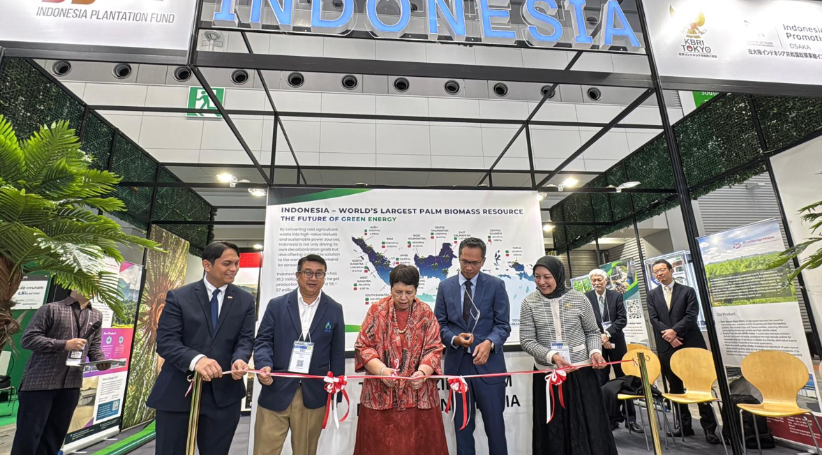
Indonesia’s palm biomass performance continues to show a positive trend in the global market, especially in Japan. The product Palm Kernel Shell (PKS), or palm shells, has recorded export volumes exceeding 5 million tons per year. Meanwhile, other biomass potentials such as Empty Fruit Bunch (EFB) are being developed for marketing in pellet form to the Japanese market.
In efforts to strengthen and expand export markets, the Indonesian Palm Shell Business Association (APCASI) participated in the International Biomass Expo 2026, held from 17 to 19 March 2026 at Tokyo Big Sight, Tokyo.
This participation is supported by the Plantation Fund Management Agency (BPDP) as well as the Directorate General of National Export Development of the Ministry of Trade of the Republic of Indonesia through the Indonesia Trade Promotion Centre Osaka and the Trade Attaché of the Indonesian Embassy in Tokyo.
The event was officially opened by the Ambassador of the Republic of Indonesia to Japan, Nurmala Kartini Pandjaitan Syahrir. As part of the programme, APCASI also held a business forum titled “The Amazing Indonesia Palm Biomass” which featured various stakeholders from Indonesia and Japan.
APCASI Chairman, Dikki Akhmar, stated that at this exhibition, they are promoting palm oil biomass, namely PKS and EFB pellets.
“Indonesian PKS has had a stable market in Japan over the past three years. Looking ahead, we are encouraging the development of EFB pellets as an alternative energy source with great potential,” he said.
He added that Indonesia’s total palm biomass potential reaches around 232 million metric tons per year, equivalent to electricity production capacity of up to 38,760 MW. This potential is seen as a major opportunity in supporting the global energy transition towards more sustainable energy sources.
Deputy Ambassador of the Republic of Indonesia to Japan, Maria Renata Hutagalung, emphasised that palm biomass trade provides a positive contribution to the Indonesia-Japan trade balance.
“The Indonesian Embassy in Tokyo will continue to support promotion efforts and market access expansion for Indonesian businesses in Japan,” she said.
Meanwhile, Director of Planning, Collection, and Fund Development of BPDP, Lupi Hartono, stated BPDP’s commitment to supporting the promotion and development of palm derivative products.
“BPDP not only supports promotion but also finances research to increase the added value of palm derivative products, including Indonesian palm biomass,” she explained.
From the quality assurance side, President Director of PT Sucofindo, Sandri Pasambuna, revealed that his company has established cooperation with Japan Quality Assurance. This collaboration is expected to enhance the credibility of Indonesian biomass certification in the eyes of Japanese buyers.
On the other hand, Director General of National Export Development of the Ministry of Trade of the Republic of Indonesia, Fajarini Puntodewi, added that palm biomass is one of the strategic commodities with great potential as a source of foreign exchange for the country.
The government, she continued, is committed to continuing to strengthen promotion and expand market access through synergies with various trade representatives in Japan, including through the Trade Attaché and ITPC Osaka.
“With the increasing global demand for renewable energy, Indonesian palm biomass is expected to further strengthen its position as a sustainable and highly competitive alternative energy source in the international market,” said Dirjen Puntodewi.