
Indonesia-China Increasingly Fond of Using Yuan, Bye American Dollar
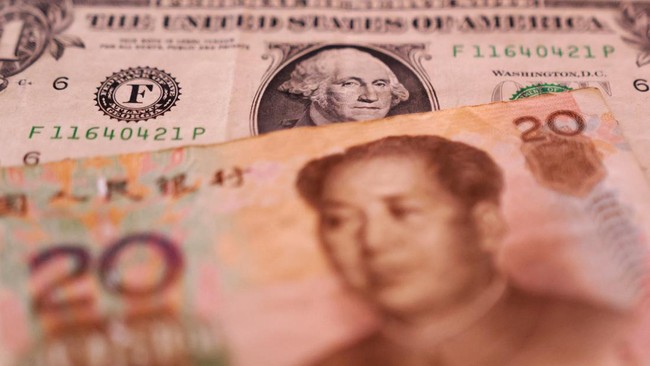
Indonesia-China Increasingly Fond of Using Yuan, Bye American Dollar
Jakarta, CNBC Indonesia - The dominance of the United States (US) dollar in global trade and financial transactions remains unchallenged to this day. Amid rising global uncertainties, the currency of Uncle Sam’s country continues to be the primary choice for market players and businesses, particularly due to its highest liquidity and status as a safe-haven asset.
This was stated by BCA Chief Economist David Sumual, who assessed that the dollar’s dominance in global transactions is still very significant. However, at the same time, he observed an increasing use of the Chinese yuan in international trade activities.
“If we look at it, USD usage is still large. For imports, it is still 90.7%, and even globally, the dollar’s role remains dominant. But there is an increase in demand for the yuan currency because they request payment in yuan,” said David at the Central Bank Forum 2026 in Jakarta on Monday (13/4/2026).
David explained that the dollar’s dominance has not yet been displaced. According to him, in world trade, the dollar remains the most liquid currency and the main benchmark for many international transactions.
“China likes to be paid in yuan, so the need for yuan is important abroad. Yuan liquidity might be affected if this continues in the long term,” added David.
He assessed that the government’s issuance of Dim Sum Bonds is an attractive instrument that could increase the supply of yuan.
In October 2025, the issuance of Dim Sum Bonds attracted interest from onshore (domestic) Chinese investors, with a total final orderbook reaching 18 billion yuan (Rp39.6 trillion).
Therefore, when geopolitical tensions rise and market players avoid risk, global capital flows quickly return to the US dollar.
Nevertheless, David sees a gradual change beginning. The additional use of the yuan is starting to appear as Indonesia’s trade relations with China grow larger.
He stated that Indonesia’s trade activities are now increasingly diversified. Previously more dependent on Japan and the US, the share of trade with China and India is now larger.
Indonesia’s exports to China, according to him, rose by around 24%, while imports from China increased by 74%.
This situation then encourages an increase in the need for yuan abroad. David explained that some transactions with China are now indeed requested to be paid in yuan. Therefore, demand for the Chinese currency is also rising.
This is also evident from the strengthening of the yuan against the Garuda rupiah. Citing Refinitiv, the rupiah’s movement against the Chinese yuan continues to weaken. Year to date (YTD), the rupiah has weakened by around 4.9% against the yuan, with the exchange rate at midday on Monday (13/4/2026) at Rp2,505/CNY.
This means the rupiah’s exchange rate weakening against the yuan is much deeper compared to the US dollar since the beginning of 2026.
Nevertheless, David also mentioned that the government has prepared several initiatives to increase yuan liquidity, including through instruments like Dim Sum Bonds.
According to him, such steps are part of efforts to diversify and reduce excessive dependence on the US dollar in international transactions.
However, David emphasised that the dollar’s role remains irreplaceable to date. Globally, he said, the dollar’s share in world transactions is still around 89%, so almost all currencies still use the dollar as the main benchmark.
“Even the world’s most liquid currency is the USD,” said David.
This means the additional use of the yuan is indeed starting to appear, but the direction is still more towards gradual diversification efforts, not a replacement for the dollar’s dominance in the near term. Amid current geopolitical turmoil, the dollar’s position is actually strengthening again due to its status as a global safe-haven asset.
Based on a Bank for International Settlements (BIS) survey, the yuan’s share in the global forex market rose to 8.5% in 2025 from 7% in 2022. Nevertheless, the US dollar still dominates with a 89.2% share of world transactions. This means the dollar remains the world’s primary currency, but yuan usage is slowly increasing.
CNBC INDONESIA RESEARCH