
Indonesia-China Digital Payment Connectivity: Indonesian QR System to Integrate with Alipay from May 2026
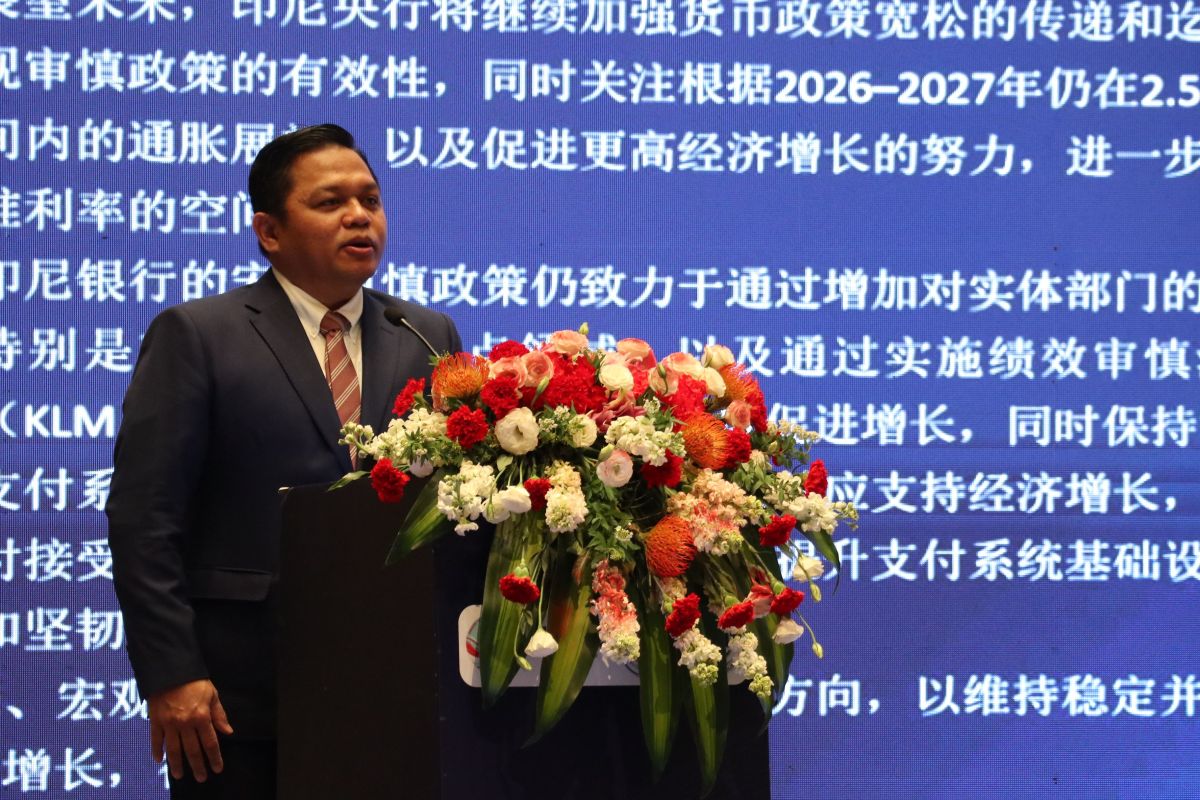
Indonesia and China continue to strengthen cross-border digital payment connectivity to facilitate transactions by tourists, consumers, and businesses through Indonesia’s domestic payment system, specifically the Quick Response (QR) system, which is scheduled to be available for use via the Alipay application from May 2026.
Yulian Wihantoro, Head of Bank Indonesia’s Representative Office in Beijing, promoted the efficiency of cross-border financial transactions through the local currency transaction framework in China. “When companies undertake international expansion and Chinese companies are known for their initiatives to expand globally, there is one important factor that is sometimes overlooked: the efficiency of cross-border financial transactions,” Wihantoro said at the “Indonesia-China Business Dialogue” event held in Changsha, Hunan Province, China on Tuesday, 10 March, local time.
The dialogue, organised by the Indonesian Embassy in Beijing in cooperation with the Indonesia Investment Promotion Center (IIPC) Beijing, was attended by approximately 200 Chinese and Indonesian business executives.
“An efficient financial system helps businesses reduce costs, manage risks, and improve operational efficiency. This is where financial cooperation between Indonesia and China becomes highly relevant and important,” he added.
Wihantoro stated that Bank Indonesia and China’s central bank signed a Bilateral Local Currency Transaction Framework in May 2025 to enable trade and investment transactions to be settled directly using rupiah and renminbi, reducing dependence on third-party currencies and enhancing cross-border transaction efficiency.
For businesses, this cooperation can lower transaction costs, as companies no longer need to use multiple currencies—only rupiah or renminbi. The cooperation can also accelerate transaction settlement processes, particularly given the one-hour time zone difference, and improve foreign exchange risk management capabilities, especially in an unpredictable global economic environment.
“This enables companies to focus more on expanding their business, operations, and partnerships,” said Wihantoro.
“Currently, the local currency transaction (LCT) framework continues to develop and the number of participating companies and transactions is increasing significantly. China now represents a large share of LCT transactions outside ASEAN countries,” he explained.
Indonesia and China are also strengthening cross-border digital payment connectivity through a QR-based payment system to facilitate payment transactions by tourists, consumers, and businesses using domestic payment applications. Support for this digital payment service is scheduled to be available via the Alipay application from May 2026.
Chen Hailei, Vice President of CNGR Indonesia, a Chinese electric vehicle battery material manufacturer operating in Morowali, stated that Indonesia has been one of the company’s foreign expansion destinations from the outset. “Indonesia has been one of our primary overseas expansion destinations from the beginning. In 2011, we came to Jakarta, and from that point forward we began our overall investment in Indonesia,” said Chen.
Chen noted that CNGR in Indonesia has become a complete business base that includes products, planning, and industrial layout. CNGR has registered many other companies in Indonesia, provided substantial technology, created employment, and transferred some of CNGR’s capacity and traditional products to Indonesia.
“Although our industrial team’s scale in Indonesia is now very large, much of this has actually been achieved in a relatively short timeframe, around five years,” Chen said.
“The products we manufacture in Indonesia, such as products within our industrial chain, including battery materials, ternary materials, and various other product forms, are all produced to global standards,” he added.
Chen stated that Indonesia possesses raw material characteristics different from China. The diversity and complexity of Indonesia’s raw materials are higher compared to China’s raw materials.
Another challenge is that companies must independently develop new industrial processes known as the second generation as a solution to balance various technical issues and industrialisation processes.
If Chinese entrepreneurs wish to invest in Indonesia, Chen said, at least three things must be undertaken. First, complete comprehensive globalisation efforts. Second, investment must be considered from the perspective of overall industrial chain integration. Third, companies must genuinely prepare how to address local issues such as various social concerns, future costs, and joint development with Indonesian companies.
“Based on our own internal calculations, the initial capital expenditure in Indonesia is currently approximately 25-30 per cent higher compared to China. That is for CAPEX, but in terms of OPEX the costs are far lower,” Chen revealed.
Chen stated that overall, investment costs in Indonesia currently may be slightly higher than in China, but the trend is continuously declining.
“I can provide you with one piece of data: since 2021 when we began investing until 2025, the overall investment cost comparison between China and Indonesia in our projects has actually fallen by nearly 30 per cent,” explained Chen.
He also emphasised that Chinese entrepreneurs who wish to do business in Indonesia need to understand Indonesia’s overall political conditions, as there are considerable differences between Chinese and Indonesian law.
“The political structure and regulatory mechanisms also differ from China. In China the government may be more prominent.”