
Indonesia Braces for Another Trump Tariff Blow, What Can the Government Do?
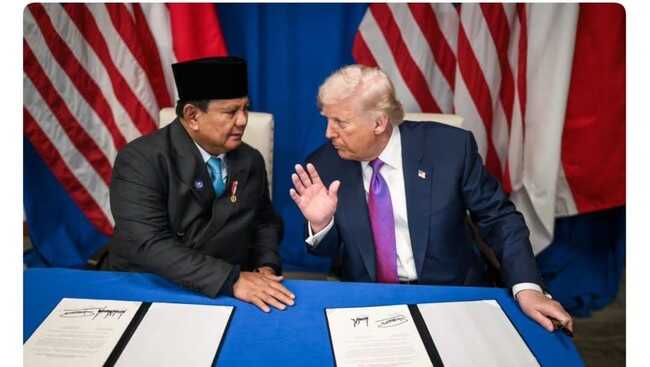
Jakarta – Following the signing of the Agreement on Reciprocal Trade (ART) between Indonesia and the United States on Thursday, 19 February 2026, President Donald Trump suddenly struck Indonesia’s solar panel industry with countervailing duties.
Trump imposed countervailing duties of 104.38% on solar cells and panels imported from Indonesia. The policy also applies to similar products from India and Laos.
Additionally, the US Department of Commerce imposed individual tariffs on several Indonesian companies. PT Blue Sky Solar faced a 143.3% tariff whilst PT REC Solar Energy was hit with 85.99%.
The tariffs were justified on the grounds of protecting US manufacturing facilities and alleging that Indonesian, Indian, and Laotian solar companies had received government subsidies, rendering US industry products uncompetitive.
This justification dealt a harsh blow to Indonesia. With the ART already signed, Indonesia must grant maximum-level special treatment to American goods entering the Indonesian market.
Besides allowing 99% of US products to enjoy tariff elimination and access to Indonesia’s 280-million-person market, the products will proceed without compliance with Indonesian technical regulations. Where technical regulations do apply, they must conform to US standards.
As stated in the Trump Administration’s Fact Sheet on Concluding a Trade Agreement with Indonesia, released on The White House website on 19 February 2026, the ART contains crucial provisions.
“Indonesia will eliminate tariff barriers on more than 99% of US products exported to Indonesia across all sectors, including agricultural products, health products, seafood, information and communications technology, automotive products, and chemicals,” reads the first key point, cited on Thursday (26/2/2026).
The second key point addresses non-tariff barriers. Indonesia will resolve non-tariff barrier issues affecting US products entering Indonesia.
“Such as freeing US companies and goods from local content requirements, accepting federal US motor vehicle safety and emissions standards, accepting FDA standards for medical devices and pharmaceuticals, eliminating burdensome certification and labelling requirements, removing pre-shipment inspection requirements, and taking steps to resolve numerous long-standing intellectual property issues,” states the second point.
Admittedly, the result is that certain Indonesian goods will enjoy reciprocal tariffs of 19% entering the US, down from the initial 32%. Some will enjoy 0% tariffs. However, this is not a uniform tariff rate, as other tariff policies remain in place.
So, is the signed agreement equitable and reciprocal for both parties? Without discriminatory pressure?
Not according to the Climate Business and Global Value Chain Research Centre at LPEM FEB UI. As detailed in the Economic Analysis Series Trade and Industry Brief volume IX, No.2 February 2026 titled “US-Indonesia Trade Agreement: Indonesia’s Response and Anticipation Following the Agreement on Reciprocal Trade and the US Supreme Court Decision.”
“US trade policy under President Trump’s administration is fraught with uncertainty and threatens the rules-based trading system,” wrote LPEM FEB UI.
“The ART places greater burden on Indonesia regarding commitments to eliminate various non-tariff policies and harmonise product standards with stricter US standards, potentially causing Indonesia to lose sovereignty in determining its own policies,” added LPEM FEB UI.
Moreover, with the ART prioritising special treatment for US products, Indonesia could face discrimination claims. Consequently, Indonesia’s diplomatic standing in the international arena will be jeopardised.
“In principle, Indonesia indeed requires improved import management to reduce transaction costs by avoiding unnecessary technical barriers and streamlining import licensing,” wrote LPEM FEB UI.
“However, unilateral recognition of US standards without full reciprocal mechanisms could potentially restrict domestic regulatory sovereignty,” the institute stressed.
Meanwhile, LPEM FEB UI assessed that it is not too late for Indonesia to make improvements. Particularly given the US Supreme Court’s decision on 20 February 2026, one day after the Indonesia-US ART was signed. That ruling struck down Trump’s reciprocal tariff policy launched in April 2025.
However, that decision does not automatically invalidate the signed ART. But, according to LPEM FEB UI, Indonesia could still renegotiate the agreement or pursue more certainty-ensuring strategies such as exploring bilateral agreements within the Preferential or Free Trade Agreement framework.
However, Coordinating Minister for the Economy Airlangga Hartarto, during an online press conference following the signing ceremony, cited on Monday (23/2/2026), did not mention termination. Airlangga only referred to evaluation.
“This agreement can be evaluated and amended at any time with written request and approval from each party,” he said.
Especially as the US Trade Representative (USTR) stated that Trump had secured the ART with partner nations, including Indonesia.
“From Buenos Aires to Kuala Lumpur, @/POTUS continues securing Reciprocal Trade Agreements with our partners worldwide. Malaysia, Cambodia, El Salvador, Guatemala, Argentina, Bangladesh, Taiwan, Indonesia,” posted @/USTradeRep, referencing President Donald Trump’s official X account, Wednesday cited Thursday (25/2/2026).
New Problems Emerge
Yet, before evaluation begins, Trump has already rolled out new policies, expanding trade uncertainty.