
Indonesia Begins to Abandon the US Dollar, Here's the Proof!
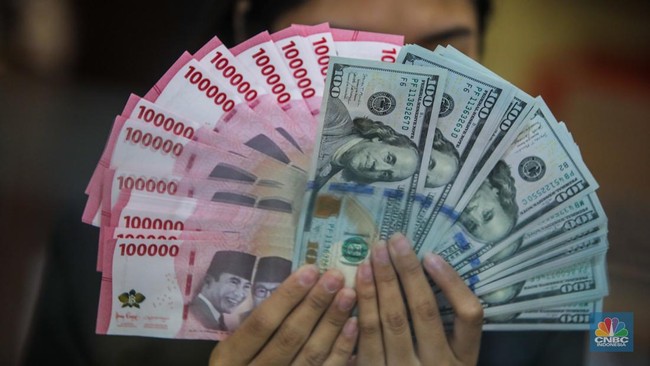
Amid the strong dominance of the US dollar in global trade and finance, Indonesia is preparing safeguards to reduce its dependence on the currency of Uncle Sam. These efforts involve diversifying transactions, from using local currencies to financial cooperation with partner central banks. One key evidence is the existence of the Bilateral Currency Swap Arrangement or bilateral currency swap agreement. Chief Economist at BCA, David Sumual, considers this scheme important as it can serve as an additional buffer during turbulent financial markets, increased dollar pressure, or tightening foreign exchange liquidity. Bilateral Swap as a Buffer When the Dollar Pressures One of the most concrete pieces of evidence of Indonesia’s efforts to reduce dependence on the US dollar is the Bilateral Currency Swap Arrangement. Simply put, this is a cooperation agreement between two central banks to provide each other with liquidity in their respective currencies if needed at any time. This scheme is crucial because it can act as an additional buffer when financial markets are volatile, pressure on the dollar increases, or foreign exchange liquidity tightens. In other words, Indonesia does not solely rely on foreign exchange reserves but also has an additional emergency channel through cooperation with partner central banks. Chief Economist at BCA, David Sumual, said Indonesia already has bilateral swap agreements with China, Japan, Australia, and South Korea, with a total value of around US$90-100 billion. According to him, this facility can function as a secondary buffer when markets face heavy pressure. “It’s like insurance or a secondary buffer. If there’s a traumatic condition like in 1998, now we have agreements like this,” said David at the Central Banking Forum 2026 CNBC Indonesia in Jakarta on Monday (13/4/2026). The value of Indonesia’s bilateral currency swaps is quite substantial. With Malaysia, it reaches MYR 8 billion or about Rp28 trillion. With Singapore, it is US$10 billion or about Rp171 trillion. Meanwhile, with Japan, it is the largest at US$22.76 billion or about Rp389 trillion. Cooperation with South Korea amounts to KRW 10.7 trillion or about Rp115 trillion. Meanwhile, cooperation with China is recorded at CNY 400 billion or equivalent to US$55.79 billion, based on the presentation material. The existence of this facility is important because it provides additional liquidity when the foreign exchange market is volatile. Thus, when dollar pressure increases or the market experiences a liquidity shortage, Indonesia does not only rely on primary foreign exchange reserves but also has additional buffers from inter-central bank cooperation. Not Just Swaps, Local Currency Transactions Are Also Promoted Besides bilateral swaps, another sign that Indonesia is reducing its dependence on the dollar is the expansion of local currency transactions and cross-border payment systems. In the presentation material, Indonesia has implemented QRIS Cross Border with Malaysia, Singapore, Thailand, Japan, and South Korea. Meanwhile, cooperation with the Philippines and Brunei Darussalam is still in the planning stage. For Local Currency Transactions (LCT), implementation is already underway with Malaysia, China, Thailand, Japan, South Korea, and the United Arab Emirates. With Singapore, the Philippines, India, and Vietnam, it is still in the planning stage. The direction of this policy shows that Indonesia is beginning to build a regional transaction ecosystem that does not entirely depend on the US dollar. The larger the portion of trade and financial transactions that can be conducted directly in local currencies, the smaller the need for dollars in transactions between two countries.