
Indonesia-Australia Research Collaboration Develops Pain Management Module, Highlights Barriers to Therapeutic Opioid Access
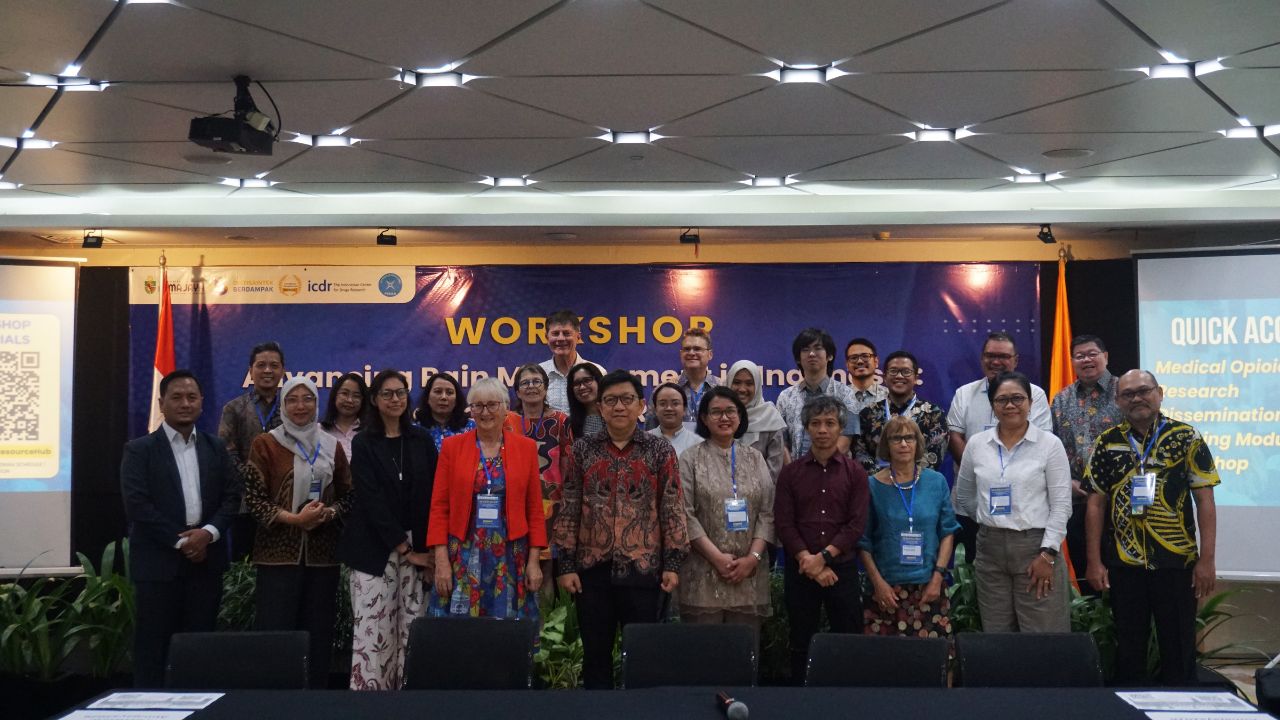
Access to therapeutic opioids for treating severe pain in Indonesia continues to face various barriers, ranging from regulation and limited healthcare resources to socio-cultural factors. These findings were presented at the Medical Opioid Research Dissemination and Workshop organised by The Indonesian Centre for Drugs Research (ICDR) at Atma Jaya Catholic University of Indonesia (Unika Atma Jaya), alongside partner universities from Indonesia and Australia, at the Semanggi Campus on Tuesday (2/6).
Titled ‘Towards Better Pain Management: Evidence, Education, and Practice in Indonesia’, the workshop represents a research collaboration between Unika Atma Jaya, UNSW Sydney, University of Sydney, Airlangga University, Udayana University, Hasanuddin University, University of Queensland, and University of South Australia. As a multidisciplinary research unit under Unika Atma Jaya, ICDR focuses on integrating policy and research in the field of drugs to strengthen policy design, teaching, and social engagement related to drug consumption and health.
The workshop was led by Dr. iur. Asmin Fransiska, S.H., LL.M., Director of ICDR, as the lead investigator of the ICDR team. The forum brought together researchers, regulators, and healthcare professionals to discuss the use of therapeutic opioids whilst refining a pain management training module.
Prof. Dr. dr. Yuda Turana, Sp.S(K), Rector of Unika Atma Jaya, affirmed that collaboration between academics, stakeholders, and practitioners is key to producing evidence-based public policy recommendations. ‘Universities are not only tasked with conveying knowledge but also with producing new knowledge that can serve as a strong basis for policy formulation, especially on complex health issues,’ he explained.
The research involved 84 participants from among healthcare professionals, government, pharmacists, hospitals, patient advocates, and industry through in-depth interviews in Jakarta, Surabaya, Denpasar, and Makassar. Based on the research findings, patients who need opioid therapy still experience access difficulties. Barriers are influenced by the location of healthcare services, resource availability, prescribing practices, and available financing schemes.
‘Patients who truly need opioid therapy face many obstacles in accessing treatment. On the other hand, healthcare workers are also confronted with medicine shortages, regulations that create administrative burdens, a lack of training and confidence in using opioids, and limited facilities to monitor patients safely,’ explained Dr. Elisabeth Kramer from UNSW.
Meanwhile, Dr. dr. Jimmy Fransisco Barus, M.Sc., Sp.N., a lecturer and neurologist from the Faculty of Medicine and Health Sciences at Unika Atma Jaya, highlighted the importance of strengthening pain management education for healthcare workers.
‘The challenges in pain education, especially regarding opioid use, are still considerable. Therefore, training materials need to be designed specifically for doctors, nurses, pharmacists, and specialists so that they have the appropriate competence to provide services, monitor side effects, and collaborate in patient care,’ he said.
Through this workshop, participants provided feedback on the research results and the draft training module being prepared. This input is expected to support the development of more responsive policies while improving access to safe, effective, and evidence-based pain management services for patients in Indonesia.
From the comprehensive 360-degree research results, it was discovered that the difficulty of accessing narcotic-class drugs for medical needs in Indonesia is not triggered by a single factor.
From the upstream side, the biggest barrier centres on policymakers at the government level. Because the majority of medical opioid commodities in Indonesia must be imported from abroad, the import process is bound by very strict global regulations from the World Health Organisation (WHO). When Indonesia wants to increase the national stock quota, the application process to the WHO requires mature future planning and takes up to a year. Unfortunately, this coordination is often late to be anticipated by the relevant agencies.
This delay is exacerbated by data reporting at the hospital level. Because stock in the field is often empty, doctors rarely prescribe it. As a result, statistical data makes it appear as though market demand or uptake for this medicine is low, so the government does not feel the need to raise the import quota.
In addition to supply problems, significant psychological and legal barriers haunt medical personnel in Indonesia. Many doctors and pharmacists experience opioid phobia—an excessive fear of producing, storing, or prescribing opioids because of their status as narcotics under the law.
Threats of legal action and the spectre of criminalisation due to malpractice cases that have recently been on the rise in Indonesia have led doctors to play it safe. Although opioid use is intended purely for medical indications under strict supervision, clinicians admit they are afraid of being labelled as ‘criminals’ or suspected dealers if there is even a slight administrative discrepancy.
Ironically, this research notes that there have been no actual legal cases in Indonesia where a doctor was convicted as a result of professionally prescribing opioids for a cancer patient. This condition is likened to ‘seeing a ghost’, where medical personnel are haunted by a great fear of a legal risk that has never actually occurred. This collective fear directly impacts the quality of life of cancer sufferers. Let alone in remote areas, even in the capital city of Jakarta, essential pain relief medicines such as morphine tablets are difficult to obtain.