
Indonesia and Philippines Forge Cooperation to Strengthen Critical Minerals Supply Chain
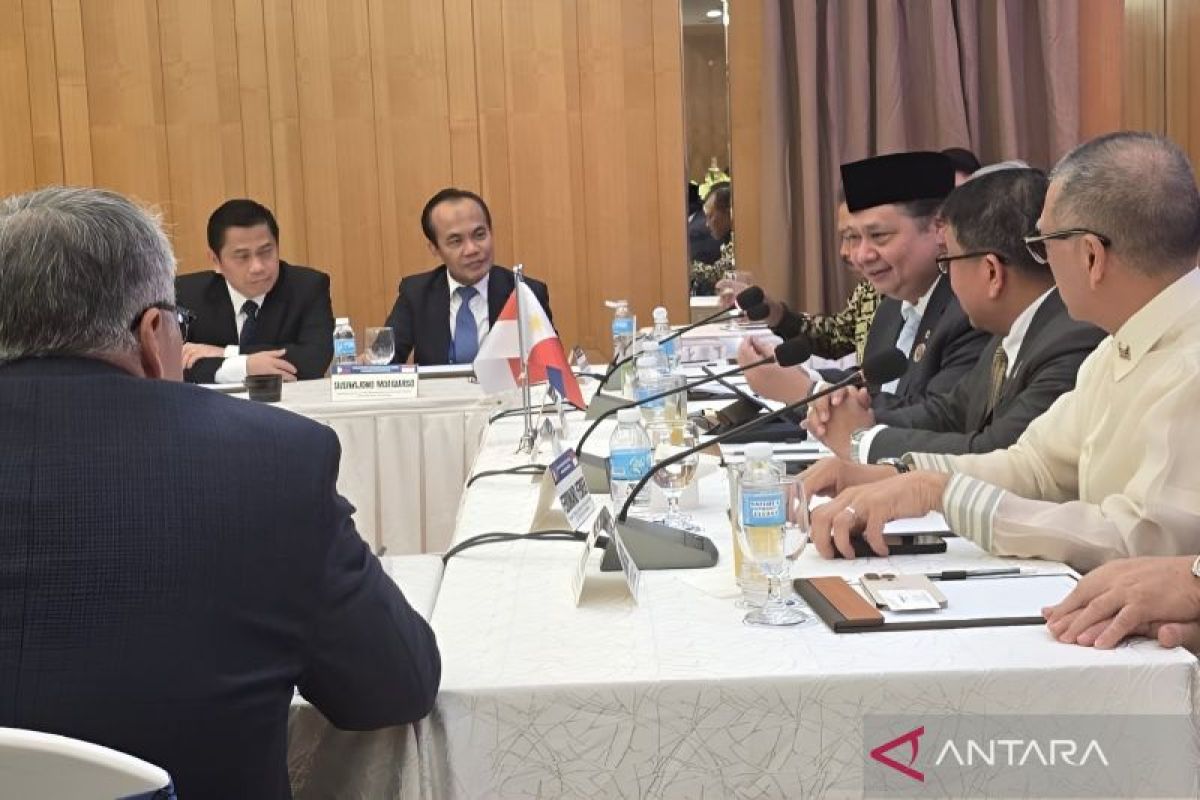
Jakarta (ANTARA) - Indonesia and the Philippines are forging cooperation to strengthen the critical minerals supply chain, marked by the signing of a Memorandum of Understanding (MoU) on Strategic Nickel Industry Development Cooperation between the Indonesian Nickel Miners Association (APNI) and the Philippine Nickel Industry Association (PNIA).
The signing was witnessed by Coordinating Minister for Economic Affairs Airlangga Hartarto alongside Philippine Trade and Industry Minister Hon. Maria Cristina A. Roque during the Indonesia-Philippines High Level Business Roundtable in Cebu on Thursday.
“This collaboration is not just an ordinary partnership. It is the foundation for the Indonesia-Philippines Nickel Corridor, a structured platform that connects Indonesia’s downstream processing and smelter strengths with upstream nickel ore supplies from the Philippines. This will become an inseparable axis for the world’s nickel reserves and production,” Airlangga stated in an official remark in Jakarta on Friday.
The MoU between APNI and PNIA encompasses strategic, long-term cooperation scopes, including:
Exchange of information to stabilise regional and global nickel trade, as well as joint development of nickel downstream technology and utilisation of value-added from side products of the processing industry.
Additionally, joint human resource development to support a sustainable nickel industry ecosystem.
Coordinating Minister Airlangga explained that Indonesia currently has a massive nickel downstream ecosystem, with the export value of processed nickel products reaching US$9.73 billion in 2025.
Projections of investments up to US$47.36 billion and absorption of 180,600 workers are also targeted by 2030. Several smelters require stable ore supplies with the appropriate silicon-to-magnesium (Si:Mg) ratio, which can be met from Philippine nickel ore through blending processes.
“With this corridor, the Philippines will no longer just be an exporter of raw ore. The Philippines will be integrated into a higher regional value chain, while Indonesia gains supply security (feedstock security) for our upstream battery and stainless steel industries. This aligns with the directives from the 27th ASEAN Economic Community Summit to strengthen critical supply chains in the ASEAN region,” the Coordinating Minister added.
Furthermore, Airlangga emphasised that nickel is a critical mineral with a central role in the energy transition.
Nickel derivative products can be integrated into national and regional energy resilience strategies through strengthened energy storage, both for electric vehicle (EV) batteries and solar panel energy storage batteries. Thus, nickel downstream processing not only supports the industrial sector but also directly contributes to a clean and sustainable energy mix.
To accelerate downstream processing, the government is also continuously promoting the development of integrated Special Economic Zones (SEZs) with critical minerals supply chains. SEZs can serve as locomotives for smelter investments, battery raw material processing, and centres for international-standard downstream technology innovation.
According to the United States Geological Survey (USGS) 2026, Indonesia and the Philippines together control 73.6% of global nickel production in 2025.
Indonesia itself contributes around 66.7% or 2.6 million tonnes, and the Philippines 6.9% or 270,000 tonnes. In terms of reserves, Indonesia holds 44.5% of the world’s nickel reserves or 62 million tonnes, while the Philippines has 3.4% or 4.8 million tonnes.
Trade relations between the two countries are also growing closer.
Throughout 2025, Indonesia’s total exports to the Philippines reached US$10.22 billion, equivalent to 8.4% of the Philippines’ total imports, making Indonesia the third-largest trading partner for the Philippines after China and Japan.
Overall, the Philippines is a crucial strategic trading partner for Indonesia in Southeast Asia, particularly for energy commodities and automotive products.
“This collaboration is not just an ordinary partnership. It is the foundation for the Indonesia-Philippines Nickel Corridor, a structured platform that connects Indonesia’s downstream processing and smelter strengths with upstream nickel ore supplies from the Philippines. This will become an inseparable axis for the world’s nickel reserves and production,” he stated.