
Indonesia and China Quietly Growing Closer, Agree to Abandon the US Dollar
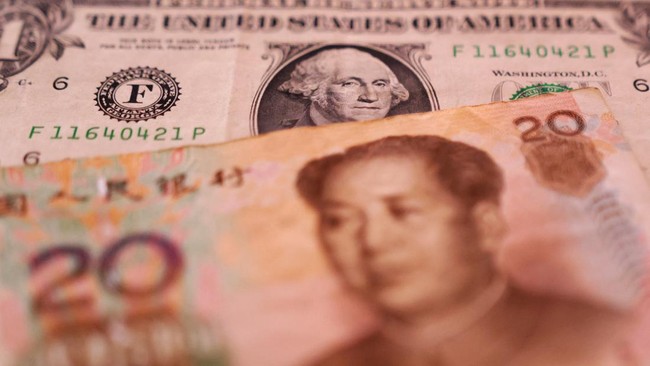
Indonesia is intensifying financial transactions and investments using the Chinese Yuan to reduce dependence on the US Dollar.
Bank Indonesia Governor Perry Warjiyo stated that this pattern of transactions without the US Dollar is supported by local currency transaction (LCT) services. These services are dominated by transactions using the Chinese Yuan.
“Domestically, the Yuan market with the Rupiah has developed because our local currency with China and the Rupiah is very high,” Perry said in the State Palace area, Jakarta, quoted on Wednesday (6/5/2026).
Based on Bank Indonesia’s latest records, the value of LCT transactions reached the equivalent of US$4.1 billion by February 2026. Of this amount, the majority was contributed by transactions with China, amounting to US$3.02 billion per month.
“And now a domestic market for Yuan and Rupiah is starting to form, including this local currency, which reduces or diversifies from the Dollar, thereby strengthening the Rupiah,” he explained.
Finance Minister Purbaya Yudhi Sadewa said the Indonesian government has been actively involved in reducing the dominance of the Dollar as Indonesia’s global transaction currency. The approach involves diversifying the bond market, now focused on Yuan denomination through the issuance of Panda Bonds.
“To strengthen the exchange rate, we will also issue bonds in the form of Panda Bonds in China with lower interest rates so that we are no longer too dependent on the Dollar,” he stated in the State Palace area.
On various previous occasions, he had also revealed that the yield demanded by Chinese investors is around 2.3%, much lower than the yield on benchmark 10-year government securities (SBN), which has been around 6%.
Therefore, he is confident that issuing Panda Bonds will enhance the diversity of foreign exchange supply in Indonesia, no longer dominated by the US Dollar.
“So our diversification will be even better going forward. The prospects are good, everyone doesn’t need to worry. Earlier, the President also told me to convey the message that my money is sufficient, there’s plenty of money, so you don’t need to worry,” he explained.
Before issuing Panda Bonds, the Indonesian government had already issued Dim Sum Bonds in October 2025. The issuance of Dim Sum Bonds attracted interest from onshore (domestic) Chinese investors, with a total final orderbook of 18 billion Yuan (Rp39.6 trillion).
Indonesia’s external debt sourced from China has also risen in February 2026, reaching an all-time high. At the same time, debt from the United States (US) also increased, while debt denominated in Yuan also broke through a new high.
Based on the Indonesian External Debt Statistics (SULNI) April 2026 edition released by Bank Indonesia on Wednesday (15/4/2026), Indonesia’s external debt position in February 2026 was recorded at US$437.9 billion, or a 2.5% year-on-year (yoy) growth.
Converted to Rupiah, the value of Indonesia’s external debt up to February 2026 reached approximately Rp7,501.22 trillion (assuming an exchange rate of Rp17,130/US$1). This value is higher than January 2026, which was US$434.9 billion with 1.7% yoy growth.
From the creditor country perspective, Indonesia’s external debt to China in February 2026 was recorded at US$25.574 billion. This figure rose from US$25.123 billion in January 2026. This increase also set a new all-time high for Indonesia’s debt from China.
Previously, the highest record for Indonesia’s debt from China was around US$25.048 billion in August 2025. Thus, the February 2026 position has surpassed the previous highest level and confirms that China’s role as one of Indonesia’s major creditors continues to grow.
Looking further back, this rise in debt from China also shows a fairly strong trend in recent years. In the landscape of Indonesia’s global creditors, China remains one of the largest lenders, and its position is now increasingly close to the US.
On the other hand, Indonesia’s external debt from the US also rose. In February 2026, it reached US$27.803 billion, up from US$27.066 billion in January 2026. With this figure, the US remains the creditor with the largest loan value compared to China.
Nevertheless, the gap between Indonesia’s debt to the US and China is now narrowing. As of February 2026, the difference between them is around US$2.23 billion. This indicates that although the US is still ahead of China, the rate of increase in debt to China appears increasingly significant and continues to approach the US position.