
Indonesia Allocates 24,000 Hectares for 100 GW Solar Power Project
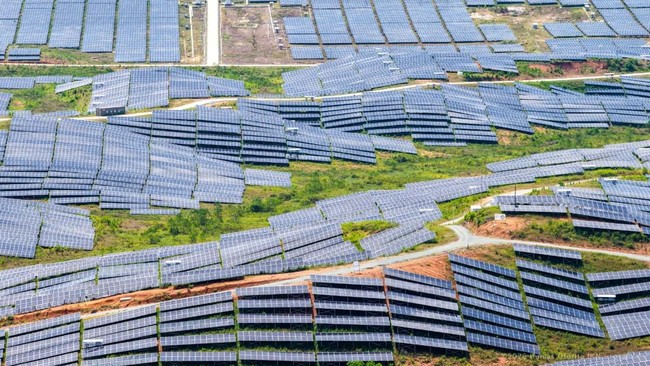
The government has begun preparing 24,000 hectares of land in Java to support the construction of a 100-gigawatt (GW) solar power plant (PLTS), one of the largest renewable energy projects being pushed by President Prabowo Subianto.
Deputy Minister of Energy and Mineral Resources (ESDM) Yuliot Tanjung stated that land availability is a crucial factor in accelerating the implementation of the 100 GW PLTS programme, hence coordination with the Ministry of Agrarian Affairs and Spatial Planning (ATR/BPN) to identify suitable locations.
“The land availability, based on our joint identification between the ESDM and ATR/BPN ministries in Java, is approximately 24,000 hectares,” Yuliot said at the ESDM Ministry on Friday, 29 May 2026.
He added that the land will undergo further verification with ATR/BPN and PT PLN (Persero) to ensure the readiness of supporting infrastructure, including transmission networks and substations to connect the power plants to the national electricity grid.
Yuliot explained the government is also preparing regulatory frameworks to expedite the PLTS 100 GW project, with a draft Presidential Regulation (Perpres) specifically for accelerating solar power plant construction nearing completion.
“The ESDM is finalising the draft presidential regulation to accelerate the 100 GW PLTS development. Alongside parallel permit approvals, we are also conducting inter-ministerial discussions to establish the regulatory basis for speeding up the 100 GW solar power initiative,” Yuliot said.
President Prabowo Subianto has accelerated the transition to green energy, targeting a massive solar power plant capacity of 100 GW by 2029.
Prabowo emphasised the government will maximise solar energy use within the next three years.
“We aim to move swiftly in utilising solar power. We have plans and are determined to proceed as quickly as possible, aiming to achieve 100 gigawatts of solar energy within three years,” Prabowo stated at the Indonesia-Japan Business Forum in Tokyo, Japan, on Monday, 30 March 2026.
The accelerated PLTS plan is deemed urgent due to escalating conflicts and geopolitical uncertainties, particularly in the Middle East, threatening national energy supply stability.
“This is more urgent because geopolitical tensions in the Middle East pose strategic uncertainties to our energy security,” Prabowo stressed.
To mitigate risks, the government is securing supply through domestic resources, including geothermal energy and boosting biofuel production such as B50 biodiesel and bioethanol.