
Indonesia Aims to Boost Solar Power, While China Reigns as World Leader
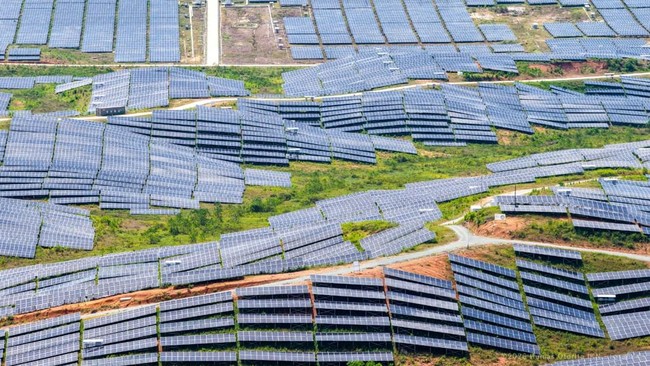
The government will build Solar Power Plants (PLTS) with a capacity of up to 100 Gigawatts (GW) within the next two years. This target is part of efforts to reduce dependence on fuel oil. President Prabowo Subianto aims for Indonesia to stop importing fuel oil (BBM) within the next 2-3 years. This follows plans to close Diesel Power Plants (PLTD), which contribute 20% to national BBM imports. In their place, the government will promote the use of PLTS, followed by electric motorcycle conversion programmes and the encouragement of electric stoves. “There will be no more power plants using diesel or solar fuel. No. With that, we will close 13 PLN diesel power plants,” explained President Prabowo at the inauguration of the Electric Bus Factory in Magelang, Central Java, on Thursday (9/4/2026). The 100 GW target in two years is certainly not a small figure. For context, the total national installed electricity capacity reaches around 107.51 GW in 2025. The total installed capacity of new renewable energy (EBT) as of December 2025 is 15.63 GW. Turmoil in the Middle East has opened the world’s eyes to the vulnerability of global energy supplies and the importance of energy diversification, including new renewable energy (EBT). The closure of the Strait of Hormuz during the Iran war drastically reduced oil and gas supplies. Indonesia still relies on oil imports for part of its domestic needs. In such conditions, Indonesia could actually rely on sunlight as a strategic reserve that does not need to be bought from abroad. For decades, the world energy power map has been determined by oil wells, tanker routes, and gas pipelines. Now, that axis is shifting to EBT, one of which is PLTS. The sun does not need to be imported, does not pass through strategic straits, and is not easily disrupted by geopolitical conflicts. Countries that can convert light into cheap electricity gain industrial advantages, energy stability, and manufacturing competitiveness. Solar Power Increasingly Becomes the Reliance, China the Champion According to the International Energy Agency (IEA), global cumulative solar capacity is projected to exceed 2,350 GW and become the world’s largest power generation capacity. Solar power is expected to surpass hydro in 2024, natural gas in 2026, and coal in 2027. This is a historic shift. A source of energy once considered supplementary is now rising to the centre of the global electricity system. Why is its growth so rapid? The answer lies in the price. Over the last decade, the cost of solar panels has dropped sharply due to mass production, technological efficiency, and giant factory scales. Many countries have found that building new PLTS is now cheaper than building new fossil plants. As electricity costs fall, investment follows naturally. However, the solar revolution creates new dependencies. If the world once worried about Middle Eastern oil, now many countries are concerned about China’s manufacturing dominance. According to the IEA, China controls around 80%-95% of global manufacturing capacity in various parts of the solar industry supply chain, from polysilicon, wafers, cells, to panel modules. As the world installs PLTS, most components come from Chinese factories. This dominance is no accident. China entered early, provided cheap credit, built industrial zones, prepared ports, and scaled up factories in unmatched ways. When global demand surged, its production capacity was ready. As a result, world panel prices are largely determined by China’s industrial efficiency. Therefore, the United States, India, and the European Union are now moving aggressively. America uses the Inflation Reduction Act, India promotes the Production Linked Incentive scheme, while Europe prepares green industry policies. The goal is the same: to reduce dependence on China and bring factories back to their respective regions. According to Global Energy Monitor compiled by Visual Capitalist, China’s total solar capacity, operational and prospective, reaches more than 1.1 million MWac or equivalent to 1,100 GW. Alone, China controls nearly 35% of the world’s solar project pipeline. Behind it stands the United States with around 238 GW and India with around 171 GW. Brazil, Spain, Australia, and new players like Mauritania and Colombia are also rising in the big list. So where does Indonesia stand? In terms of projects, Indonesia has not yet entered the top ranks. However, in terms of resources, its position is far more promising. A World Bank study, Global Photovoltaic Power Potential by Country, places Indonesia in the group of countries with strong solar potential, with daily electricity output in the globally competitive range of 3.5-4.5 kWh/kWp. As a tropical country, Indonesia receives relatively stable sunlight exposure throughout the year without long winters. This means Indonesia’s challenge is not a lack of sunlight. The challenge lies in execution. The world shows that the solar explosion only happens when three foundations work together: strong transmission networks, energy storage systems like batteries, and regulations that provide long-term certainty for investors. The 100 GW target itself means a massive undertaking. If one utility-scale PLTS project averages 100 MW, Indonesia needs around 1,000 projects of equivalent scale. The fastest path is not a single model, but a combination of large-scale PLTS, floating PLTS on reservoirs, rooftop PLTS for households, industrial zones, and utilisation of former mining lands. There is a broader economic dimension. Countries that only install panels will enjoy cheap electricity. Countries that also produce modules, cells, solar glass, inverters, cables, and batteries will gain new industries, jobs, and value-added exports. China understood this logic from the start. Many other countries are now trying to catch up. For Indonesia, President Prabowo’s target could be read