
Indonesia Aims for Top Spot in Global Halal Industry
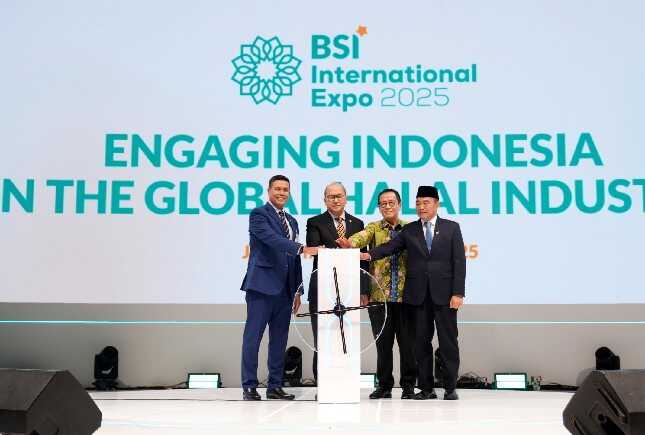
Indonesia is preparing to claim the top position in the global halal industry. This was affirmed by Investment Minister and BKPM Head, who also serves as CEO of Danantara Indonesia, Rosan P. Roeslani, during the opening of BSI International Expo 2025, held from 26 to 29 June in Jakarta.
Referring to the National Long-Term Development Plan (RPJPN) for Sharia Economics and Finance 2025–2045, Rosan emphasised that the advancement of the Islamic finance industry plays a strategic role in realising the Golden Indonesia 2045 vision.
“The current global landscape is filled with various challenges, from geopolitical uncertainty, climate change, to technological and economic disruption. In such situations, we are required to find new sources of growth that are inclusive, sustainable and resilient,” said Rosan.
Based on several scoring systems, Indonesia currently ranks third in the global halal industry. Yet Indonesia has the potential, with more than 80 per cent of Indonesian consumers already aware of the importance of halal products. The domestic market is essentially ready to support the growth of the halal industry.
However, challenges remain, ranging from low halal literacy among business operators to the suboptimal harmonisation of halal certification between countries. Therefore, strengthening the halal ecosystem cannot be done in a piecemeal fashion. Synergy is needed between regulators, business operators, consumers and financial institutions such as BSI.
With an agile, innovative and sustainable spirit, BSI continues to forge cross-sector collaboration to strengthen Indonesia’s position as a major player in the global sharia economy. BSI International Expo 2025 represents a concrete manifestation of this effort — a strategic step to propel Indonesia towards the top ranking in the Global Islamic Economy Indicator.
“The halal ecosystem offers a strategic solution to current global challenges. This ecosystem is becoming a new engine of growth for Indonesia. The halal ecosystem is no longer an alternative but has become the mainstream for economic growth,” Rosan added.
He further stated that “BSI International Expo 2025 is designed as a meeting point for business operators, communities, regulators and the public to build a comprehensive and sustainable halal ecosystem.”
President Director of PT Bank Syariah Indonesia Tbk, Anggoro Eko Cahyo, expressed appreciation for the support of the Government, regulators, Danantara, ministries and all stakeholders towards BSI and the halal industry. The BSI International Expo serves as a platform for literacy and education to drive sharia market penetration, which remains relatively low with a market share of approximately 8 per cent.
BSI International Expo 2025 showcases halal products with 330 tenants including gold booths, 50 hajj and umrah agents, food and beverage tenants, Muslim fashion brands, umrah travel operators, automotive, property, education and more across 25 categories.
“Bank Syariah Indonesia, as the largest Islamic bank under the auspices of Danantara Indonesia, is ready to serve as an aggregator for the growth of Indonesia’s halal ecosystem,” said Anggoro. He noted that the Islamic ecosystem has become the company’s business focus. “The Islamic ecosystem, encompassing halal food and beverages, fashion, pharmaceuticals and cosmetics, as well as halal tourism, holds enormous business potential that can be harnessed for the benefit of the community.”
BSI’s contribution to the development of the halal ecosystem is also supported by MSME strengthening — helping to improve the capabilities of MSME customers through mentorship via BSI’s Talenta Wirausaha (TWB) programme, establishing BSI MSME Centres, and organising business matching events to connect BSI-mentored MSMEs with potential buyers from 20 countries.
Anggoro appreciated Danantara’s support and synergy in helping BSI enhance the halal ecosystem. Currently, BSI focuses on offering unique sharia products such as gold and Islamic ecosystem services, particularly hajj and umrah. BSI has adapted to current public demand, where interest in gold-based products and hajj and umrah services is considerably high.
He affirmed BSI’s position as a leader in the hajj and umrah ecosystem, where on average each year 80 per cent of total hajj pilgrims register through BSI. Indonesian hajj pilgrims number approximately 221,000 annually, whilst umrah pilgrims total around one million per year.
Head of Banking Supervision at the Financial Services Authority (OJK) and OJK Board of Commissioners member, Dian Ediana Rae, said: “Islamic banking performance continues to show positive results amid a challenging year. Islamic banks do not only prioritise profit but also social value. To strengthen and support sharia economic growth, OJK has drawn up a roadmap for Islamic financial institutions.”
OJK is also focused on enhancing the capacity of Islamic banks for national economic growth through literacy, MSMEs, and contributions to the halal ecosystem by developing Islamic banks that are healthy, efficient and competitive. Islamic banking is expected to play a role in minimising economic impacts on the public. The sharia economy grows based on the principle of rahmatan lil alamin whilst also contributing to social aspects.