
Indigenous Peoples Bill Stalled for 16 Years in Parliament; Pigai Reveals Why
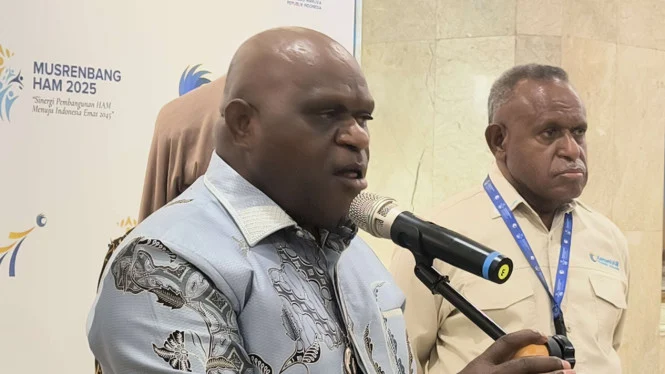
Jakarta, VIVA — For sixteen years, the Indigenous Peoples Bill (RUU Masyarakat Adat) has been stalled in the House of Representatives (DPR). Despite ongoing agrarian conflicts and mounting demands for the recognition of indigenous territories, the draft legislation has yet to become a permanent legal framework.
Indonesia’s Minister for Human Rights, Natalius Pigai, has revealed the primary reason the Indigenous Peoples Bill has failed to be enacted for 16 years. According to him, the tug-of-war between competing interests and existing sectoral legislation has been one of the greatest impediments.
Pigai made the remarks after submitting the draft Indigenous Peoples Bill to the DPR’s Legislation Body (Baleg) at the Nusantara I Building on Thursday, 19 February 2026.
“Why has this bill not been enacted for 16 years? One of the reasons is these competing interests. There are concerns that once an indigenous peoples law exists, the forestry law, the agriculture law, the plantation law, and the agrarian law would all suddenly need to be adjusted — and that becomes an obstacle,” Pigai said.
He explained that concerns have long persisted that enacting the Indigenous Peoples Bill would necessitate amendments to a range of other laws governing land, forests, and natural resources.
“The most recent argument is always this: once the indigenous peoples law is enacted, other laws must be adjusted, correct? So what about the land law, the environmental law, the agrarian law? That would become a major problem,” he explained.
For this reason, the government and DPR have agreed to adopt a “precision” approach to avoid direct conflicts between regulations.
“We have agreed with the DPR that this law must be crafted with precision, so that it does not collide with everything else. Precision means that with the existence of an indigenous peoples law, we should not force other laws to conform to it. That would certainly create conflict,” he said.
“So we must not force the agrarian law to be amended, nullified, or diminished following the enactment of this law,” he added.
However, Pigai stressed that the precision concept does not mean the Indigenous Peoples Bill must be subordinate to existing regulations.
“No. When this law comes into existence, it must not undermine other laws. It must not diminish or nullify them. But it should be a law that is moderately positioned — not extreme,” he affirmed.