
Indian businesses brace for fallout as Middle East conflict escalates
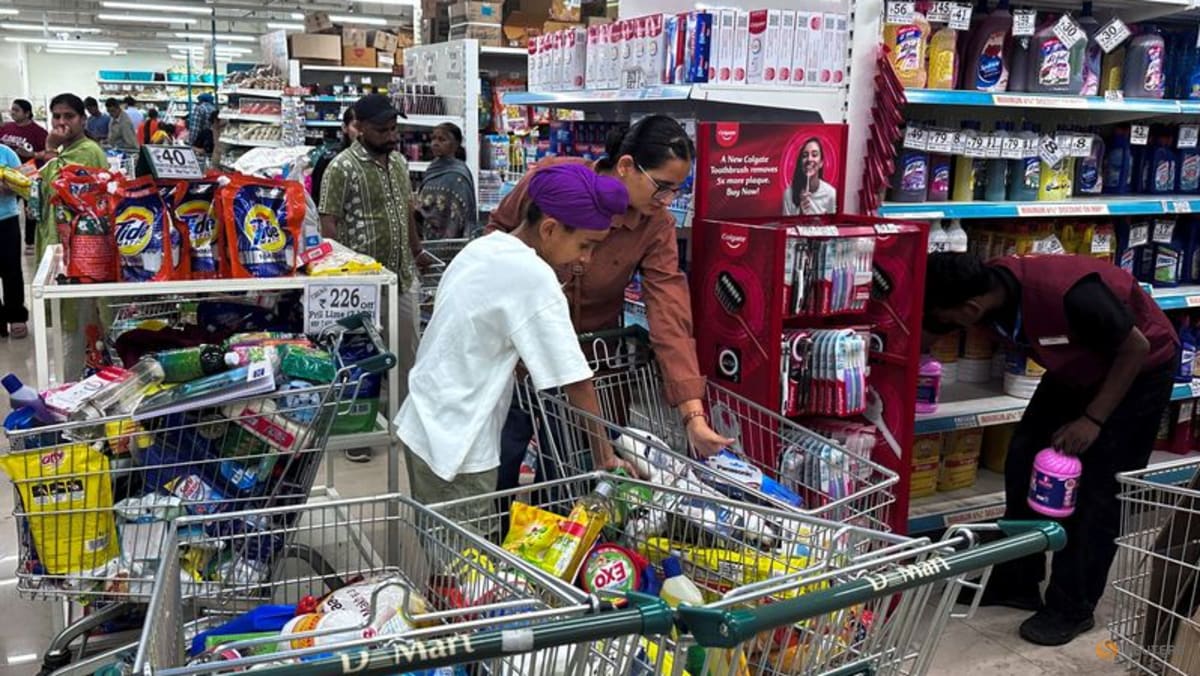
Indian businesses brace for fallout as Middle East conflict escalates
With much of India’s oil and gas trade flowing through the Strait of Hormuz, any disruption there could quickly ripple across its economy, observers say.
SINGAPORE: Indian businesses are bracing for turbulence as the escalating conflict between the United States, Israel and Iran threatens to send shockwaves through one of India’s most vital economic corridors.
The first tremors are already visible. Crude oil prices are climbing amid fears that fighting could disrupt shipping through the Strait of Hormuz, the narrow gateway between the Persian Gulf and the Gulf of Oman that carries a significant share of the world’s oil and gas.
For companies across sectors, from biscuits and confectionery to billion-dollar infrastructure projects, that waterway has suddenly become a pressure point.
India is the Gulf Cooperation Council’s second-largest trading partner after China, with bilateral trade worth US$158 billion in 2024 - about 10 per cent of the bloc’s total trade.
Energy-intensive and export-driven sectors such as textiles, leather, gems and jewellery, marine products and garments are particularly vulnerable to higher transport and input costs.
Mumbai-based multinational conglomerate Parle Products, whose Parle-G biscuits have become a staple in Gulf supermarkets, expects packaging costs linked to crude oil derivatives to rise.
Freight charges on exports to the Middle East are also likely to increase, Parle Products’ vice-president Mayank Shah says.
Any escalation would push up expenses and could eventually burden consumers, he told the Press Trust of India.
“The expectation is that it should not prolong, and that is what we hope,” he said.
While the exact share of Parle-G’s Gulf revenue is unclear, the company does not have manufacturing facilities in the Middle East, leaving exports exposed to higher shipping and energy costs if tensions persist.
For other firms, the exposure runs much deeper.
Infrastructure giant Larsen & Toubro (L&T) employs more than 58,000 people in the Middle East, from which it derives nearly 40 per cent of its total business, according to stock market analytics platform Trendlyne.
The company said it is closely monitoring developments in the Middle East and that its employees and assets remain safe.
Its share price has fallen more than 12.5 per cent since last Friday (Feb 27), local media reported - a sign of investor unease.
OIL: THE CRITICAL PRESSURE POINT
Energy remains the biggest concern, observers say.
In 2025, nearly half of India’s crude oil and LNG imports - and more than 85 per cent of its liquefied petroleum gas - passed through the Strait of Hormuz, according to Ajay Srivastava, founder of the Global Trade Research Initiative (GTRI).
“Closure of the Strait of Hormuz would not only drive up global oil prices but also threaten physical supply availability,” he said.
The strait handles about a-fifth of global crude and LNG consumption - and up to 13 million barrels per day of crude exports, roughly a-tenth of global demand, could be affected by any serious disruption.
Roughly 50 to 60 per cent of India’s crude imports, or 2.5 to 2.7 million barrels per day, go through the strait, along with the majority of its LNG supplies.
Higher oil prices would inflate India’s import bill, widen the current account deficit and add to inflationary pressures.
Following joint Israel-US strikes on Iran, global crude benchmarks jumped nearly 10 per cent on fears of supply shocks.
“Oil prices are already rising sharply, and India’s import bill will increase,” said Karthik Nachiappan, a research fellow at the Institute of South Asian Studies.
Rising petrol, diesel and LPG prices would ripple across the economy, lifting transport and manufacturing costs and squeezing household budgets, he added.
TRADE, TECH AND REMITTANCES
Beyond oil, the Gulf has become a crucial market for Indian exports and a growing source of investment.
Shipments to the United Arab Emirates (UAE) rose 25.6 per cent to US$27.4 billion in the 2023-24 financial year, driven largely by non-oil goods. Smartphones alone accounted for US$2.5 billion in exports.
The region has also emerged as an important source of capital for India’s technology sector. Over the past 18 months, Gulf funding has backed IT services, artificial intelligence ventures and data centre projects.
“Much of the deep capital for tech relies on money from the Middle East. It will be affected, because investors are unlikely to commit during a crisis,” Nachiappan said.
Trade with Iran remains limited due to longstanding US sanctions, but even modest flows - about US$1.2 billion in Indian exports and US$408.6 million in imports in 2025 - could face further complications if shipping lanes are disrupted.
Overseas remittances present another vulnerability.
More than 8.8 million Indians live in the Gulf, including over 3.5 million in the UAE and nearly 2.5 million in Saudi Arabia, sending roughly US$45 billion to India annually.
Any instability affecting jobs or capital flows could dampen consumption in several Indian states, such as Kerala and Odisha, that depend heavily on Gulf incomes, observers say.
“Those people working in the Gulf probably have to save more to deal with potential shocks in their own economies. So that means they have less money to send from overseas to India,” said Nachiappan.
BUSINESS AS USUAL FOR CHINESE FIRMS - FOR NOW
The Middle East has become an increasingly important destination for Chinese companies, driven by expanding trade, investment and infrastructure ties - including projects linked to Beijing’s Belt and Road Initiative (BRI).
Gulf hubs such as Dubai and Riyadh now host growing clusters of Chinese businesses and workers across technology, logistics, energy and services.
As regional tensions escalate, Chinese firms operating there told CNA they are closely monitoring developments, with many reporting limited immediate disruption so far.
Food deliv