
Increasingly Reckless: 21 Large Bags of Rubbish Dumped at Sanur Wisata Junior High School
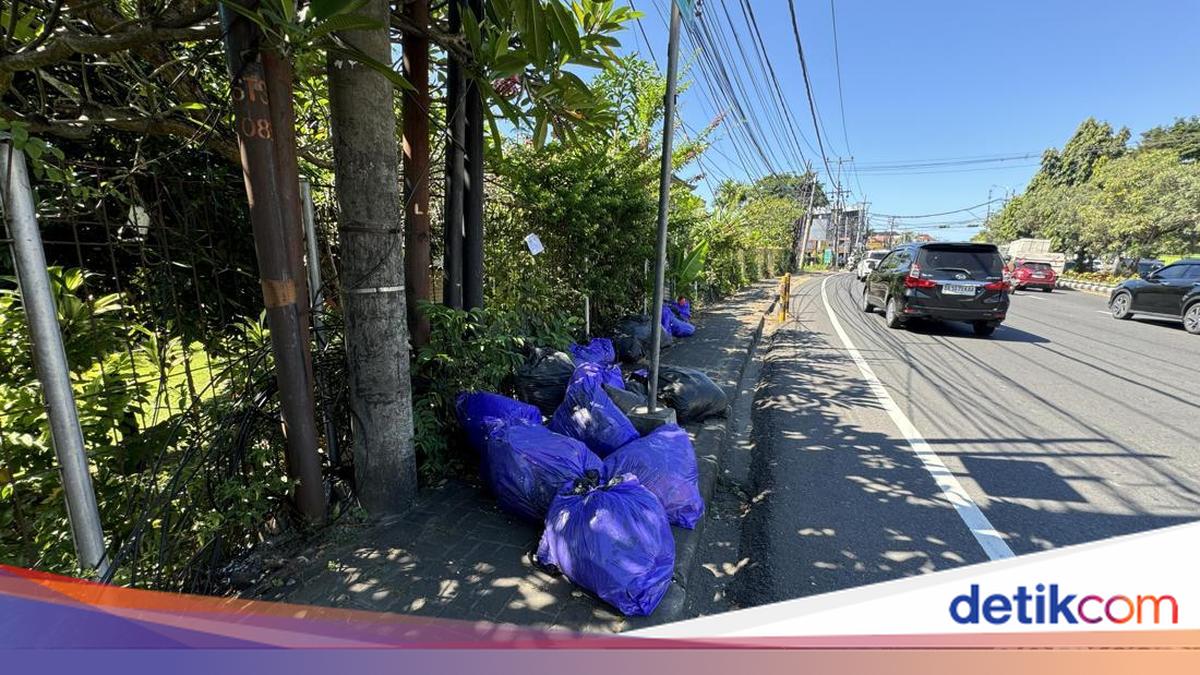
Illegal dumping incidents have become more frequent since the closure of the Suwung Final Waste Processing Site (TPA) in Denpasar. The latest case involves 21 large bags of rubbish found in different areas of SMP Widya Sastra Taruna (Wisata) Sanur, Denpasar.
The 21 bags of rubbish were discovered on Monday (13/4/2026). “Yesterday, while I was checking the waste sorting project at the back, I was walking in the garden and saw about 10 large purple plastic bags inside the school,” said the Head of SMP Wisata Sanur, Ida Ayu Krisna Ari, when interviewed by detikBali on Tuesday (14/4/2026).
Ari explained that the culprits likely mistook the school garden area for vacant land. “Possibly at night or dawn. Because on Sunday at 19:00 WITA, the gardener was still watering the plants and there was no rubbish. There’s a fence, and nearby there’s a bypass bus stop. In front of the fence, there’s rubbish, perhaps this was thrown inside,” Ari elaborated.
The rubbish had been neatly packed in purple and black rubbish bags. The school has not yet opened the bags. “We don’t dare to open them; I instructed not to open them, because that would be the same as us sorting it,” Ari clarified.
She admitted to being confused about how to handle the rubbish. The school has reported it to the Denpasar City Environment and Cleanliness Agency (DLHK), but has not received a response yet.
“So after it went viral, I’m also confused about the solution. Well, I returned it to the road. I instructed the gardener. Then let the government decide, whether to pick it up or what,” Ari said.
Meanwhile, Sanur Subdistrict has inspected the pile of rubbish and coordinated with DLHK Denpasar for the removal of the illegal waste.
“This is illegal waste, so if we don’t have transport, for now, we’re waiting for DLHK, because it’s illegal waste, so perhaps DLHK can pick it up,” said Sanur Subdistrict Head Ida Bagus Made Windhu Segara, when interviewed on Tuesday.
Segara admitted that this is not the first such incident, and even previously involved larger volumes of waste. Sanur Subdistrict works with Community Protection (Linmas) and local Environment Heads (Kaling) to conduct patrols in vulnerable dumping spots from 00:00 to 01:00 WITA.
Another solution implemented by Sanur Subdistrict to address this is the installation of CCTV in the dumping areas. “In the subdistrict, the mobile equipment arrived yesterday; if needed, it can be installed here, as long as there’s electricity. Because it’s mobile, we can monitor it too. But in the subdistrict, we don’t have funds. We only got one; if necessary, it will be installed here,” Segara explained.
He acknowledged that Sanur Subdistrict does not yet have a Reduce, Reuse, Recycle Waste Processing Site (TPS3R). In its development, Sanur Subdistrict is seeking collaboration with Sanur Kauh Village.
“We in Sanur Subdistrict hope to get assistance for transportation. We don’t have land or funds for waste processing. We’ve coordinated with Sanur Kauh; permission has been given, it’s okay. But for now, it’s still full, so we’re still waiting. For self-management, we’ll re-evaluate,” Segara said.
SMP Wisata Sanur Has 4 Modern Bins
SMP Wisata Sanur places two bins in each classroom. Green and yellow bins are used for sorting organic and non-organic waste.
This waste sorting involves the entire school community. “We’ve posted sorting instructions in front of each classroom. We’ve educated them: finish your food. If not finished, leftover rice goes to organic, corn to non-organic. That’s it; if someone doesn’t do homework or is late, the punishment is to sort waste,” explained Head of SMP Wisata Sanur Ida Ayu Krisna Ari.
“It should actually be four categories: organic, inorganic, hazardous waste (B3), and residue. But for now, just two; I’ve made holding tanks at the back. The important thing is to start the learning process,” Ari said.
SMP Wisata Sanur also has four modern composters and biopore holes. The school sorts organic waste, which is then turned into compost for maintaining plants on the school grounds. Non-organic waste is separated, with recyclable items sold to a waste bank, while residue waste is collected.
“Previously, we paid up to Rp800,000 for one truck of unsorted waste. We’ve sorted it, but in the end, it’s mixed again. Finally, we only sort the residue waste,” Ari said.
In addition, through extracurricular activities in hydroponics and gardening, SMP Wisata Sanur has harvested and sold the produce. The profits are returned to the school fund and reused, such as for competition needs.
“We plant vegetables at the back. Coincidentally, everything has been harvested. Before harvest day minus one, I already posted a story; many saved it for several kilos,” Ari said.
The school grows hydroponic plants like pak choi, water spinach, and lettuce. They also grow soil-based plants like chillies and eggplants.