
In the Constitutional Court, Komdigi says expired internet quotas are a service-delivery issue, not a matter for the Job Creation Act
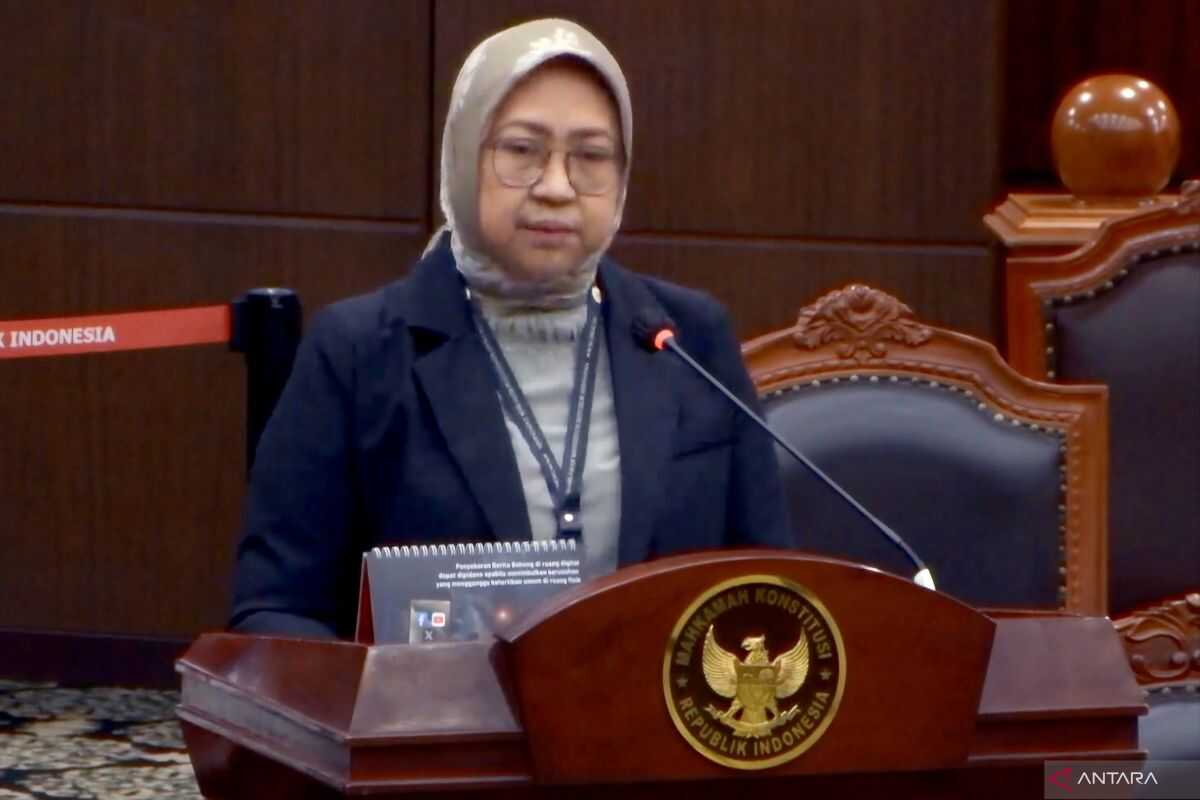
Jakarta – The Ministry of Communications and Digitalisation (Komdigi) has stated that the controversy over expired internet quotas is actually a service-delivery issue that is the responsibility of mobile network operators, not an issue of constitutional provisions in law. Consequently, the Government has asked the Constitutional Court (MK) to reject two petitions challenging the Job Creation Act that concern internet quotas, namely petitions No. 273/PUU-XXIII/2025 and 33/PUU-XXIV/2026. The statement was delivered by Cahyaning Nuratih Widowati, Senior Expert Staff to the Minister for Legal Affairs at Komdigi, during a subsequent session held concurrently for both petitions in the MK Plenary Courtroom, Jakarta, on Wednesday. ‘What needs to be considered regarding the applicants’ concerns about the expiry of access to internet services provided by mobile network operators is in fact a service-delivery issue that should be more informative and transparent for users,’ she said. Komdigi assesses that the provision under dispute by the applicants, Article 71(2) of the Job Creation Act, is in line with the principle of legal certainty as mandated by the constitution. Cahyaning explained that the provision does not give telecom operators freedom to set the level of telecom tariffs because tariff setting must be based on a formula established by the central government. According to him, users actually have a choice to select the type of internet service. If there is alleged violation of consumer rights, the mechanism for resolution lies within the realm of consumer protection law or administrative oversight. ‘Thus, according to the government, the petitioners’ claim of legal uncertainty has no constitutional basis,’ Cahyaning stated. The clause stating that tariffs are set by telecom operators based on a formula prescribed by the central government is believed to reflect the state’s involvement in ensuring tariffs are not exploited. He explained that the government has issued various derivative regulations that essentially regulate comprehensively the obligation of mobile operators to set tariffs in an accountable manner. ‘Including the obligation to set tariffs based on internationally recognised formulas, the obligation of transparency in service package offers, the obligation to provide accurate and non-misleading information to consumers, and the prohibition on imposing tariffs that are anti-competitive,’ he said. In petition No. 273/PUU-XXIII/2025, online ride-hailing drivers (ojol) Didi Supandi and online culinary trader Wahyu Triana Sari test Article 71(2) of Law Number 6 of 2023 on Job Creation. The article, which is an amendment to Article 28 of Law Number 36 of 1999 on Telecommunications, governs the tariffs for telecommunications provision. The applicants request MK to interpret Article 71(2) of the Job Creation Act as: Tariff setting and the framework for the provision of telecommunications services must provide a guarantee of the accumulation of unused data quotas (data rollover) that have been paid by consumers. In petition No. 33/PUU-XXIV/2026, TB Yaumul Hasan Hidayat, a student, also tests the same article. He contends that internet quotas affect online learning. The unilateral removal of quotas without consent and fair compensation is deemed contrary to the principle of legal certainty and justice. In his petition, he asks Article 71(2) of the Job Creation Act to be amended to: Internet quotas paid by consumers may not be unilaterally deleted or forfeited, and if a restriction on validity is set, it must be accompanied by a fair, transparent, and proportionate mechanism to guarantee legal certainty and the protection of citizens’ constitutional rights.