
"Impossible" Mission to Open Hormuz Amid War: Costly, Uncertain Results
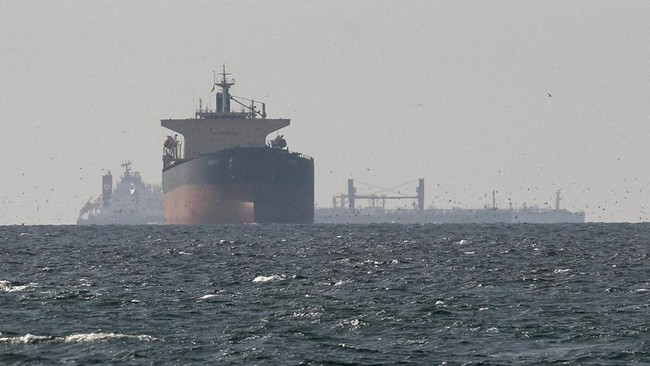
Jakarta, CNBC Indonesia - The United States (US) is reportedly preparing military options if diplomatic efforts with Iran fail to end the conflict. US President Donald Trump has stated that he is speaking with Iranian leaders to end the US bombing campaign. Although Iran denies this, Washington appears to be preparing other options should negotiations fail to yield results. According to The Economist, two US Marine amphibious units are heading to the Gulf region, one from Japan and one from California. Additionally, one elite infantry division specialised in airborne assaults is reportedly set to follow soon. This deployment indicates that Trump may be considering a military operation to forcibly reopen the Strait of Hormuz. However, this would not be an easy task. The operation would be phased but highly dangerous. Since the start of Operation Epic Fury, Iran has continuously threatened the Strait of Hormuz route, which handles around 20% of the world’s oil and gas exports, as well as other vital cargoes. Nineteen civilian ships have reportedly been attacked, either in the Gulf, the strait area, or nearby. As a result, shipping traffic in the region has slowed dramatically and is now mostly filled with ships linked to Iran. This situation has triggered major volatility in global commodity and financial markets. The Pentagon is said to have a three-phase plan to reopen the strait. The first phase involves hunting Iranian military assets threatening shipping, such as speedboats, missiles, drones, and mines. Iranian warships and submarines appear to have been destroyed first. This operation has so far largely been conducted via air strikes, though ground forces may be involved in the future. The second phase is clearing the Strait of Hormuz of mines. Once the Iranian threat to ships is deemed sufficiently reduced, the third phase would see the US Navy begin escorting tankers passing through the strait. Each phase is estimated to take several weeks and carries significant risks for US forces. Iran has many ways to attack ships. Attacks could come from above via missiles and drones. From the sea surface, speedboats carrying missiles or explosives could swarm or ram ships. From below, threats come from various types of mines. The problem is that Iran’s personnel and equipment are dispersed and hidden in small bays, caves, and underground tunnels along hundreds of kilometres of coastline. Therefore, these threats are difficult to neutralise solely through air strikes. In recent days, US fighter jets have continuously pounded Iran’s coastline. On 19 March, General Dan Caine, the US’s top military official, said US jets dropped 5,000-pound bombs to penetrate rock and concrete layers to destroy underground bunkers storing anti-ship missiles. Additionally, the US has deployed helicopters and low-flying attack aircraft like the A-10 Warthog to target Iranian speedboats. The US military claims to have damaged or sunk more than 120 Iranian naval vessels and 44 mine-laying ships. Bryan Clark from the Hudson Institute, as cited by The Economist, said that what the US is currently doing is pounding every cave, building, and storage site suspected of holding such weapon systems. Nevertheless, he assessed that it is very difficult to completely eliminate all existing threats. One idea gaining traction is to deploy special forces or Marines to nearby islands to detect and destroy targets hidden in rugged terrain. US military officials are reportedly considering the possibility of seizing Kharg Island, Iran’s main oil export terminal, or three islands controlled by Iran but claimed by the United Arab Emirates near the strait area. In addition to hunting threats, these forces could install short-range air defences to help protect passing ships, according to Mark Cancian from the Center for Strategic and International Studies. However, deploying ground forces is also highly risky. They would be within range of Iranian artillery and drones. Moreover, these forces would need continuous logistical resupply, meaning more aircraft and ships entering the danger zone. Their presence may not provide significant advantages, as Iran’s Shahed-136 drones have a range of over 1,500 km, allowing attacks on nearly the entire strait and Gulf area from almost anywhere in Iran. The mine-clearing phase is no less dangerous. There are conflicting reports on whether Iran has already laid mines, but shipping companies are certainly reluctant to take risks. Before the war began, Iran was estimated to have around 6,000 mines of various types. There are mines that float subsurface and explode when hit by ships, as well as more advanced ones on the seabed that activate based on a ship’s magnetic signature or noise. Although the US has sunk many of Iran’s mine-laying ships, merchant or fishing vessels could still be used to lay mines. Retired Admiral James Foggo said that essentially any ship could be turned into a mine-layer. Another issue is that the US Navy has long neglected mine warfare. In January, at a highly inopportune time, the US retired its last Avenger-class minesweeper based in the region. Two of the three replacements, littoral combat ships equipped with mine-clearing gear, are not currently in the Gulf and still need to move from Asia. Upon arrival there, these ships could then…