
Important! MBG Quality Must Be Improved, Zulhas's Office Reveals the Method
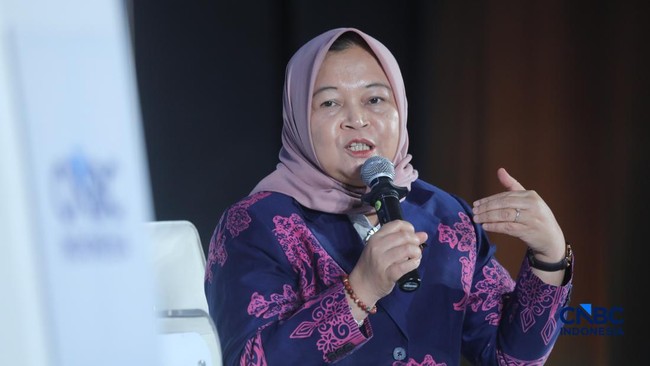
Jakarta, CNBC Indonesia - Deputy for Coordination of Food Affordability and Security at the Coordinating Ministry for Food, Nani Hendiarti, stated that the quality of food safety in the Free Nutritious Meals (MBG) programme needs to be improved, including guarantees of food security.
In this regard, she continued, the MBG programme refers to Presidential Regulation (Perpres) No. 115/2025 on the Governance of the Free Nutritious Meals Programme.
“And of course, this includes the nutritional quality of the food. So that is included in the governance,” she said at the Food Summit 2026 CNBC Indonesia in Jakarta on Monday (27/4/2026).
“Actually, the implementation of MBG is divided into two parts. One part is the implementation carried out by the National Food Agency (BGN). The other, larger part is the support for implementation by other Ministries/Institutions (K/L),” she added.
According to Nani, there are around 18 Ministries/Institutions now involved in the MBG programme process.
“So we have a National Coordination Team (TKN) where the Coordinating Minister for Food serves as the chair of the national coordination team to oversee the programme so that it is implemented according to the governance. The governance certainly aims to make everything better,” she said.
“And specifically for food security, here we see it becoming even more important or urgent, after we saw that starting around August, September, October last year, there was a sharp increase in extraordinary events (KLB) of food poisoning. Then, the coordination team immediately moved,” she explained.
Therefore, she continued, by including food guarantees in the governance, it was then agreed that SPPG or kitchens must or are required to have Hygiene and Sanitation Fitness Certification (SLHS).
“Which previously was not mandatory. So the supervision must be integrated within MBG. We can consider it layered,” said Nani.
“In the implementation process, there are already 8 technical guidelines (juknis) that we have created to oversee and ensure food security. From how to prepare raw materials to SOP if there is a KLB. All of that clearly has guidelines,” she added.
This SOP, she added, will serve as a reference for implementation in the field.
“In this context, it is in SPPG and also to the distribution of beneficiaries. That is the first,” said Nani.
“Secondly, it is also integrated, coordinated by the Coordinating Ministry for Food, not only in the kitchen but also at the beneficiaries. There are two large groups,” she explained.
The first group, she clarified, is students and now also educators. The second group is pregnant women, breastfeeding mothers, and toddlers.
“And here we also monitor and up to how to consolidate if there are findings and coordination to local governments. This is the most important, local governments know and are directly coordinated by the coordination team,” said Nani.
“So it’s not just central, but central and regional. Perhaps we want to illustrate how this can work well. For example, we implement requiring SLHS as part of the obligation,” she said.
Impacts of Losses Due to Unsafe Food
Meanwhile, Nani explained, the urgency of food security in supporting sustainable economic development in Indonesia includes preventing unsafe food materials from being consumed by the public, national food security supervision, and the prevalence of food poisoning incidents in Indonesia.
“The impact of food poisoning in Indonesia causes losses of Rp2.4-3.1 trillion per year,” said Nani.
The data only covers the costs of treating KLB food poisoning. The data comes from the 2022 Health Research and Development Study by the Ministry of Health.
It doesn’t stop there, she continued; food poisoning also triggers other subsequent losses.
Nani quoted WHO data recording losses due to unsafe food.
“The impact is quite significant. On average, 1.6 million people fall ill per year. So, it needs to be reminded. Many types of diseases, children under 5 years are affected, suffering from foodborne diseases,” said Nani.
According to WHO, she continued, health impacts from unsafe food trigger 200 types of diseases, from diarrhoea to cancer.
And it triggers deaths for at least 340 children up to 5 years old due to foodborne diseases.