
Important Announcement Due at Start of September, Brace for a Surprise!
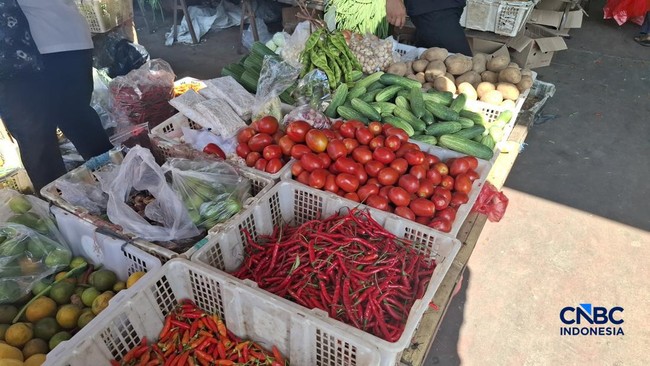
Indonesia’s Consumer Price Index (CPI) is expected to rise or experience inflation in August 2026. The CPI increase is mainly driven by rising prices of several food commodities, gold, and education costs.
However, lower airfares and non-subsidised fuel prices are expected to restrain inflationary pressure.
Statistics Indonesia (BPS) will announce the August 2026 CPI data on Tuesday (1/9/2026).
The market consensus compiled by CNBC Indonesia from 12 institutions expects the CPI to rise month-to-month (mtm) or experience inflation of 0.18%.
Meanwhile, the CPI year-on-year (yoy) is expected to rise or experience inflation of 3.13%.
For reference, in the previous inflation release for the July 2026 period, deflation of 0.14% (mtm) was recorded, while annually there was inflation of 2.88% (yoy).
Thus, the CPI is expected to turn upward on a monthly basis after declining in July. Annual inflation is also projected to increase by 0.25 percentage points compared to the previous month.
If the projection is realised, August annual inflation will remain within Bank Indonesia’s target range of 2.5% plus or minus 1%.
Bank Mandiri’s Office of Chief Economist team expects the rise in inflation to be mainly driven by a reversal in volatile food prices. The group is expected to rise again after falling quite deeply in July.
The increase mainly occurred in chicken meat and bird’s eye chilli prices. Food price pressure also risks persisting due to production disruptions triggered by El Nino and the dry season.
“Food price pressure may continue amid production disruptions due to El Nino and the dry season, although lower garlic and shallot prices provide some offset,” wrote Bank Mandiri’s Office of Chief Economist team.
Bank Maybank Indonesia economist Juniman also assessed that rising food prices were one of the drivers of inflation during August.
“August inflation was mainly driven by rising food prices such as rice, cooking oil, beef, chicken meat, eggs, red chillies, and soybeans,” Juniman told CNBC Indonesia.
The price movements are visible in data from the National Strategic Food Price Information Centre (PIHPSN). The average price of bird’s eye chillies rose by 10.60% in August to Rp61,855 per kilogram. Chicken meat prices also experienced the same trend, rising 8.22% to Rp41,348 per kilogram.
Meanwhile, the average price of red chillies rose 4.60%, and rice prices increased 0.54% to Rp16,270 per kilogram.
On the other hand, lower onion prices helped to dampen food pressure. The average price of shallots fell the most, by 11.12%, from Rp44,000 to Rp39,108 per kilogram.
Garlic prices also fell 6.82%, from Rp43,411 to Rp40,450 per kilogram.
Inflationary pressure in August did not only come from food. Bank Mandiri assessed that core inflation also has the potential to increase along with rising gold prices.
Gold prices are estimated to rise by around 7.2% month-to-month. The increase could lift jewellery gold prices, which are one component in the CPI calculation.
Pressure on core inflation also came from education.
“Education costs increased in line with the start of the new academic year for academies and universities,” said Juniman.
In addition, the weakening rupiah also increases the risk of imported inflation. The impact is visible in rising prices of goods with high import content, such as electronics, cars, and motorcycles.
Amid rising food prices and several core components, the group of government-administered prices is actually expected to restrain the pace of inflation.
Bank Mandiri assessed that the decline mainly came from air transport fares. Airline ticket prices are estimated to fall by around 2.7% month-to-month following the government’s policy of reducing the maximum limit for fuel surcharges on domestic flights in August.
Besides airline tickets, lower non-subsidised fuel prices also provide room for easing price pressure on transportation.
For reference, all fuel distribution business entities have adjusted non-subsidised product prices starting 1 August 2026. The adjustments were made by Pertamina, Shell Indonesia, BP-AKR, Vivo Energy Indonesia, and Mobil Indostation.
For example, at Pertamina petrol stations in the Jabodetabek area, the price of Pertamax Turbo fell from Rp19,300 to Rp18,300 per litre. The price of Pertamax Green 95 also fell from Rp17,000 to Rp16,600 per litre.
The decline also occurred for Pertamax RON 92, from Rp16,250 to Rp15,950 per litre. The adjustment is in line with weakening crude oil prices on the international market.