
Implementation of Junior Secondary Academic Ability Test Proceeds Smoothly, Government Ensures More Measurable Academic Evaluation
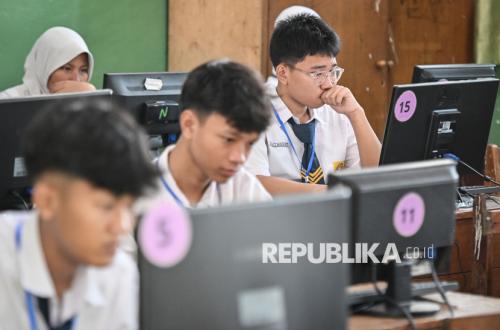
REPUBLIKA.CO.ID, JAKARTA — The implementation of the Academic Ability Test (TKA) for junior secondary level in several regions has proceeded smoothly in accordance with procedures. The government assures that this test serves as an instrument for evaluating students’ abilities in a more measurable manner, without causing excessive pressure on participants.
Vice Minister of Basic and Secondary Education Atip Latipulhayat directly inspected the TKA implementation in Bandung City, West Java. He stated that the examination process ran orderly and in line with the mechanisms, with no violations found.
“Based on field observations, the implementation has gone well. Hopefully, it remains consistent going forward,” he said.
According to Atip, the TKA is not intended to determine graduation but rather as a means to measure individual students’ academic abilities. Therefore, he advised participants not to feel anxious and to prepare themselves optimally.
In other regions, readiness for implementation was also demonstrated by the Bandarlampung City Government. The Education Office ensured that all junior secondary schools were prepared in terms of facilities and infrastructure, from computer devices and internet networks to operator personnel.
The TKA implementation in Bandarlampung was participated in by around 15,000 students and will proceed in stages until mid-April 2026. The test is conducted in several sessions with main subjects such as Mathematics and Indonesian Language.
Local governments have also anticipated potential technical issues, including ensuring internet network stability in every school and increasing bandwidth capacity to support the smooth running of the computer-based examination.
Meanwhile, the Ministry of Basic and Secondary Education emphasised that the 75-minute duration for completing the TKA has undergone trials and is deemed sufficient to finish all questions.
Head of the Basic and Secondary Education Policy Agency, Toni Toharudin, mentioned that the question composition has been adjusted to the difficulty level, making the allocated time proportional for students.
This composition consists of knowledge questions, concept application, and reasoning. With this design, participants are expected to demonstrate comprehensive thinking abilities, not just memorisation.