
IMF Urges Government Not to Splurge on Spending with Recession Looming
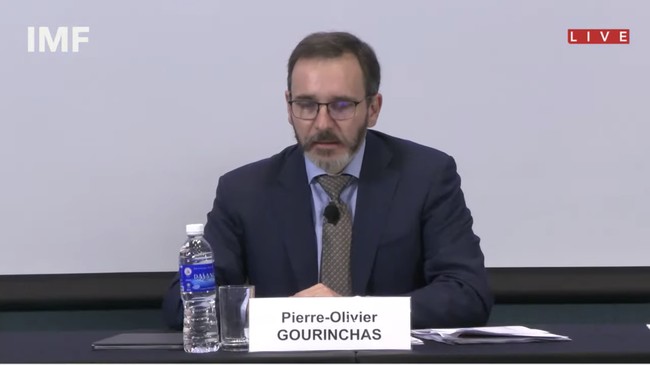
The International Monetary Fund (IMF) has cautioned the government against excessive spending amid uncertainties stemming from the Middle East conflict. This warning comes alongside risks of a recession should the war continue to rage in Iran and pressure oil prices. The IMF sees no clear solution to address this issue. “The closure of the Strait of Hormuz and serious damage to key energy facilities in the Middle East heighten the prospects of a major energy crisis if long-term solutions are not found soon,” said IMF Chief Economist Pierre-Olivier Gourinchas during a press conference at the IMF-World Bank Spring Meetings, quoted on Monday (20/4/2026). Oil and gas prices have risen sharply, as have prices for diesel, jet fuel, fertiliser, aluminium, and helium. According to him, the overall impact will depend on three channels. First, higher commodity prices represent a typical negative supply shock: raising prices and costs, disrupting supply chains, and eroding purchasing power. Second, this effect could be amplified as firms and workers seek to recoup losses, risking a wage-price spiral, especially where inflation expectations are not well anchored. “Third, financial conditions could tighten, with lower asset valuations, higher risk premiums, capital flight, dollar appreciation, which dampen demand,” he explained. The IMF’s baseline forecast assumes a short-lived conflict and a moderate 19% rise in energy prices in 2026. However, he believes some damage remains unavoidable. Global growth falls to 3.1% this year, down from the January forecast, while core inflation rises to 4.4%. “Our downside scenario assumes further disruptions, leading to higher energy prices and inflation expectations, as well as tighter financial conditions throughout the year. Growth falls to 2.5% this year and inflation rises to 5.4%.” Then, the IMF’s severe scenario assumes energy supply disruptions continue into next year, with greater macroeconomic instability. Global growth falls to 2% this year and next, while inflation exceeds 6%. Pierre-Olivier assesses that the risk of a global growth downturn is clearly very high in this scenario. Growth below 2% if the war continues and oil prices rise would constitute a major recession hitting the world. As a note, the world has only experienced four recessions since the 1980s. So, what should governments do? Pierre-Olivier reminds that with rising public debt trajectories, fiscal space is much narrower than before. Price caps, subsidies, and interventions are popular policies, but they distort prices and are often poorly designed, causing dependency and being ‘expensive’. “Most countries no longer have that luxury. Where support for the most vulnerable is needed, targeted and temporary measures should be implemented, consistent with medium-term plans to rebuild fiscal buffers and avoid demand stimulus where inflation is rising,” he said. In the worst-case scenario, monetary and fiscal policies must be ready to switch to supporting the economy and protecting the financial system, alongside appropriate financial and liquidity policies. However, he acknowledges that central banks will not be able to do much to influence energy prices that will drive up inflation. Markets will also price in rate hikes. In this situation, the IMF also urges central banks not to rush to raise interest rates as long as inflation expectations remain well anchored. “However, as long as inflation expectations remain well anchored, central banks can wait and see for now. But they must monitor risks and clearly communicate their readiness to act decisively to maintain price stability,” said Pierre-Olivier.