
IMF Urges BI and Fed Not to Rush Interest Rate Hikes This Year
The International Monetary Fund (IMF) assesses that central banks in various countries do not need to rush to raise benchmark interest rates in response to potential inflationary pressures stemming from the war between US President Donald Trump and Iran in the Middle East.
As is known, the conflict is disrupting one of the world’s main trade routes for energy commodities, namely the Strait of Hormuz. This disruption is causing high volatility in global crude oil prices, gas, and fertilisers.
Although various risk scenarios from the conflict would push global inflationary pressures above the normal 2-3% range, the IMF believes that central banks have many options to suppress price rise expectations in their respective countries.
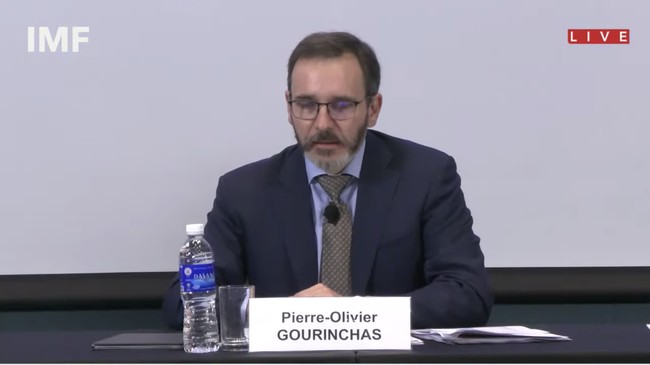
“I emphasise that central banks cannot do much about oil prices, but they can take steps to prevent the emergence of a wage-price spiral and the unanchoring of inflation expectations,” said IMF Economic Counsellor and Research Director Pierre-Olivier Gourinchas during the IMF Spring Meetings media briefing, quoted on Wednesday (15/4/2026).
“This means that central banks do not have to immediately implement aggressive tightening. Major central banks—whether the Federal Reserve, the European Central Bank, the Bank of Japan, or the Bank of England—do not always need to raise interest rates right away,” he stressed.
Rather than raising interest rates, he opined that central banks around the world could collaborate with governments to find ways to diversify energy sources and rely more on domestically produced energy, such as renewables.
This, according to Gourinchas, is one of the strong lessons from the stagflation conditions that disrupted global economic activity in the 1970s era. At that time, the world also faced issues with disrupted energy commodity supply chains, leading to high inflationary pressures amid a weakening economy.
Meanwhile, the risk of stagflation, according to Gourinchas, would worsen if the conflict disrupting the Strait of Hormuz continues into next year, with greater macroeconomic instability. In the worst-case scenario, global growth would fall to 2% this year and next, while inflation exceeds 6%.
The severe scenario is if the war continues to disrupt energy prices and leads to higher inflation expectations as well as tighter financial conditions throughout this year. Under those conditions, growth would drop to 2.5% this year and inflation would rise to 5.4%.
As for the moderate scenario based on IMF calculations, if the conflict resolves in the short term with a moderate 19% rise in energy prices in 2026, global growth would fall to 3.1% this year, down from the January forecast, and core inflation would rise to 4.4%.
“However, in our baseline scenario, this pressure is expected to ease next year, and by 2027 we will be back on the disinflation path that has been underway in recent years,” Gourinchas stated.
“However, if they (central banks) start seeing signs that inflation is strengthening, the emergence of a wage-price spiral, or household and business expectations of more permanent and persistent inflation, then they need to take action. This is one of the important lessons we learned from the 1970s decade and we must not forget it,” he emphasised.