
IMF Reveals Shocking Fact: The World Begins to "Punish" America
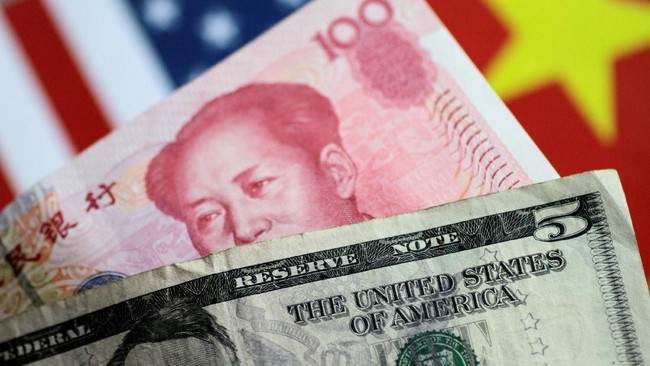
The US dollar’s share of global foreign exchange reserves continued to decline in the fourth quarter of 2025, as the yuan and other currencies gradually expanded their roles.
The latest data from the International Monetary Fund (IMF) in its Currency Composition of Official Foreign Exchange Reserves (COFER) report shows that the share of global reserves denominated in US dollars fell to 56.77% in Q4 2025, down from 56.93% in Q3 2025.
Over the course of 2025, the trend indicates a weakening role for the dollar in the composition of global reserves. In Q1 2025, the dollar’s portion was still around 57.79%, then it dropped sharply to 56.32% in Q2 2025, before fluctuating around 56.9% in the second half of the year and closing at 56.77%.
At this level, the dollar’s share is at its lowest point since the mid-1990s, signalling that while the greenback’s dominance remains significant, it is being steadily eroded.
US dollar-denominated foreign exchange reserves include various financial instruments held by central banks worldwide, from US government debt securities or US Treasury securities, US government agency debt, mortgage-backed securities (MBS), US corporate bonds, to other dollar-denominated assets.
In other words, the decline in the dollar’s share in global foreign exchange reserves does not equate to central banks dumping dollar cash en masse, but rather reflects changes in the composition of their reserve portfolios.
Meanwhile, total global foreign exchange reserves in the same period actually rose to US$13.14 trillion from US$13.03 trillion in the previous quarter.
The Dollar Is Not Being Dumped, But Its Share Is Continuously Eroded
A key point from the IMF data is that the decline in the dollar’s share is not caused by large-scale selling of dollar-denominated assets.
On the contrary, nominal ownership of dollar assets remains large and even increased in some periods, but the growth is far slower than the addition of assets in other currencies.
The IMF also emphasises that in Q4 2025, the influence of exchange rate valuations on changes in reserve composition was relatively small, so the decline in the dollar’s portion more accurately reflects the ongoing direction of diversification.
This situation has actually been evident in recent years.
The US Federal Reserve (The Fed) in its study The International Role of the U.S. Dollar - 2025 Edition notes that the dollar still accounts for about 58% of global official foreign exchange reserves in 2024, far above the euro, yen, pound sterling, and yuan.
However, The Fed also underlines that the decline in the dollar’s share from its peak is not primarily shifting to one main rival, but rather because global reserve managers are increasing exposure to various smaller currencies.
On the other hand, the euro remains the world’s second-largest reserve currency. The euro’s share in Q4 2025 was 20.25%, slightly down from 20.36% in Q3 2025.
Meanwhile, the Chinese yuan’s share rose slightly to 1.95% in Q4 2025 from 1.92% in the previous quarter, but overall it is still far from the level once hoped to be a main competitor to the dollar.
Although the yuan’s role in global foreign exchange reserves is still relatively small, China’s currency is increasingly entering international market discussions, particularly due to its potential in cross-border trade, energy transactions, and the emergence of the term “petroyuan”.
Attention to the yuan has strengthened again amid the war still shaking the Middle East and the strategic shipping route of the Strait of Hormuz.
Several market reports highlight that if energy trade access in the region becomes increasingly linked to the use of currencies other than the US dollar, then the dollar’s dominance in oil transactions could face new pressures. Nevertheless, this process is still very early and cannot yet be called a permanent change in the global trading system.
Non-Traditional Currencies Gain Greater Role
Non-traditional currencies are also playing an increasingly larger role in global foreign exchange reserves. This portion has actually become one of the most interesting data points from the IMF’s latest release.
In Q4 2025, the share of the group of other currencies outside those recorded separately in the COFER data rose to 6.13%, from 5.61% in Q3 2025.
The IMF notes that the share of this currency group has been continuously increasing since 2021 and is now more than double. This shows that global central banks are not only adding reserves in euros or yuan, but also beginning to spread their foreign exchange holdings to more currencies that were previously not very dominant in the global financial system.