
Illegal Cigarettes Given Ultimatum: Pay Excise Duty or Face Closure
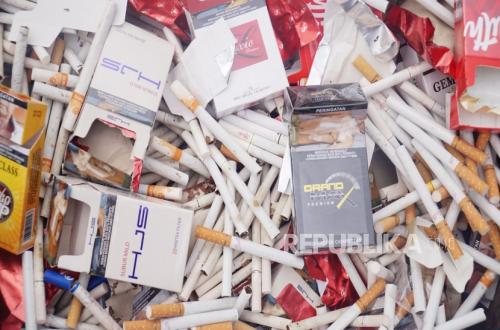
The government has assured that it will take firm action against the circulation of illegal cigarettes. Business actors are given a stark choice: enter the official system or face closure.
Finance Minister Purbaya Yudhi Sadewa emphasised that illegal cigarettes will not be legalised outright. The government is only providing space for actors to switch to the legal route by paying excise duties.
“They are not being legalised just like that. They must enter the system and pay excise duties. We are giving them an opportunity. If not, they will be closed,” Purbaya stated at the Attorney General’s Office complex in Jakarta last Friday.
The government is preparing an additional layer in the tobacco excise (CHT) structure as an entry path for illegal actors. This policy is targeted to begin operating no later than May 2026.
“We want it to be running by May at the latest, so that revenue comes to us and I can truly ban illegal cigarettes,” he said.
Through this scheme, illegal cigarette actors are still given the chance to enter the official market. However, the government assures that businesses operating outside the rules will be shut down.
“Later, we will give them the opportunity to operate in the legal market. If they don’t want to, we will close them,” Purbaya added.
For years, illegal cigarettes have been a source of state revenue leakage. Untaxed products are also sold more cheaply, pressuring legal business actors, especially small and medium enterprises.
The government hopes that adding the excise layer can create a transitional bridge to the official system. This step is also expected to foster fairer business competition.
Purbaya noted that the policy proposal has been finalised and will soon be discussed with the DPR. However, the potential additional state revenue will still be calculated after implementation.
“If it is really as large as claimed, its contribution would be enormous. But we will see how it goes. I don’t want to speculate before we observe for a month or two once it is running,” he said.
Director General of Economic and Fiscal Strategy at the Ministry of Finance, Febrio Kacaribu, stated that the policy is formulated with a legal approach. The government is also considering its impact on labour-intensive sectors.
According to him, legal space remains open for business actors as long as they fulfil excise obligations. This step is to maintain a balance between state revenue and industry sustainability.
As a note, the CHT tariff structure has been simplified from 19 layers in 2009 to 8 layers in 2022. The latest provisions are regulated in Minister of Finance Regulation Number 97 of 2024.