
IKN Toll Road Targeted for Full Completion and Operation by 2027
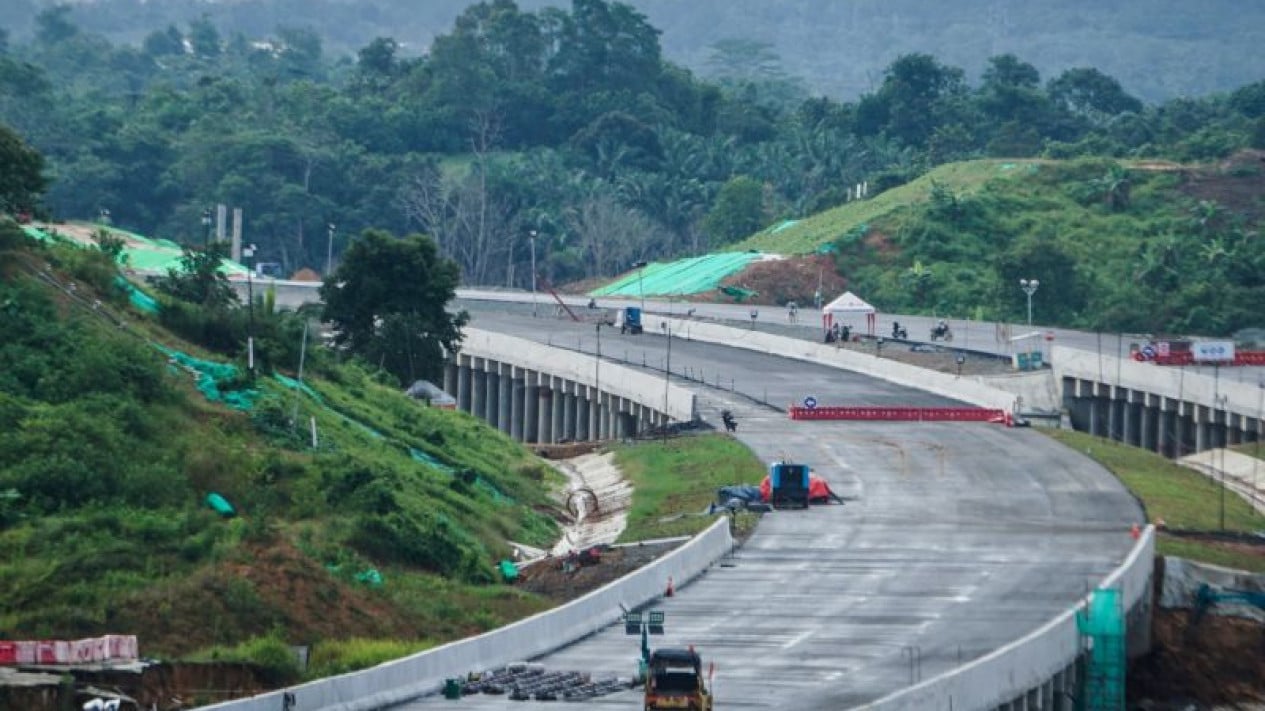
The government continues to push for the acceleration of infrastructure development in the Nusantara Capital (IKN), including the toll road network that serves as the backbone of connectivity in the area. Although some sections have already been operationalised, full completion will still take time.
This was stated by the Minister of Public Works (PU), Dody Hanggodo. He assured that the construction of the toll road in the IKN area is targeted to be fully completed in 2027.
Currently, the government is focusing on completing the remaining work in stages according to the annual budget allocation. “Functional openings have been done several times. But fully, all plans from the Directorate General of Highways are targeted for 2027,” Dody said when met by the media at the Rest Area KM 379 Batang, Semarang, Central Java, on Saturday, 28 March 2026.
He explained that the work on projects in IKN is not entirely carried out directly by the authority, but rather more in the form of support for units handling follow-up projects. The government is also prioritising the provision of basic infrastructure, such as clean water and water treatment systems, which are considered the most urgent needs in the area.
“But there is nothing major being worked on directly by the authority. We support the units and complete what is still remaining from before,” he said.
Regarding the management of the toll road after construction is completed, Dody mentioned that the scheme used will most likely follow the pattern that has been running so far, namely managed by Toll Road Business Entities (BUJT). This aligns with the practice of toll road management in various regions of Indonesia involving private parties through cooperation schemes.
“Usually by BUJT. That’s how it has been so far,” he said.
In addition to discussing the progress of the IKN toll road, Dody also touched on the importance of applying technology in the transportation system, including the discourse on implementing a multi-lane free flow (MLFF) system. However, he emphasised that the implementation of such technology must still go through a series of trials before it can be applied widely.
“That can only be answered from the trial results. If it hasn’t been tested, we can’t talk,” he asserted.
According to him, although similar technology has been applied in several countries, Indonesia’s conditions have their own challenges, from weather factors to traffic complexity. Therefore, the government does not want to rush into decisions without ensuring the system’s overall readiness.