
IKAHI Ensures Gender Equality in Judicial Institutions is Already in Place
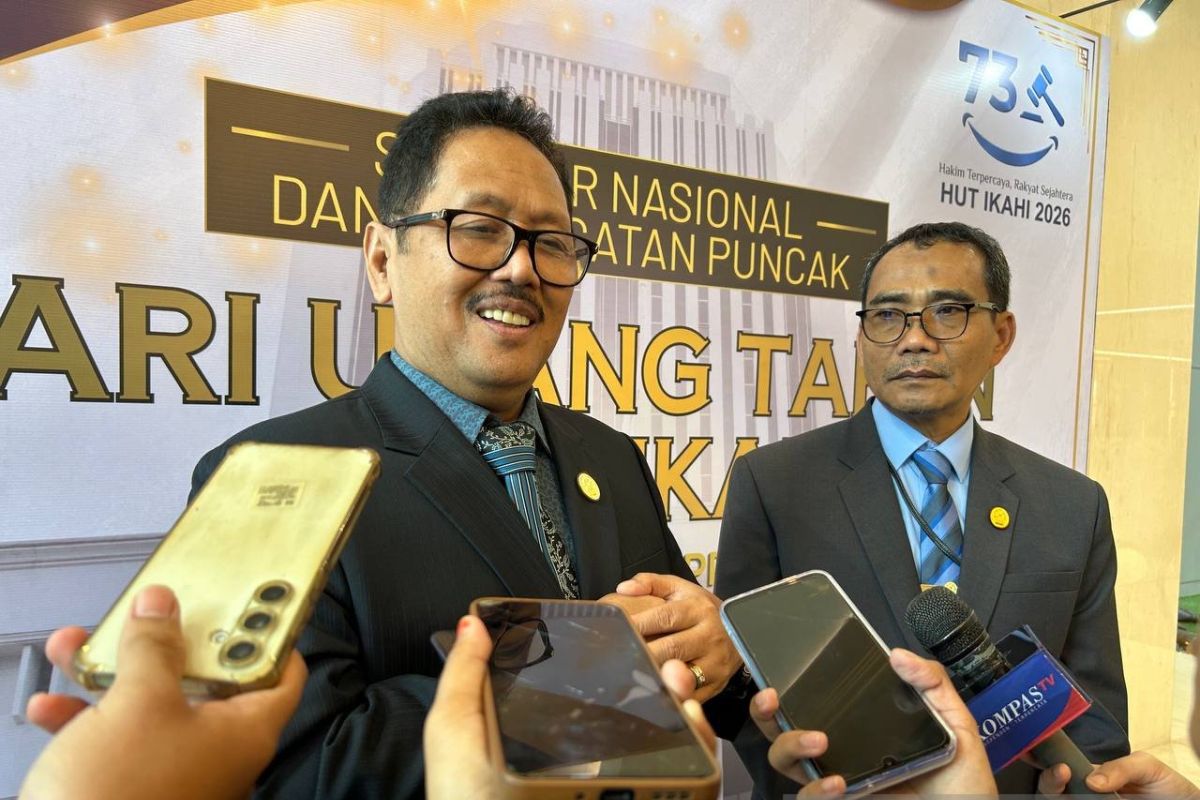
Jakarta (ANTARA) - Chairman of the Indonesian Judges Association (IKAHI) Prof. Yanto has assured that gender equality in judicial institutions has been in place since the era of Indonesia’s fourth President Abdurrahman Wahid, or Gus Dur.
“Gender equality no longer needs to be questioned. Currently, the head of the Central Jakarta Court is a woman, the head of the High Military Court is also a woman, and the chief clerk of the Supreme Court is now a woman,” Yanto stated in Jakarta on Tuesday.
IKAHI held a national seminar to mark the organisation’s 73rd anniversary with the theme “Trusted Judges, Prosperous People”.
The seminar, which took place concurrently with Kartini Day commemorations, featured the sub-theme “Sentencing in the 2023 Criminal Code and 2025 Criminal Procedure Code: Implementation of Non-Imprisonment Penalties and Actions in Indonesia’s Criminal Justice System”.
In reflecting on Kartini Day, Yanto noted that female judges within the Supreme Court and court environments already hold important positions, similar to those held by many male judges.
“So, that has been the case since the time of President Abdurrahman Wahid. At that time, the Deputy Chief Justice of the Supreme Court was Mariana Sutadi, the Head of the Research and Development and Training Agency of the Supreme Court was Retno Wulandari, and the Director General of Badilmiltun was Bu Lulik,” he explained.
Although in terms of percentage, the number of male judges still dominates, many female judges are trusted to hold important positions, such as court chairmanships and chief clerk roles.
In terms of quantity, he said, male judges still dominate, including in the selection of Supreme Court justices where there are more men than women.
“If expressed as a percentage, it has not yet reached 50 per cent because the majority of judges are male, but in terms of holding positions, many female judges are trusted to lead. So, there are almost no restrictions now,” said Yanto, who is also the spokesperson for the Supreme Court.
The Chairman of the Supreme Court’s Supervisory Chamber added that from the hundreds of applicants for Supreme Court justices and ad hoc judges, the majority are male, while women account for less than a quarter of the total applicants.
“This means that among the applicants, whether they are accepted or not, there is no longer any gender difference. It is equal; female judges hold positions in central courts that serve as international courts, with jurisdictions broader than those of district and high courts,” he said.