
IHSG weakens following Asian market decline amid global oil price surge
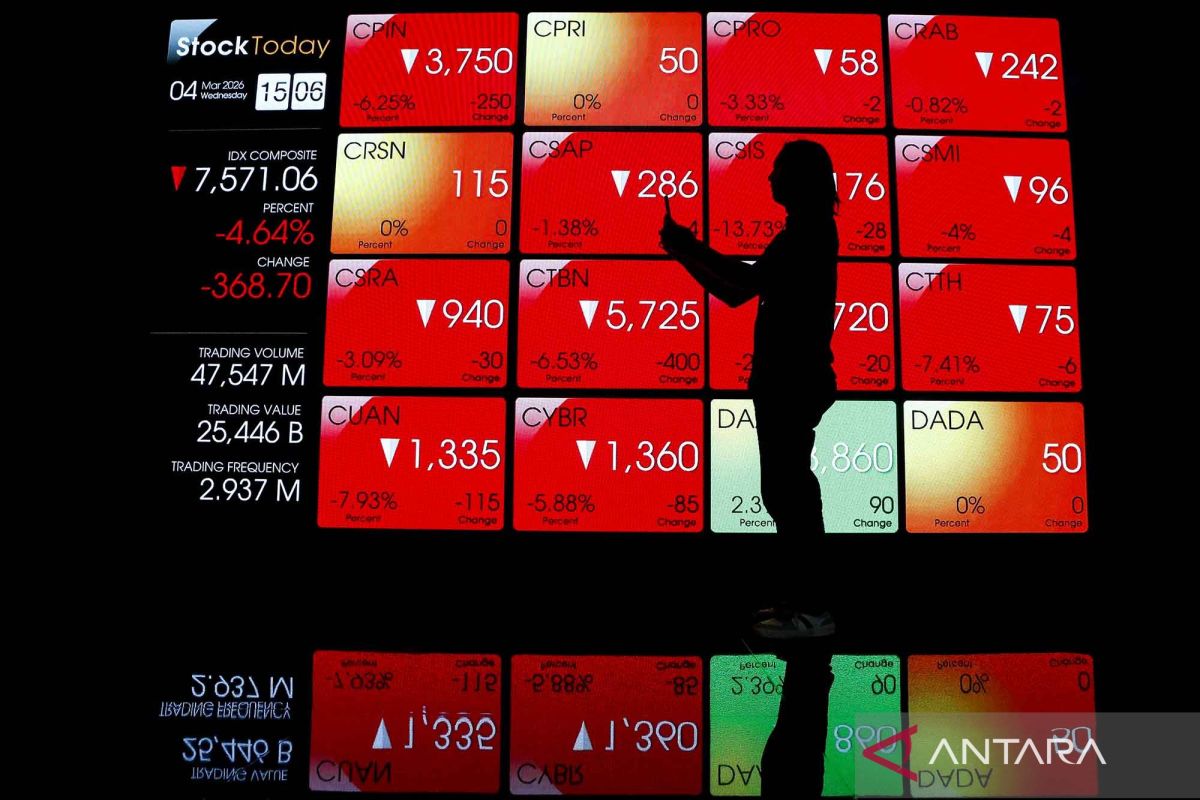
Jakarta — Indonesia’s Composite Stock Index (IHSG) on the Indonesia Stock Exchange (IDX) declined on Monday, following weakness across Asian equity markets triggered by a sharp surge in global oil prices.
The IHSG opened weaker by 211.38 points, or 2.79 per cent, at 7,374.31. Meanwhile, the blue-chip LQ45 Index fell 22.31 points, or 2.87 per cent, to 753.74.
Kiwoom Research cautioned investors that volatility would remain elevated throughout the week, with further consolidation risks towards 7,335. Head of Research at Kiwoom Securities Indonesia, Liza Camelia Suryanata, recommended adopting a “wait and see” approach whilst monitoring global sentiment.
Escalating conflict between the United States, Israel, and Iran across multiple regions has heightened concerns over disruptions to global energy supplies. Investors shifted towards safe-haven assets and liquidity, strengthening the US dollar whilst equities and risk assets faced pressure.
Uncertainty intensified after Iran appointed Mojtaba Khamenei, son of deceased Supreme Leader Ayatollah Ali Khamenei, as the new Supreme Leader. The appointment of a figure known to be close to hardline factions reinforced perceptions that Iran is unlikely to soften its stance imminently, thereby increasing risks of geopolitical escalation in the Middle East.
Oil prices surged sharply due to conflict escalation and shipping disruptions in the Strait of Hormuz. At 07:50 WIB on Monday, WTI Crude Oil prices had climbed 20.81 per cent to $109.82 per barrel, whilst Brent Oil had risen 18.17 per cent to $109.53 per barrel.
Rising energy prices increase risks of global inflation and could dampen economic growth through higher fuel and production costs, Liza noted. Several Middle Eastern energy producers have begun reducing output owing to supply chain disruptions.
Meanwhile, US-China trade relations remain fragile ahead of a scheduled meeting between US President Donald Trump and Chinese President Xi Jinping in late March 2026, expected to focus on maintaining economic stability rather than implementing significant resets in business and investment relations.
The US seeks to ensure China honours its trade agreement commitments, including purchases of US agricultural products, Boeing aircraft, and rare earth supplies. One potential agreement under discussion involves China’s purchase of approximately 500 narrow-body Boeing aircraft.
This week, market participants will focus on two primary factors: developments in Middle East conflict and US inflation data. Attention will centre on the release of the US Consumer Price Index (CPI) for February 2026. Higher-than-expected inflation could reinforce concerns that rising energy prices will delay the Federal Reserve’s interest rate-cutting cycle, with the probability of a 25 basis-point cut in June 2026 currently estimated at approximately 45 per cent.
Domestically, the government is modelling the impact of oil price surges on fiscal finances. Finance Minister Purbaya Yudhi Sadewa stated that should average oil prices reach $92 per barrel, the state budget deficit could widen to 3.6-3.7 per cent of gross domestic product without adjustment measures. The government is currently maintaining the deficit below the 3 per cent GDP threshold in line with fiscal discipline guidelines.
Geopolitically, President Prabowo Subianto stated Indonesia would withdraw from the “Board of Peace” initiative proposed by US President Trump if it fails to benefit Palestine or serve Indonesian national interests. The government has also postponed further discussions on forming a UN-backed Gaza stabilisation force until the regional conflict situation stabilises.
On Friday (6 March) of last week, European bourses declined uniformly, including the Euro Stoxx 50 falling 1.09 per cent, the UK FTSE 100 declining 1.24 per cent, the German DAX sliding 0.94 per cent, and the French CAC dropping 0.65 per cent.
US Wall Street indices also fell uniformly on Friday (6 March), with the Dow Jones Industrial Average declining 0.95 per cent to 47,501.55, the S&P 500 weakening 1.33 per cent to 6,740.02, and the Nasdaq Composite falling 1.59 per cent to 22,387.68.
Asian regional exchanges on Monday morning included Japan’s Nikkei falling 4,185.60 points, or 7.53 per cent, to 51,435.00; Shanghai’s index declining 57.98 points, or 1.41 per cent, to 4,066.70; Hong Kong’s Hang Seng dropping 797.78 points, or 3.10 per cent, to 24,959.26; and Singapore’s Strait Times falling 148.93 points, or 3.07 per cent, to 4,699.68.