
IHSG Under Pressure Amid Global Conflicts, Analysts Say Oil Prices Pose New Risk
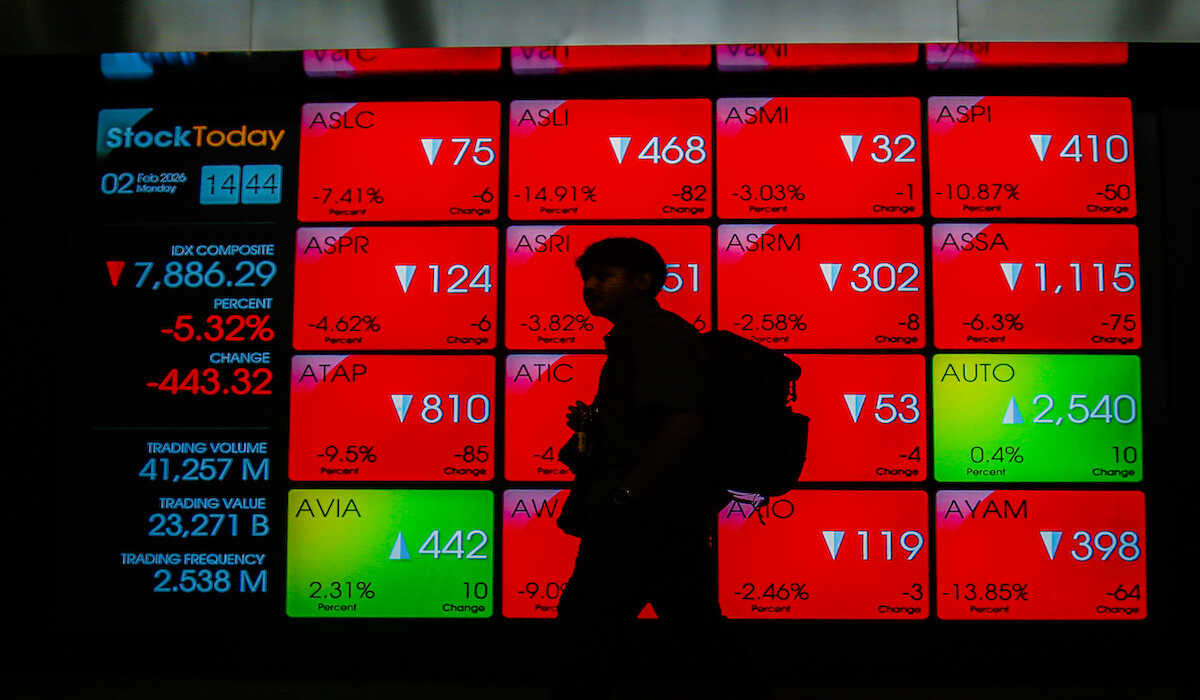
The Jakarta Composite Index (IHSG) fell sharply after briefly piercing the 7,500 level and is now trading below 8,000. The weakness is seen as the result of the cumulative pressures from both global and domestic fronts acting simultaneously.
Market analyst and founder of Republik Investor, Hendra Wardanal, explained that externally, the escalation of the conflict between the United States and Iran has sparked a rise in global oil prices and heightened uncertainty in global financial markets. Brent crude has breached $80 per barrel, a concern for oil-importing countries like Indonesia.
As a net oil importer, every rise in oil prices not only fuels inflation but also potentially widens the subsidy burden and adds pressure on the state budget, he told Media Indonesia on Wednesday, 4 February.
He said the rising fiscal risk has led market participants to take defensive positions. Negative market sentiment intensified after Fitch Ratings downgraded Indonesia’s outlook from stable to negative, although the credit rating remained at BBB investment grade.
Hendra said the change in outlook is not a rating downgrade per se, but the market read it as a signal of growing economic risk ahead, particularly regarding fiscal resilience and policy stability.
“Amid a global environment already saturated with geopolitical tensions and rising energy prices, this outlook change becomes added sentiment that accelerates selling, especially from foreign investors who are sensitive to macro risk,” he said.
In addition to external factors, Hendra noted that the IHSG correction was also influenced by technical market factors. After a long rally since the start of the year, some investors took profits.
At the same time, the rupiah’s weakness due to short-term capital outflows and concerns about rising energy inflation added to the pressure.
He explained that the situation could limit scope for rate relaxation and intensify market pressure in the short term.
Going forward, up to the end of March, IHSG movements are expected to be heavily influenced by two main factors: oil prices and rupiah stability. As long as Brent remains below $90 per barrel, market pressure is projected to be limited to short-term volatility.
However, if oil prices approach $100 per barrel and there are distribution disruptions in the Strait of Hormuz, markets could enter a deeper risk-off phase.
Technically, the 7,500-7,600 zone is seen as an important psychological support for the IHSG. If geopolitical tensions ease and the rupiah stabilises, the index could rebound gradually to around 7,900-8,100 by the end of March.
Conversely, if the conflict escalates and fiscal pressures rise, the IHSG could test the 7,400 level again.
Nevertheless, analysts say the current conditions reflect a consolidation phase with high volatility rather than a long-term trend change, as long as domestic economic fundamentals remain intact.
Fitch highlighted that the government’s 8% economic growth target for 2029 remains challenging without more significant structural reforms.
Fitch Ratings Indonesia has assigned the Long-Term National Rating ‘AAA (idn)’ for KB Bank Syariah (KBBS) and the National Short-Term Rating ‘F1+(idn)’. The US$700 million loan facility (or Rp10.7 trillion) will be used to refinance maturing syndicated loans.
The Jakarta Composite Index (IHSG) of the Indonesia Stock Exchange (BEI) on Thursday, 3 August 2023, was poised to weaken amid global sentiment. A downgrading of the United States’ debt rating by Fitch Ratings could signal risk-off among investors in global financial markets, including in developing countries.
Energy and Mineral Resources Minister Bahlil Lahadalia has assured that subsidised Pertalite fuel prices will not rise.
Azis Subekti, a member of the Indonesian House of Representatives Commission II, warned of systemic risks to the Indonesian economy arising from the heats in the Middle East.
Tensions in the Middle East spurred a rise in global oil prices after three ships were attacked in the Strait of Hormuz.
The importance of Indonesia’s energy self-sufficiency to anticipate oil price spikes and global supply chain disruptions stemming from the US-Israel-Iran escalation is underlined.
Iran has increased oil exports to up to 3 million barrels per day at Kharg Island to anticipate threats of attacks by Donald Trump. See the impact of Iran-US tensions.