
IHSG Second Session Closes Weaker at 0.37%, Falling to 7,362 Level
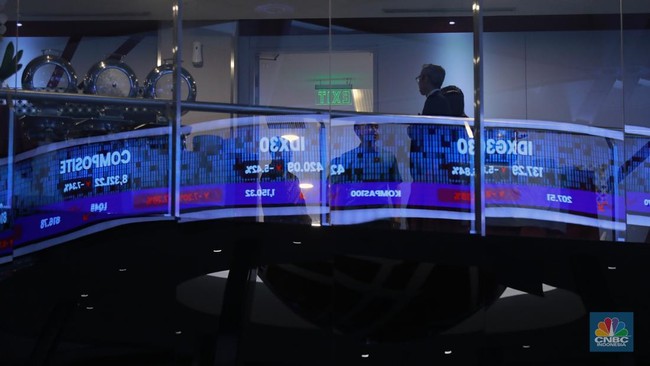
Jakarta — Indonesia’s composite stock index (IHSG) retreated 0.37% or fell 27.28 points to 7,362.12 at the close of the second trading session on Thursday, 12 March 2026.
A total of 211 stocks advanced whilst 461 declined, with 149 unchanged. Transaction value reached Rp 13.38 trillion across 26.81 billion shares in 1.61 million trades. Market capitalisation fell to Rp 13.15 trillion.
The majority of trading sectors weakened, with the steepest declines recorded in the infrastructure, property and non-primary consumer sectors. Only the technology and financial sectors strengthened today.
Large-cap stocks drove IHSG performance, with stocks including DCII, BBCA, BMRI, BYAN and SMMA providing support. The heaviest drags on the index were declines in BREN, DSSA, BRMS, VKTR and MORA.
Market participants today faced several crucial macroeconomic indicators and fundamental sentiments, both domestic and international. Market movements are expected to focus on the stability of US inflation releases, the resilience of Indonesia’s state budget in facing geopolitical escalation, and the strategic transition in the leadership of Indonesia’s Financial Services Authority (OJK).
On the previous day, Commission XI of Indonesia’s House of Representatives approved five candidates for the OJK Board of Commissioners. This decision followed a fit and proper test conducted on Wednesday, 11 March 2026. Today, the House of Representatives plenary session approved these five names for OJK leadership positions.
The approved names are Friderica Widyasari Dewi as Chair, Hernawan Bekti Sasongko as Vice Chair, Hasan Fawzi as Executive Head of Capital Markets Supervision, Adi Budiarso as Executive Head of Innovation, Technology and Crypto, and Dicky Kartikoyono as Executive Head of Consumer Education and Protection.
These multidimensional factors will serve as primary catalysts driving the capital market, debt market, foreign exchange rates and the direction of strategic portfolio decisions today.
Escalating conflict between Iran and US-Israeli coalition proxies in the Middle East has prompted Gulf states to adopt defensive positions. Gulf capitals have stated they will not facilitate military operations targeting Iran and are attempting to prevent their sovereign territories from being drawn into open war.
Security analysts assess that these nations are proceeding cautiously, as direct conflict escalation threatens their vital infrastructure, economies and social order.
Iran has stated the world should prepare for crude oil prices reaching US$200 per barrel following its forces’ attacks on commercial vessels on Wednesday. Simultaneously, the International Energy Agency (IEA) has recommended massive releases of strategic oil reserves to dampen one of the worst oil price shocks since the 1970s.
Meanwhile, from the regional Asia-Pacific area, Australia’s S&P/ASX 200 Index fell 1.56%. Japan’s Nikkei 225 Index plummeted 1.6%, whilst the Topix lost 1.34%. South Korea’s Kospi Index declined 0.75%.
Hong Kong’s Hang Seng index futures stood at 25,756, compared with the index’s last close of 25,898.76.
Overnight in the US, the Dow Jones Industrial Average declined as investors continued monitoring US-Iran conflict developments and crude oil prices.
The 30-stock index lost 289.24 points, or 0.61%, to close at 47,417.27. The S&P 500 Index slipped marginally 0.08% to 6,775.80, whilst the Nasdaq Composite rose slightly 0.08% to 22,716.13.
West Texas Intermediate crude oil prices rose more than 7% to US$93.8 per barrel on Wednesday. Brent crude rose nearly 8% to US$99.1 per barrel.