
IHSG Second Session Closes Down 3.27% to Level 7,337
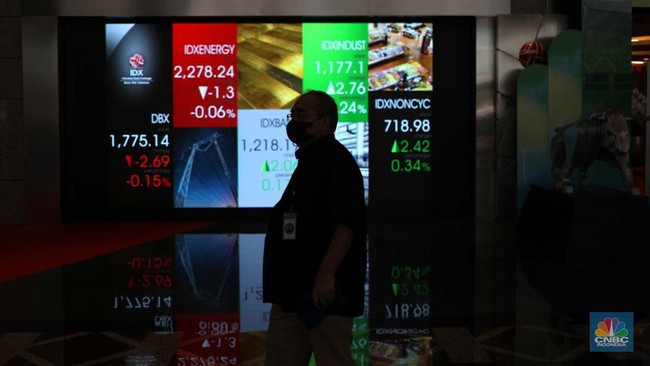
Jakarta – Indonesia’s Composite Index (IHSG) collapsed during trading on Monday, 9 March 2026. The IHSG briefly touched a low of minus 5.2% at level 7,156 but trimmed losses to minus 3.27%, declining 248 points to 7,337.37.
A total of 708 stocks declined, 68 advanced, and 41 remained unchanged, indicating heavy selling activity in the domestic equity market. Transaction value reached Rp 23.77 trillion, involving 46.64 billion shares across 1,624,710 million transactions.
All trading sectors weakened, with the infrastructure and industrial sectors recording the deepest corrections. Blue-chip stocks with large market capitalisation emerged as the main weights on IHSG performance today. Shares in BBRI, BYAN, BREN, AMMN, and BMRI were the primary drags on IHSG performance.
Over the past week, the IHSG has plunged nearly 8% in just one week, marking the worst decline surpassing the MSCI crash of late January. Three factors are driving the sharp decline in Indonesia’s share market.
In recent times, the IHSG has been influenced not only by domestic factors but also by external pressures and shifts in global investor perception of Indonesia as an investment destination.
Escalating geopolitical tensions, particularly in the Middle East, have prompted global investors to adopt a more defensive stance. Under such uncertainty, financial markets typically experience a shift in sentiment towards risk-off positioning, whereby investors reduce exposure to assets deemed riskier.
Emerging market nations, including Indonesia, often become the hardest hit as foreign capital inflows that previously entered can rapidly reverse direction.
This situation triggers a phenomenon commonly referred to as geopolitical contagion, whereby the impact of conflicts or tensions in one region spreads to global financial markets. International investors tend to redirect funds to instruments considered safer, such as advanced economy government bonds or US dollar-based assets.
Consequently, emerging market stock markets face pressure from capital outflows. For Indonesia, this condition can trigger volatility in the equity market whilst constraining the potential for IHSG appreciation in the near to medium term.
Second, there is growing concern regarding Indonesia’s position within global share indices. Investor attention is also focused on the possibility of Indonesia’s classification changing within the global index compiled by Morgan Stanley Capital Index (MSCI).
Currently, Indonesia’s weighting in the MSCI Emerging Markets Index continues to experience a declining trend and has approached approximately 1%. This weight reduction reflects the diminishing share of Indonesia’s equity market within global portfolios that track this index.
A risk increasingly discussed among market participants is the potential for Indonesia to experience a downgrade in status from emerging market to frontier market classification.
Although this scenario may not occur imminently, discussion of such a possibility is sufficient to influence investor sentiment. Many global investment funds, particularly passive funds and ETFs, automatically adjust their portfolios based on MSCI index composition.
Should a country experience a classification change, the capital flows tracking that index would likewise shift. In an extreme scenario, such a status change could trigger significant foreign capital outflows from the domestic equity market.
Third, there is heightened focus on country credit risk. Beyond external pressures and market classification concerns, investors are closely monitoring developments on the macroeconomic fundamentals front, particularly regarding perception of government debt risk.
Several international rating agencies including Fitch Ratings, Moody’s Investors Service, and S&P Global Ratings have issued cautionary signals through changed outlooks on Indonesia becoming more negative.
These outlook changes do not necessarily mean credit rating downgrades will occur imminently.
However, such signals indicate that rating agencies are beginning to perceive risks warranting caution, particularly concerning fiscal conditions, government debt dynamics, and potential pressure on budget deficits in the future.
For global investors, changing perception of country credit risk can have broad implications as it affects government and corporate sector funding costs. Should risk be deemed to have increased, investors typically demand higher yields to hold assets of that country.
In the equity market context, heightened concern regarding sovereign credit can equally suppress market sentiment.
Investors tend to become more selective in deploying capital in domestic assets, thus IHSG movements have the potential to become more limited and sensitive to various policy developments and global conditions.
Beyond the three reasons above, the intensifying Iran-Israel-United States conflict has driven global oil prices to record highs. This poses a significant risk of triggering substantial inflation across nearly all nations.
Additionally, the rupiah’s exchange rate against the US dollar has continued to weaken, even breaching the psychological level of Rp 17,000 per dollar. The absence of positive sentiment suggests that downward pressure on the IHSG is predicted to deepen going forward.