
IHSG Rebounds Sharply, but Market Activity Quiet
IHSG Rebounds Sharply, but Market Activity Quiet
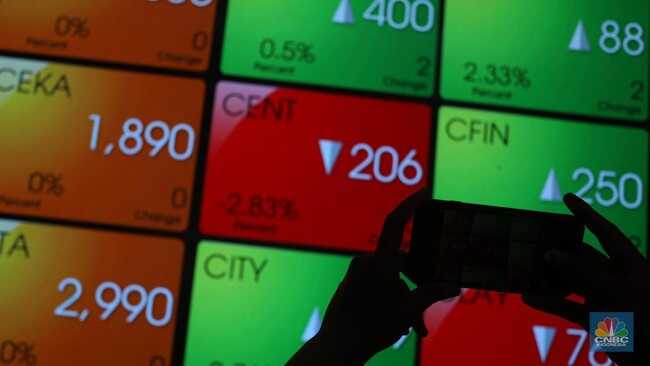
Jakarta, CNBC Indonesia — The Jakarta Composite Index (IHSG) closed higher by 133.48 points or 1.76% at 7,710.54 on Thursday (5 March 2026). A total of 625 shares rose, 134 fell and 199 were unchanged.
Today’s turnover was modest at Rp 17.43 trillion, compared with Rp 29.59 trillion on Wednesday.
Across the session, 31.17 billion shares changed hands in 2.01 million trades, well below yesterday’s record.
According to Refinitiv, the IHSG was lifted by banking stocks. Bank Central Asia (BBCA) contributed 21.32 index points, followed by Bank Mandiri (BMRI) with 11.26 points and Bank Rakyat Indonesia (BBRI) with 9.43 points.
In tandem, the financial sector rose by 2.34%.
Elsewhere, regional markets also rose, led by the Kospi in South Korea, which closed up 9.63% and briefly touched a 12% gain. Large-cap shares such as SK Hynix and Samsung rose by more than 10% and 11% respectively.
The previous day, Kospi had closed down by 12%. In response, South Korean President Yoon Suk Yeol on Thursday urged the government to promptly launch a stimulus package worth 100 trillion won (about US$68 billion) and Rp 1,149.06 trillion to stabilise the country’s financial markets. The plan comes amid rising Middle East tensions seen as a risk to market confidence.
According to The Korean Times, in his opening remarks at a Cabinet meeting on Thursday, President Lee Jae-myung warned that the worsening crisis in the Middle East exacerbates the global economic and security environment. He highlighted growing uncertainty in financial markets, while energy supply volatility and trade conditions could create broader difficulties across the economy.
Meanwhile, Asia-Pacific markets also slowly recovered. The Nikkei in Japan rose 1.9% after a prior decline of 3%. The STI in Singapore rose 0.53% and the Hang Seng in Hong Kong gained 0.28%.
In yesterday’s trade, beyond geopolitical tensions, domestic stock markets were also pressured by Fitch Ratings’ decision to cut Indonesia’s outlook from stable to negative. However, the long‑term foreign currency rating was left at BBB (investment grade). The move signals increased risk on the medium term horizon, even though Indonesia’s investment-grade status remains unchanged.
Fitch attributed the revision to rising policy uncertainty and concerns about the consistency and credibility of the policy mix, especially amid centralised decision-making.
(mkh/mkh)