
IHSG poised to weaken amid profit-taking ahead of weekend
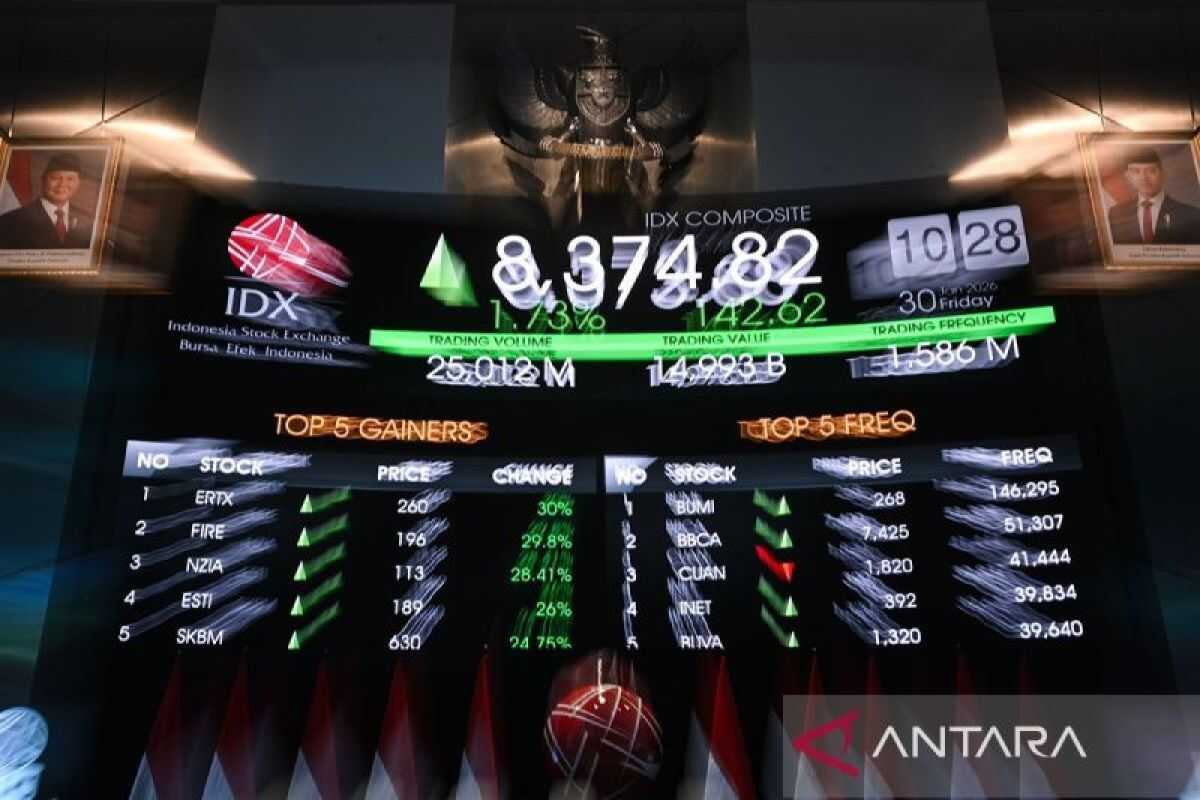
Jakarta – Indonesia’s composite stock index (IHSG) at the Indonesia Stock Exchange (BEI) on Friday is poised to move lower amid profit-taking by market participants ahead of the weekend.
The IHSG opened weaker by 23.95 points or 0.29 per cent to 8,211.31. Meanwhile, the 45 leading shares group or LQ45 index fell 2.99 points or 0.36 per cent to 834.90.
“A combination of fiscal risks, sensitivity to rating headlines, and fund flows related to rebalancing make the domestic market more vulnerable to profit-taking compared to the region,” said Liza Camelia Suryanata, Head of Research at Kiwoom Securities Indonesia, in her analysis in Jakarta on Friday.
From the domestic front, Liza explained the domestic market remains pressured by a warning from S&P Global Ratings highlighting a rise in government debt interest burden that is “very likely” to have exceeded 15 per cent of state revenue, and increasing the risk of negative rating action.
Market concerns emerged alongside the January 2026 state budget deficit recorded at Rp54.6 trillion, which triggered investor caution despite the government successfully raising Rp50.8 trillion from issuing global bonds in euro and yuan offshore denominations, with a bid-to-cover of 3.4 times and yields of 4-5 per cent, reflecting solid demand.
Additionally, Liza continued, pressure was further exacerbated by technical factors from MSCI rebalancing effective after the close of 27 February 2026, with INDF shares exiting MSCI Global Standard and entering MSCI Small Cap, whilst ACES and CLEO shares exiting Small Cap.
The next MSCI review is scheduled to be announced on 12 May 2026 and becomes effective on 1 June 2026.
From abroad, global markets are moving amid a combination of sentiment uncertainty around artificial intelligence, shifts in interest rate expectations, geopolitical risks, and tariffs.
The AI narrative has resurfaced with markets questioning whether large capital expenditure in the AI sector can generate returns meeting expectations, whilst the standard for positive surprises for Nvidia is deemed very high after rising more than 1,400 per cent since October 2022.
From a monetary policy perspective, futures have fully priced in a 25 basis point rate cut by US central bank the Federal Reserve in September 2026.
With US core PCE inflation at 3 per cent, a monetary policy pause is considered reasonable, whilst incoming Federal Reserve Chairman Kevin Warsh is not necessarily expected to be dovish.
Meanwhile, uncertainty over trade policy also looms over markets, following the US Supreme Court’s change to the tariff legal framework. On the other hand, the US government continues pursuing potential new tariffs of up to 15 per cent through alternative legal channels.
At the same time, continued technical talks between the US and Iran are scheduled in Vienna, Austria, next week, with US President Donald Trump warning of consequences if there is no meaningful progress.
US stock markets on Wall Street were mostly weaker on Thursday (26 February 2026), including the S&P 500 index weakening 0.54 per cent to 6,908.86, the Nasdaq index weakening 1.16 per cent to 25,034.37, and the Dow Jones index rising 0.03 per cent to 49,499.20.
Regional Asian stock markets this morning included the Nikkei index weakening 226.39 points or 0.39 per cent to 58,527.00, the Shanghai index weakening 0.82 points or 0.02 per cent to 4,145.81, the Hang Seng index rising 69.98 points or 0.27 per cent to 26,451.00, and the Straits Times index weakening 2.04 points or 0.04 per cent to 4,962.34.